St Petersburg tourist traps: saving time and money
St Petersburg tourist traps begin before you reach the city centre. The main failures are predictable: an unlicensed taxi at Pulkovo Airport, a street performer demanding payment for a photograph, a…
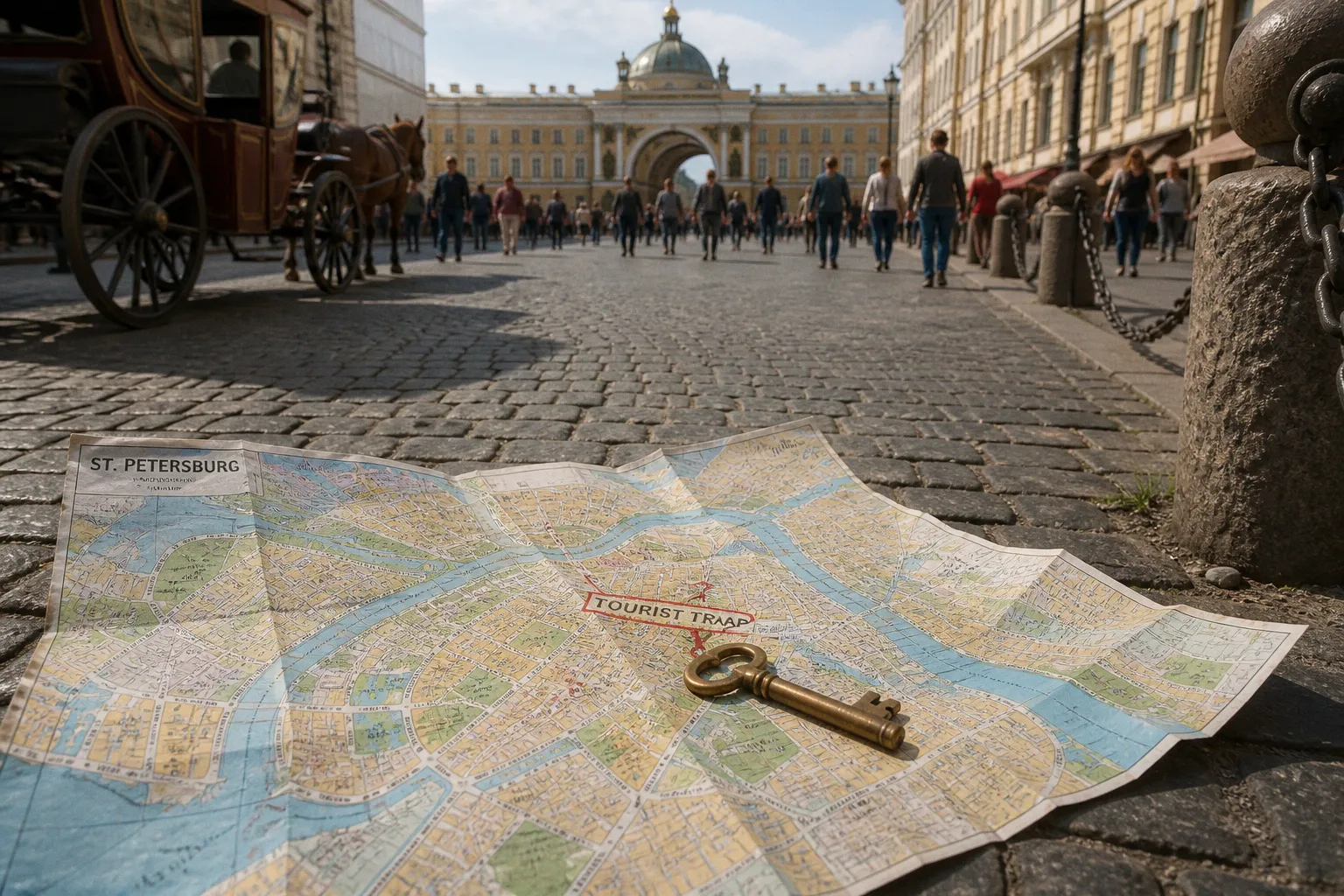
St Petersburg tourist traps begin before you reach the city centre. The main failures are predictable: an unlicensed taxi at Pulkovo Airport, a street performer demanding payment for a photograph, a canal-tour promoter selling an unauthorized ticket, and a museum visit planned around a queue at the Winter Palace.
The correction is procedural. Use official booking channels, fixed-fare transport applications, a payment fallback, and buffer time between timed entries. Do not negotiate with street sellers after the service has been delivered. At that point, the transaction has already failed.
Pulkovo Airport: the first cost-control point
The airport arrival sequence has one primary risk: accepting transport from a person who approaches you inside or outside the terminal. A driver may claim to represent a taxi service, offer a fixed fare, or present a vehicle immediately at the exit. None of this establishes authorization.
Unlicensed airport taxis can overcharge foreign visitors. The fare may be unclear until arrival. The vehicle may not provide a receipt. Dispute resolution is then limited.
Use a mobile application such as Yandex Go to order the car. The application provides the route, vehicle details, pickup instructions, and fare before departure. It also creates a record of the booking. That record matters if the driver does not follow the stated route or requests an additional payment.
Apply this sequence:
1. Leave the baggage area and move to a location with mobile reception.
2. Open the transport application before approaching the vehicle collection area.
3. Confirm the registration number and vehicle description.
4. Follow the application’s pickup instructions rather than a street agent’s directions.
5. Keep the destination displayed in the application.
6. Reject any request to cancel the application booking and pay a different amount in cash.
Do not enter a vehicle because the driver knows your hotel name. Hotel names are visible on luggage tags, booking documents, and arrival messages. That is not proof of authorization.
Public transport can reduce the airport transfer cost, but it adds handling requirements. Baggage, late arrival, and a hotel outside the central districts can make a private car the lower-risk option. The objective is not to select the cheapest movement in isolation. It is to control the full transit corridor from terminal to accommodation.
At Pulkovo, the correct taxi is the one booked through a traceable channel. A driver’s confidence is not a compliance document.
If your phone connection fails, use the airport’s official taxi desk or arrange a transfer through your accommodation before departure. Do not treat the terminal exit as a negotiation area.
Nevsky Prospekt: photo charges and street sales
Nevsky Prospekt concentrates the city’s pedestrian traffic. It also concentrates informal sellers. The most common exposure involves people dressed as historical figures, mascots, or handlers carrying birds. They invite a photograph or position themselves beside a visitor. The charge is then announced after the image has been taken.
The control is simple: do not accept an unsolicited photo service.
This applies even when the person appears to be part of the public atmosphere. Costumes, props, and animals do not establish a municipal license or a published tariff. If you want a staged photograph, agree to the price before the image is made. If the price is not displayed in writing, decline.
Use short refusals. Do not explain your budget. Do not provide your hotel name. Do not hand over a phone or camera after the interaction has become unclear. Move toward a staffed shop, hotel entrance, museum entrance, or other controlled location if the seller becomes confrontational.
The same rule applies to souvenir purchases. Shops on the central avenue have a location premium. Exact prices for items such as matryoshka dolls or amber vary by material, workmanship, and seller, so a universal street price is not reliable. The risk is not only overpayment. It is also uncertain provenance, unclear quality, and no practical return procedure.
For controlled purchasing:
- Compare at least two shops before buying a high-value souvenir.
- Request the price in rubles before payment.
- Confirm whether the item is handmade, factory-produced, or simply marketed as traditional.
- Keep the receipt.
- Avoid buying amber or other valuable items from a pavement seller.
- Do not allow a seller to replace the selected item during packing.
A souvenir is not a transport emergency. If the seller creates urgency, terminate the transaction.
Canal tours: buy the route, not the pitch
River and canal boat trips are a standard component of a St Petersburg itinerary. The failure point is the ticket channel. Street barkers along Nevsky Prospekt promote departures and direct visitors to boats or ticket points that may not provide the expected operator, route, duration, or boarding location.
The seller may describe the excursion as an official tour. That description does not confirm the fare or service. A ticket may be valid but overpriced. It may also be for a different departure point from the one the visitor assumes.
Purchase through an official pier or the operator’s online booking channel. Confirm five fields before payment:
| Field | What to confirm |
|---|---|
| Operator | The company or booking platform responsible for the departure |
| Pier | Exact boarding location, not only the district or nearest landmark |
| Departure time | Scheduled time and required arrival buffer |
| Route | Canal and river coverage, if that distinction affects the experience |
| Ticket conditions | Refund, rescheduling, language, and weather policy |
Do not follow a promoter through several streets to a boarding point. That removes your ability to compare operators and creates a time dependency. If the boat is leaving soon, the promoter controls the decision. That is the condition to avoid.
Allow buffer time between a boat tour and the next timed activity. Embankment traffic, boarding queues, bridge openings, and weather can extend the transfer. A canal cruise booked immediately before a museum entry is a schedule fault, not an efficient itinerary.
If you use an online booking page, retain the confirmation on your phone and in an offline format. Do not rely on a foreign-issued Visa or Mastercard at the pier. These cards do not function at Russian merchants or ticket desks. Carry sufficient rubles or use a local payment solution available to you.
The Hermitage: queue management and ticket control
The Hermitage Museum is not a location for improvised ticketing. The general entry price is commonly in the range of 500–800 rubles, depending on the ticket type and current conditions. The larger cost is often lost time.
The Winter Palace box office is the most visible access point. It is not automatically the fastest. Online tickets can reduce queue exposure. The General Staff Building can also provide a lower-congestion entry option for visitors whose itinerary includes its collections.
Check the following before leaving for the museum:
- The ticket category and admission date.
- The entrance named on the ticket.
- Whether the ticket covers the building or exhibition you intend to visit.
- The required arrival window.
- Any identity or document requirement stated during purchase.
- The payment method accepted by the booking channel.
Do not buy a museum ticket from an unsolicited street seller. The product may be a valid admission ticket sold at an inflated rate, a ticket for another time, or a document that does not match your intended entrance. The term official is not meaningful unless the seller is connected to the museum’s recognized sales channel.
Do not build the schedule around a free-entry day unless you have a reservation and a confirmed entry procedure. Free admission does not mean no queue. It does not mean unrestricted access. It does not remove security screening or capacity controls.
A controlled museum sequence looks like this:
1. Select the building and collection before booking.
2. Buy through the museum’s official online channel where available.
3. Download the confirmation before travelling to the entrance.
4. Arrive with a time margin for security and internal navigation.
5. Use the entrance stated in the booking rather than the most prominent doorway.
6. Keep the ticket until the final inspection point.
The General Staff Building is useful for route management because it may avoid the highest concentration at the Winter Palace box office. It is not a universal substitute. Check the collection coverage first. Entering the wrong building efficiently is still a failed museum plan.
Transport inside the city: the payment protocol
Saint Petersburg’s metro, buses, trolleybuses, and trams support a reusable Podorozhnik card. It generally offers lower per-ride fares than single-ride cash tokens. The exact current fare should be confirmed locally because tariff values change.
For a short stay, the decision is operational:
| Travel pattern | Payment approach | Main control |
|---|---|---|
| One or two isolated journeys | Single-ride payment | Carry rubles and allow time at the station |
| Several metro and surface-transport journeys | Podorozhnik card | Load credit before the first time-critical transfer |
| Mixed transport with luggage | App-booked taxi plus public transport | Use the taxi for the exposed corridor, not every movement |
| Card-dependent itinerary | Not suitable without a fallback | Foreign Visa and Mastercard may not work at merchants or ticket desks |
Do not assume that a foreign bank card will function at a metro desk, museum counter, café, or boat pier. Foreign-issued Visa and Mastercard cards do not function at Russian merchants or ticket desks. This is a route-planning constraint.
Carry rubles in separate locations. Keep one reserve outside your wallet. A single payment failure should not terminate the day or force an unplanned exchange at the first available counter.
Use transport applications for route planning, but download key information before leaving accommodation. Mobile access can fail. Station names can appear in transliteration. Surface routes can change. The application is a planning tool, not a substitute for a payment reserve.
The most efficient central itinerary usually reduces unnecessary crossings. Group the Hermitage, Palace Square, the Admiralty, and the nearby embankments in one movement block. Schedule Nevsky Prospekt as a corridor rather than repeatedly returning to it. Place a canal departure near the preceding district. Every extra crossing consumes buffer time and increases exposure to informal sellers.
White Nights pricing and seasonal pressure
Late May to early July is the White Nights high season. Local travel, accommodation, and dining prices increase by an estimated 10–15% during this period. Budget studio or apartment rentals can average approximately 35–50 EUR per night in peak season, while a casual café or restaurant meal can cost roughly 20–25 EUR per person. These are planning ranges, not guaranteed tariffs.
The pressure affects more than accommodation. Museum time slots become harder to secure. Canal departures fill earlier. Central restaurants operate at capacity. Taxi demand increases around major arrival and event periods.
Book the items with limited capacity first:
1. Accommodation with a clear cancellation and payment policy.
2. Museum entries for the dates that cannot move.
3. Canal transport if it is central to the itinerary.
4. Airport transfer for late-night or early-morning arrival.
5. Restaurant reservations only after the fixed transport and museum elements are stable.
Late September is a lower-cost shoulder-season option compared with the White Nights period. It also changes the daylight and weather operating conditions. Do not select it solely for price if your itinerary depends on late evening outdoor movement or a specific seasonal event.
December 7 is associated with the Hermitage anniversary and annual open-day activity. Treat that date as a capacity risk. Free or special-access conditions can increase demand rather than reduce it. Confirm the current admission procedure before assigning the day to the museum.
A troubleshooting matrix for common failures
Tourist traps are easier to prevent when the trigger is identified in advance.
| Failure point | Immediate warning | Correct response | Recovery |
|---|---|---|---|
| Airport taxi | Driver approaches without an application booking | Leave the interaction and order through a traceable channel | Use the official airport taxi desk or prearranged transfer |
| Character or animal photograph | Price is absent before the photograph | Decline and keep moving | Enter a staffed premises if payment is demanded |
| Canal-tour promoter | No written operator, pier, or fare | Compare official pier or online options | Cancel the informal purchase and rebook from the confirmed location |
| Museum ticket seller | Seller claims urgency or special access | Use the museum’s recognized sales channel | Reschedule the visit if ticket validity is unclear |
| Payment failure | Foreign card is rejected | Use rubles or an available local solution | Activate the cash reserve; do not exchange under pressure |
| Schedule compression | Transfers leave no margin before admission | Rebuild the day around fixed entries | Drop the least critical stop before missing a paid reservation |
The matrix is not a substitute for judgement. It defines the first action when the situation becomes unclear. That is the point at which visitors usually lose money: they continue because they have already spent time.
Build the day around controlled entry points
A St Petersburg travel guide that lists attractions without entry control is incomplete. The route must account for access, payment, queues, and transfer time.
Use three categories:
- Fixed points: museum reservations, airport departures, train departures, and booked boat trips.
- Flexible points: streets, squares, churches, viewpoints, and cafés without a timed reservation.
- Abort points: souvenir shopping, informal photographs, street-promoted excursions, and any activity with unclear pricing.
Fixed points determine the sequence. Flexible points fill the available corridor. Abort points are removed first when time or payment conditions change.
This structure prevents a common failure: spending the morning in an unplanned shop or street activity and then rushing to a timed museum entry. The central districts are walkable in sections, but not on an unlimited schedule. Security controls, weather, crowds, and bridge openings remain outside your control.
Use online museum tickets where available. Use mobile transport applications. Carry rubles. Keep documents and confirmations offline. These are not optional conveniences for a foreign visitor. They are continuity measures.
The fail-safe plan
Prepare the fallback before the first failure.
Keep:
- The accommodation address in Russian and English.
- The airport transfer confirmation.
- Museum and boat tickets stored offline.
- A reserve of rubles separated from the main wallet.
- A charged phone and a portable battery.
- A written sequence for returning to accommodation without the main payment card.
- Sufficient buffer before every fixed departure.
If a taxi booking fails, use the official airport desk or the prearranged transfer. If a canal tour seller cannot produce operator and pier details, cancel the purchase. If the Hermitage entrance is congested, follow the ticketed entrance rather than joining the most visible queue. If a foreign card fails, stop attempting the same transaction and switch to cash or a local payment method.
Do not recover a compromised schedule by accepting a second informal service. One failed decision does not justify another.
St Petersburg tourist traps are not hidden systems. They operate where the visitor has no price, no receipt, no confirmed operator, or no time to compare. Remove those conditions. Book the airport corridor. Purchase museum and boat access through controlled channels. Use Podorozhnik for repeated public transport. Carry rubles. Keep buffer time.
The backup plan is part of the itinerary. Without it, the route depends on every transaction working on the first attempt. That is not travel planning. It is exposure.