Russian payment traps: cash and card guide for tourists
Foreign-issued Visa, Mastercard, and American Express cards do not work in Russia. Apple Pay and Google Pay do not work either. This is not an airport inconvenience.
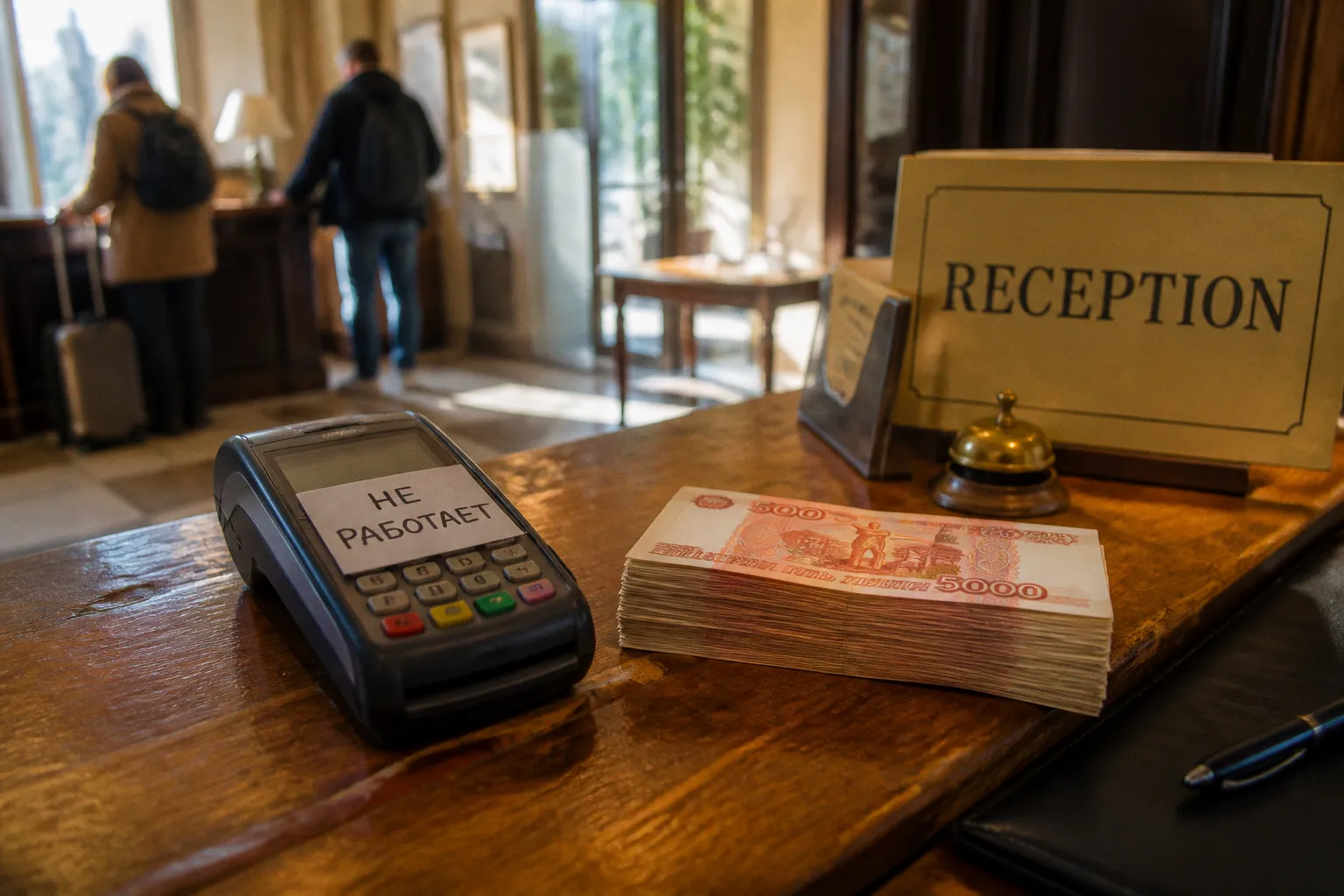
It affects hotel deposits, train tickets, metro top-ups, restaurants, taxis, pharmacies, and online bookings.
Build a payment route before departure. The minimum viable setup is:
- ruble cash in banknotes accepted by Russian exchange offices;
- one backup cash reserve stored separately;
- a virtual or physical MIR card if your trip depends on online payments;
- a payment plan for the first 24 hours, before any local banking service is available.
Do not treat a foreign UnionPay card as the solution. Acceptance is restricted and inconsistent. A card that worked in one Russian terminal may fail at the next terminal or ATM.
In Russia, payment compliance starts before boarding. Arrive with rubles or a functioning MIR route. Do not arrive with a foreign card and an assumption.
The operating rule: foreign cards are not a fallback
Visa, Mastercard, and American Express issued outside Russia suspended operations in the country in 2022. Russian ATMs and merchants cannot process them through the domestic payment infrastructure. The same restriction applies to mobile wallets linked to those cards.
This produces several predictable failures:
1. The card works at home but fails at the first Russian terminal. The issue is not the card balance, PIN, or contactless function. The issuing network is unavailable inside Russia.
2. The mobile wallet fails even when the physical card is present. Apple Pay and Google Pay cannot bypass the network restriction.
3. A hotel booking made online does not guarantee payment at check-in. Some reservations are prepaid. Others require payment or a deposit at the property. Confirm the payment status and keep a ruble method for the balance.
4. A foreign booking platform may accept the card outside Russia but not for a Russian transaction. Do not confuse a successful reservation attempt with a functioning payment method during the trip.
5. An ATM with a familiar logo does not mean your card is supported. The terminal may be connected to the Russian network only.
Using UnionPay cards in Russia is a separate risk category. Foreign-issued UnionPay cards are highly unreliable. Many Russian terminals and ATMs stopped servicing them after UnionPay restricted support for foreign-issued cards in late 2022. There is no operational basis for making UnionPay your only payment method.
For transport, this matters immediately. You may need rubles for a taxi from the airport, a metro ticket, a luggage locker, or food before reaching your hotel. You may also need to pay for domestic rail or air tickets through a Russian booking channel that does not accept your card.
Plan the first payment corridor:
- airport to hotel;
- hotel check-in and deposit;
- food and water;
- local transport;
- emergency communication;
- the first intercity ticket if purchased after arrival.
Keep the first-day cash in two locations. One wallet is not a backup system.
Cash is the primary route, but currency selection matters
Foreign tourists can legally bring up to $10,000 in cash, or the equivalent in another currency, into Russia without declaring it. Customs rules can change, and other declaration requirements may apply. Check the current rules for your departure country and transit countries before travel.
For most travellers, US dollars are the practical cash currency. Euro banknotes create additional compliance exposure because EU rules restrict the export of euro-denominated banknotes to Russia. Do not assume that carrying euros through an EU land border is equivalent to carrying dollars. Transit-country rules govern the route.
Russian shops, hotels, restaurants, and transport providers generally require payment in rubles. Foreign currency is not a substitute for rubles at the point of sale. Exchange the money through a bank or authorised exchange office.
Banknote condition is a hard control
Russian banks and exchange offices inspect foreign banknotes closely. Minor damage can trigger rejection:
- folds;
- tears;
- writing or stamps;
- stains;
- heavy creases;
- damaged edges;
- tape or repairs;
- older series or notes the office does not accept.
Use clean, unmarked US dollar notes in good physical condition. Do not fold them into a passport wallet. Store them flat in a document sleeve. Separate travel cash from spending cash.
The airport is not automatically the correct exchange location. Airport exchange offices may provide less favourable rates, restricted opening hours, or limited denominations. The operational solution is not to avoid all airport exchange. It is to avoid exchanging the full travel budget there.
Use a staged cash conversion:
1. Carry a small ruble reserve or exchange only the amount required for the airport transfer and first meal.
2. Reach the city with your foreign cash protected.
3. Compare rates and commission at a bank or authorised exchange office.
4. Exchange in several stages rather than converting the entire budget at the first counter.
5. Keep a reserve in the original currency until the return journey is funded.
Do not select an exchange office by rate alone. A displayed rate may apply only above a minimum amount, include a commission, or differ between buy and sell operations. Ask for the final ruble amount before handing over the banknotes.
The relevant calculation is simple:
- foreign cash delivered;
- exchange rate applied;
- commission charged;
- rubles received.
If the counter cannot state the final amount clearly, stop the transaction.
Denominations affect daily operations
Large ruble notes can be inconvenient for a small purchase, especially at kiosks, transport counters, and smaller food outlets. Request a mix of denominations after exchange. Keep a working balance in smaller notes for:
- metro and bus fares;
- short taxi trips;
- snacks;
- cloakrooms and lockers;
- small museum or market purchases;
- tips where applicable.
Cash is not a complete payment strategy if all of it is stored in one large bundle. Divide it by function:
- arrival reserve;
- daily spending;
- intercity transport;
- emergency reserve;
- return-journey reserve.
The emergency reserve should not depend on a hotel room safe, a single wallet, or a single travelling companion.
Virtual MIR cards: useful for online and in-country payments
A MIR card is the domestic payment route. Foreign tourists can access MIR solutions through services designed for non-residents, but eligibility, verification, limits, funding methods, and service availability require current confirmation before departure.
Two services in the current tourist-payment market are Pay in Russia and YooMoney. They are not interchangeable.
Pay in Russia
Pay in Russia, operated by Promselkhozbank, allows tourists to open a virtual MIR card remotely.
The unverified version has:
- a maximum balance of 15,000 rubles;
- a monthly turnover limit of 40,000 rubles.
The verified version allows a balance of up to 600,000 rubles. The exact nationalities eligible for verification are not universal and must be confirmed during the application process. Do not assume that holding a passport from a particular country guarantees access to the verified tier.
Funding costs also require planning. Topping up with a foreign credit card can involve an approximate 10% mark-up compared with funding through USDT. That difference can exceed the cost of several transport tickets. Confirm the current fee and settlement method before loading the card.
Use Pay in Russia when you need a domestic card for:
- Russian online booking services;
- transport purchases;
- hotel payments that require a Russian card;
- QR or card payments at merchants;
- a payment reserve that is safer than carrying the full trip budget in cash.
Do not load the full budget until identity verification and card operation have been tested. Start with a controlled amount. Complete one low-value transaction. Then use the card for larger payments.
YooMoney
YooMoney allows foreign tourists to register online and obtain a virtual MIR card after remote verification. The verified wallet can hold up to 500,000 rubles. A physical card can be ordered for delivery abroad for a fee of 799 rubles.
The physical card is not required for every use case. A virtual card may cover online transactions and mobile account access. The physical option provides a separate instrument if a merchant requires a card rather than a wallet interface.
Before relying on YooMoney, confirm:
- whether your nationality is accepted for registration;
- which identity documents are required;
- whether remote verification is available from your country;
- how the account is funded;
- whether the card works for the specific Russian merchant or booking platform;
- how long physical-card delivery will take;
- what happens if the account is restricted during verification.
A virtual card is not cash. It depends on account access, a functioning phone, an active data connection, and an accepted funding route. Keep physical rubles even after the MIR card is active.
MIR setup sequence
Treat the application as a pre-trip compliance task, not a last-minute travel app installation.
1. Register using the legal name shown in your passport.
2. Complete identity verification before departure where possible.
3. Record the card number and account recovery method securely.
4. Test the application on both mobile data and Wi-Fi.
5. Load a small amount.
6. Complete a low-value Russian transaction.
7. Confirm that the balance, transaction history, and support channel are accessible.
8. Store cash as the independent backup.
If the service uses a phone number for authentication, confirm that you can receive codes while roaming. A card without access to its authentication channel is not an operational payment method.
A MIR card reduces cash exposure. It does not remove the need for cash. It adds a second corridor; it does not replace the first.
Local banking after arrival: T-Bank and tourist services
A local debit card can be useful for longer stays, repeated domestic travel, or a trip that includes high-value hotel and rail payments. It is not the correct solution for the first airport transfer because issuance takes time and requires documents.
T-Bank offers the T-Bank Black debit card to foreign citizens. The card can be ordered online and delivered free to a hotel or airport in Russia within one to three days. The applicant must present:
- passport;
- visa;
- migration card.
The delivery window is a buffer requirement, not a promise to build the itinerary around. Orders may require additional checks. Hotel delivery also depends on the property accepting the delivery and holding the card securely until collection.
Use the first arrival period to establish the card:
- submit the application after entering Russia;
- select a delivery point with a staffed reception or agreed handover process;
- keep the passport, visa, and migration card available;
- retain cash for the one-to-three-day issuance period;
- test the card with a low-value payment before transferring larger funds.
A local card may simplify payments for restaurants, shops, taxis, domestic transport, and Russian booking services. It also creates account-management obligations. Protect the phone number, application login, and recovery credentials. Do not store all payment access on a device that can be lost during a train transfer.
Sberbank opened a specialised tourist and banking office in Moscow in May 2025. The service provides a dedicated Tourist Card and support in English, Chinese, and Arabic. This can be relevant for travellers who need in-person assistance after arrival or cannot complete remote verification independently.
Do not assume that a specialised office eliminates documentation requirements. Carry the passport and migration documents. Check opening hours and service availability before routing across Moscow. A branch visit is a controlled task only when the branch is open and the required service is available.
A payment matrix for the main travel expenses
The correct method depends on the transaction, not on preference. Use this allocation:
| Travel expense | Primary method | Backup method | Main failure point |
|---|---|---|---|
| Airport transfer | Ruble cash | Verified MIR card | No local card before arrival |
| Hotel balance or deposit | MIR card or rubles | T-Bank card after issuance | Reservation may not include payment |
| Russian train tickets | MIR card through an accepted booking channel | Cash at a station or ticket office where available | Foreign card rejection; limited ticket availability |
| Sapsan tickets | MIR card or pre-purchased ticket | Cash-based purchase through a local channel | Popular departures can sell out |
| Moscow metro | Ruble cash, local transport method, or MIR-supported payment | Spare cash in small denominations | Contactless foreign card failure |
| Restaurants and shops | Rubles or MIR | Cash reserve | Foreign Visa, Mastercard, and Amex rejected |
| Domestic flights | MIR or pre-purchase through an accepted channel | Local card after arrival | Payment page may require domestic processing |
| ATM withdrawal | Russian-issued MIR route | Cash carried from abroad | Foreign card and UnionPay support unreliable |
| Exchange operation | Foreign cash at an authorised office | Bank exchange counter | Damaged notes or poor airport rate |
Purchase time-sensitive transport before the departure window closes. A payment failure on the day of travel is not merely a financial problem; it becomes a schedule failure. Keep a buffer between booking and departure when the ticket is essential.
For hotel logistics, confirm three separate points:
- whether the booking is prepaid;
- whether the hotel accepts rubles or MIR for the remaining balance;
- whether a deposit is required at check-in.
Do not infer the third point from the first. A prepaid room may still require a refundable deposit.
For metro travel, do not arrive at the gate with only a foreign contactless card. Keep rubles accessible. Moscow's transport network is fast, but payment troubleshooting at a station is not.
Online payments, cross-border transfers, and the Fast Payment System
Online payment in Russia usually depends on the payment method accepted by the Russian merchant, not simply on whether a website opens in your browser. A Russian booking page may require a domestic bank card, a MIR card, a local phone number, or a payment application. A foreign card that works on an international website is not automatically a usable cross-border payment method for a Russian merchant.
Use this sequence for an online purchase:
1. Check whether the booking is actually prepaid or only reserved.
2. Confirm which payment systems the merchant accepts before entering your details.
3. Use a tested MIR route or a Russian-issued card for a transaction that requires domestic processing.
4. Save the confirmation, ticket, and payment receipt offline.
5. Keep cash available if the booking can be paid at a station, hotel, or ticket office instead.
Russia's Fast Payment System, commonly used for instant bank transfers and QR-code payments, is a domestic banking service. It can be convenient for people with a participating Russian bank account or payment application, but it is not a universal replacement for Visa or Mastercard. A foreign tourist should not assume that a QR code can be paid from an overseas banking app.
The same distinction applies to bills. For a hotel, apartment, tour, or other service, ask whether payment is due in cash, by MIR card, or through a local bank transfer. Pay only to the account or merchant details supplied by the provider, and keep a receipt or written confirmation. Do not make a personal transfer merely because a message contains bank details.
Receiving a payment from Russia is a separate banking and compliance issue, not a travel-payment shortcut. Availability depends on the banks, countries, currencies, sanctions controls, and payment route involved. Use only a lawful route confirmed by both the sending and receiving banks. Do not ask a hotel, guide, or stranger to move money through a personal account on your behalf.
What to do when the payment route fails
A robust plan needs a recovery sequence. Use it in order.
If a foreign card is rejected
Do not retry at multiple terminals and assume the next one will work. Move to rubles or MIR. Contact the issuing bank only to confirm that the card has not been blocked globally; the Russian network restriction will not be solved by a new PIN or an increased limit.
If a UnionPay card fails
Treat the failure as expected. Do not search for an ATM as the primary recovery action. Use cash or a Russian-issued MIR instrument. Foreign UnionPay acceptance is too restricted for itinerary-critical payments.
If an exchange office rejects your banknotes
Do not argue about a minor crease. Ask whether another authorised bank or exchange office accepts the note. Keep spare banknotes from a separate batch. If several notes are rejected, stop and inspect the full cash supply.
If the virtual MIR card is not verified
Use the unverified limits only if they cover the immediate requirement. Pay in Russia's unverified version permits a maximum balance of 15,000 rubles and monthly turnover of 40,000 rubles. Do not plan a long trip around those limits without confirmation that verification will be completed.
If the phone is lost or offline
Use the cash reserve. The backup must be physically independent of the phone, card app, and email account. Restore account access only after the immediate transport and accommodation problem is controlled.
If the local card delivery is delayed
Continue with cash and any active MIR route. The local card is a convenience, not the foundation. Treat the first three days as a cash corridor: food, transport, and hotel extras should all be covered without the card. Reorder only if the service confirms a new delivery window. If the delay extends beyond the planned stay, escalate to the bank's tourist support channel rather than waiting for the courier to reappear.
If a hotel demands a deposit at check-in
Present rubles first. If the desk insists on a card, ask whether a MIR card is accepted. A foreign Visa, Mastercard, or American Express will not resolve the issue. If neither is available, ask the desk to pre-authorise a small cash hold instead of a full room charge. Keep the deposit receipt and the room number in writing.
If the Sberbank tourist office is unavailable
Do not restructure the day around a single branch visit. Confirm opening hours and queue times before travel. If the office is closed or fully booked, the T-Bank delivery route or the Pay in Russia verification path covers most of the same functions. The dedicated tourist office is a support channel, not a mandatory step.
If a taxi or ride app requires a domestic card
Carry cash for short urban trips. Many taxi drivers and aggregators still accept rubles. Confirm the currency before the trip starts, and agree the route or estimate the typical fare in rubles. A driver who refuses cash is usually a sign that the platform is the only payment route on that vehicle — switch to a different aggregator or a hotel-recommended service.
If a train booking channel rejects the card
Do not wait until the station to fix the payment. Most Russian rail tickets can be bought at the station ticket office for cash, but popular Sapsan and long-distance services sell out. The operational move is to keep the ruble balance separated from the planned intercity budget and to attempt the booking at the first available window.
If verification photo or document is rejected
Recheck the document quality, the lighting, and the spelling of the name. Verification systems are strict on name match and photo clarity. Do not upload a cropped passport page or a screenshot. If the system flags the application, contact the support channel before re-uploading. Multiple rejected attempts can lock the account for manual review.
A practical closing
The Russian payment system is not hostile to foreign tourists, but it is closed to foreign issuers. That distinction matters. The infrastructure runs on domestic rails, and the rails do not connect to Visa, Mastercard, American Express, or to most foreign-issued UnionPay instruments. A traveller who arrives with rubles, a verified MIR route, and a plan for the first three days navigates the country without friction. A traveller who arrives with a single foreign card and a hotel confirmation on file spends the first day troubleshooting.
Treat the payment route as part of the itinerary, not as a separate administrative task. The same discipline that goes into choosing the hotel, the rail tickets, and the visa support applies to the choice of cash currency, the denomination mix, and the fallback instruments. A payment failure in the wrong moment — at the airport, at the hotel desk, at the metro gate, on the Sapsan platform — is not a recoverable inconvenience. It is a logistics failure.
Build the corridor before departure. Test it. Carry rubles. Keep a backup. The rest of the trip will then run on the schedule, not on the payment network.