Trans-Siberian railway trip: which stopovers are worth it?
The most expensive mistake in a Trans-Siberian railway trip is not paying too much for the ticket.
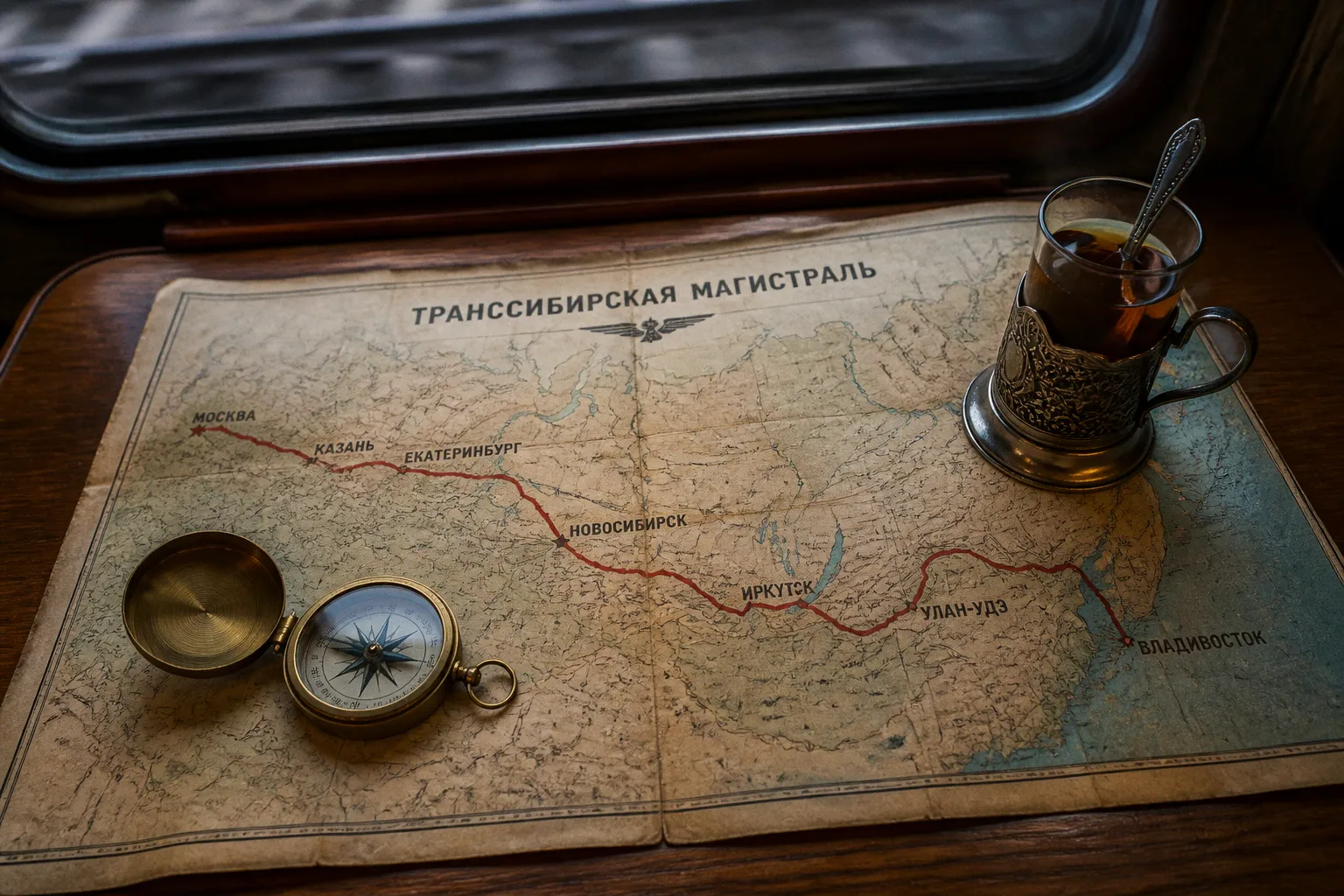
It is buying the wrong itinerary: seven days of continuous travel, no meaningful stopovers, and a final bill that includes lost time, rushed transfers, and attractions seen through a train window.
The classic Trans-Siberian route runs 9,289 kilometers from Moscow’s Yaroslavsky Station to Vladivostok, crossing eight time zones. That scale creates the central planning problem: where should you stop, and for how long? You cannot treat every station as an equal tourism asset. Some cities justify two or three nights. Others are useful only as a logistical break. A few are expensive distractions if your available time is limited.
For most international travelers, the strongest Trans-Siberian railway trip stopover cities are Kazan, Yekaterinburg, Irkutsk and Ulan-Ude, with Novosibirsk serving a different purpose: less postcard value, more infrastructure, urban scale and a clear view of modern Siberia.
The route is not one itinerary. It is a portfolio of decisions.
A classic Moscow–Vladivostok journey takes you across a country large enough to punish vague planning. You are not simply choosing train stations. You are allocating nights, transfer capacity and recovery time across a route where distances are measured in thousands of kilometers.
The construction of the Trans-Siberian Railway took place between 1891 and 1916. The line remains the backbone of long-distance travel across Russia, but the tourist value of the journey comes from the stopovers rather than the rail mileage itself. A sealed compartment and a moving landscape are not a complete cultural program.
Your itinerary should answer three commercial questions:
1. What experience are you buying at each stop?
Imperial history, regional cuisine, Buddhist culture, Lake Baikal, Soviet urbanism and industrial Siberia are different products. Combining them without a plan produces a trip that feels long rather than rich.
2. How much operational slack do you have?
A two-night stopover can work in a compact city. It is less convincing when one day is consumed by arrival, check-in and a long excursion outside town.
3. What is the cost of skipping the stop?
If a city offers only another regional museum and a generic central square, your opportunity cost may be high. If it is the gateway to Lake Baikal, the calculation changes immediately.
The table below is a practical way to compare the main stops on the classic route and its most useful detours.
| Stopover | Approximate position from Moscow | What justifies the stop | Minimum useful stay | Main planning risk |
|---|---|---|---|---|
| Kazan | 793 km | Tatar history, Islamic architecture, Volga culture and strong food identity | 2 nights | It is a detour on the southern route, not a standard stop on the main historical line |
| Yekaterinburg | 1,816 km | Ural geography, Romanov history, major urban culture | 2 nights | Treating the city only as a historical site and missing its broader regional identity |
| Novosibirsk | 3,335 km | Siberian scale, transport history, large-city infrastructure and cultural institutions | 1–2 nights | Expecting a resort-style destination rather than a working metropolis |
| Irkutsk | 5,185 km | Historic Siberian architecture and access to Lake Baikal | 2–3 nights | Confusing Irkutsk with the lake itself; Listvyanka is about 70 km away |
| Ulan-Ude | 5,640 km | Buryat culture, Buddhism and the transition toward the Russian Far East | 2 nights | Underestimating transfer time to Ivolginsky Datsan and other regional sights |
Kazan and Yekaterinburg: two different gateways
Kazan is the strongest early detour if you want the journey to develop a cultural argument rather than become a sequence of railway platforms. Located approximately 793 kilometers from Moscow, the capital of Tatarstan brings together Volga trade routes, Tatar identity, Islamic heritage and Russian imperial history.
That combination has measurable itinerary value. You get a destination that feels distinct from Moscow without requiring a major operational reset. Kazan is not merely “another historic Russian city.” Its cultural proposition is clearer: a meeting point of Russian and Tatar traditions, with food and architecture that give the stopover a defined regional character.
The caveat is structural. Kazan is a detour on the southern route, not a stop on the main historical northern alignment of the Trans-Siberian Railway. That distinction matters when you build a rail itinerary. A detour can be worth every hour if it adds a genuinely different experience. It can also create unnecessary friction if your schedule is already compressed.
Plan Kazan when:
- you have at least two nights before continuing east;
- regional culture and food matter as much as railway history;
- you want an early stop that breaks the Moscow-to-Siberia transition;
- your route design allows the southern alignment without creating a costly backtrack.
Yekaterinburg is a different proposition. At kilometer 1,816, it marks the Urals and the symbolic boundary between Europe and Asia. The city earns its place through scale, history and geography rather than through a single visual identity.
Its most internationally recognized historical site is the Church on the Blood, built between 2000 and 2003 on the site of the Ipatiev House, where Nicholas II and his family were executed in 1918. You should not reduce Yekaterinburg to that event. Doing so turns a substantial regional capital into a memorial stop with a city attached.
The better commercial logic is to use Yekaterinburg as a transition point. Moscow and Kazan give you European Russia and the Volga world. Yekaterinburg introduces the Urals: a major industrial region, a city with a strong contemporary profile and a visible relationship with the country’s eastward expansion.
A two-night stay is the minimum viable allocation. One day can cover the central districts and the Romanov-related sites. The second gives you room for a broader city program or a Ural excursion, depending on season and transport availability.
A stopover earns its place when it changes the cultural product of the journey—not when it merely adds another pin to the map.
Novosibirsk: the city that exposes weak itinerary design
Novosibirsk is often treated as a mandatory stop because it is the largest city in Siberia and the third-largest city in Russia. That is not, by itself, a sufficient reason to stay. Population is not an attraction category.
The case for Novosibirsk is different. It gives you Siberian urban scale, transport infrastructure and a direct look at how the region functions beyond the romanticized image of forests, snow and remote villages. The city is a working metropolis, not a decorative pause between Europe and Lake Baikal.
Novosibirsk-Glavny station covers approximately 30,000 square meters. That figure is more than trivia. It reflects the city’s role as a major transport and economic node. If your interests include railway history, Soviet urban development, science, theatre or modern Siberian life, the city can support a useful one- or two-night program.
If your priority is dramatic landscapes and heritage streets, Novosibirsk may deliver a lower return than Irkutsk or Ulan-Ude. The city’s value is analytical: it shows what the Trans-Siberian corridor supports when it becomes a permanent urban system rather than a tourist experience.
Use Novosibirsk as a stopover when:
- you want to understand contemporary Siberia, not only its natural attractions;
- your route needs a sensible break between the Urals and Lake Baikal;
- you are interested in transport, science, urban planning or performing arts;
- you are building a longer itinerary and can afford a night without cutting Baikal time.
Skip or shorten it when your available journey is under two weeks and your central objective is Lake Baikal, Buryatia or the Far East. Every extra city creates booking exposure and luggage movement. Novosibirsk is valuable, but it is not a universal requirement.
This is where many Trans-Siberian route stops lists become operationally weak. They confuse geographic importance with visitor value. A city can be crucial to the railway and still be optional for your holiday.
Irkutsk is the gateway. Baikal is the product.
Irkutsk, approximately 5,185 kilometers from Moscow, is the stop with the clearest conversion from rail journey to destination experience. It is the primary gateway to Lake Baikal, the world’s deepest and oldest freshwater lake. That positioning makes the city strategically important to your itinerary, but it also creates a common planning error.
Irkutsk is not directly beside the lake. Listvyanka is about 70 kilometers away, and reaching the lakeside requires a bus, car or other transfer. Olkhon Island is approximately 250 kilometers from Irkutsk, with a separate and more demanding transport calculation. If you book two nights in Irkutsk and assume you have “seen Baikal,” the itinerary has failed before arrival.
The city itself deserves attention. Irkutsk’s historic architecture, including its surviving wooden houses and older urban fabric, gives you a more textured view of Siberian history than a short transfer stop would allow. But the principal reason to allocate time here is access logistics.
You need to choose which Baikal experience you are purchasing:
Listvyanka for lower friction
Listvyanka is the practical option for a shorter itinerary. At roughly 70 kilometers from Irkutsk, it can be reached as a day trip or a one-night extension, depending on your onward train schedule and season.
The advantages are obvious:
- shorter transfer exposure;
- easier integration into a two- or three-night program;
- direct access to lakeside views and local visitor infrastructure;
- less risk of losing an entire day to road conditions or ferry schedules.
The trade-off is equally clear. Listvyanka is the most accessible lakeside base, which means it is also the most commercially developed and more likely to feel busy during peak periods. If your idea of Baikal is solitude, Listvyanka may not deliver the full value proposition.
Olkhon Island for stronger destination value
Olkhon requires more time and planning. At approximately 250 kilometers from Irkutsk, the island is not a casual add-on between two train departures. It is a separate destination with transfer requirements, seasonal considerations and a larger exposure to delays.
The return can justify the cost. Olkhon offers a more expansive landscape experience and a stronger sense of Baikal as a geographic system rather than a scenic waterfront. But the itinerary must absorb the transport. Do not compress the island into a nominal overnight unless you have verified every connection and accepted a narrow recovery margin.
A practical Baikal allocation looks like this:
- Two nights: Irkutsk with a tightly managed Listvyanka excursion.
- Three nights: Irkutsk plus Listvyanka, with enough room for the city itself.
- Four to five nights: Irkutsk and Olkhon Island, provided the seasonal transport plan is confirmed.
- One night only: Usually poor value. You are paying for the gateway without buying the destination.
For detailed Lake Baikal tour planning, the decision should be based on transfer tolerance rather than on the number of attractions listed by a supplier. Ask for door-to-door timing, not brochure distance. “70 kilometers from Irkutsk” does not tell you how the road, weather, vehicle type or departure schedule will affect the day.
Lake Baikal is not an attraction beside the railway. It is a logistics project attached to the railway—and the margin for poor planning is expensive.
Ulan-Ude: where the itinerary changes direction
Ulan-Ude sits approximately 5,640 kilometers east of Moscow and provides one of the most distinctive cultural transitions on the route. It is the capital of the Republic of Buryatia, and its identity reflects the meeting of Russian, Buryat and Buddhist traditions.
The city’s most recognizable public monument is the 7.7-meter-high Lenin head, reported as the largest Lenin head monument in the world. It is an efficient urban landmark, but it should not be the whole program. The real value of Ulan-Ude is the wider cultural framework, particularly the role of Buddhism in the region.
Ivolginsky Datsan, the center of Buddhism in Russia, is approximately 35 kilometers from Ulan-Ude. The transfer is manageable, but it still consumes capacity. Build it as a half-day or longer excursion rather than as a quick photo stop. The monastery opened in 1945 and remains a significant religious and cultural site.
Ulan-Ude makes sense when you want your Trans-Siberian railway itinerary planning to move beyond a Moscow-to-Europe narrative. After Kazan and Yekaterinburg, it adds another layer: Buryat culture, Buddhist institutions and the eastern edge of the traditional Russian railway story.
It is particularly strong for travelers who have already seen major Orthodox landmarks and want a more varied cultural route. It also pairs logically with Baikal. The two destinations are close enough in the broad geography of the journey to form a coherent regional segment, but different enough to avoid duplication.
Allow two nights if you want to see the city and Ivolginsky Datsan without treating the entire stop as a timed transfer. Add another night if you are extending the program toward the Russian Far East or need protection against a disrupted connection.
How many stopovers should you actually book?
The answer depends on trip length, not on how many cities appear in search results.
A common mistake is to build an itinerary with a stop every 24 hours. It looks efficient on a spreadsheet. In practice, it creates a sequence of check-outs, station transfers, hotel arrivals and partial sightseeing days. That is not optimization. It is administrative overhead disguised as travel.
Use a smaller number of stronger stops:
For a 10–12 day journey
Choose two major stopovers. Yekaterinburg plus Irkutsk is the most balanced combination if Lake Baikal is a priority. Kazan can replace Yekaterinburg if Volga and Tatar culture are central to the trip.
A realistic structure might include:
1. Moscow departure and initial rail segment.
2. Two nights in Yekaterinburg.
3. Continuous rail travel toward Siberia.
4. Three nights in Irkutsk and Listvyanka.
5. onward travel toward Vladivostok or a return flight, depending on the route.
This is not an exhaustive Trans-Siberian experience. It is a controlled one.
For a 14–18 day journey
Three or four stops become viable. Kazan, Yekaterinburg, Irkutsk and Ulan-Ude form a strong cultural sequence, although the rail timetable and route alignment need to be confirmed before any deposit is paid.
Novosibirsk can be added if urban Siberia matters to you. If it does not, use those nights for Baikal. The opportunity cost is straightforward: one night in Novosibirsk may be less valuable than one additional night on Olkhon Island or in Ulan-Ude.
For three weeks or more
You can afford the route’s longer transitions and more complex regional excursions. This is where Novosibirsk becomes more defensible, and where you can separate Irkutsk from Baikal rather than treating the city as a simple gateway.
Longer journeys also support a more deliberate balance between movement and recovery. A train segment of several days can be part of the experience, but only if the itinerary does not demand immediate sightseeing at full capacity after arrival.
The 2026 payment issue is a procurement risk, not a footnote
Foreign travelers planning a Trans-Siberian journey in 2026 need to address payment before building the itinerary around specific trains. Foreign-issued Visa, Mastercard and American Express cards cannot be used on the Russian Railways website, which accepts Russian MIR cards.
That changes the booking model. You should not assume that a foreign card will work at the final payment stage, and you should not leave ticket acquisition until the last moment because a preferred train or class may disappear while you search for a workaround.
The practical options are:
- use a reputable travel operator that can arrange rail tickets and provide a clear service fee;
- confirm whether your visa-support or destination-management provider also handles domestic rail bookings;
- obtain a precise cancellation and amendment policy before payment;
- separate the rail ticket cost from the operator’s procurement and handling fee;
- request the exact train number, departure time, carriage class and passenger details in writing.
A turnkey service can reduce friction, but “turnkey” is not a synonym for transparent. The liability sits with you if the supplier cannot explain what happens after a missed connection, a schedule change or a passenger-data error.
For corporate or group travel, ask for a booking workflow that identifies:
- who is the ticketing entity;
- how passenger passport data is checked;
- when tickets are issued;
- what happens if one traveler’s details change;
- whether the supplier can support a missed train;
- which costs are refundable and which are administrative fees.
This is basic risk management. A cheap ticket that cannot be amended may produce a more expensive journey than a properly managed booking.
Train class, hotel nights and the economics of comfort
The classic route is often sold as a single heroic rail experience. That framing is useful for marketing and weak for budgeting. You need to decide where comfort creates genuine ROI.
A long overnight segment may justify a higher class if it replaces a hotel night and gives you a reasonable chance of arriving functional. A short daytime segment does not automatically require an upgrade. Conversely, selecting the cheapest berth across multiple nights can reduce the value of every stopover that follows.
Think in terms of total trip performance:
- Rail class: Does the berth allow you to sleep, store luggage and arrive ready to move?
- Hotel location: Does it reduce transfer time from the station and to the next excursion?
- Excursion design: Is the guide or vehicle capacity appropriate for the group size?
- Buffer: Does the program survive a delay without losing the only planned visit to Baikal or Ivolginsky Datsan?
- Payment route: Is the saving from self-booking real after currency, procurement and failure risk are included?
The lowest headline price is often a budget leak. It transfers work and liability to the traveler, then charges for the consequences later.
The best stopover is the one that protects the route’s purpose
There is no single answer to where to stop on the Trans-Siberian train. The correct answer depends on the experience you are trying to protect.
Choose Kazan for a strong early cultural contrast and a Volga-based itinerary. Choose Yekaterinburg for the Urals, Romanov history and a major urban transition. Choose Novosibirsk when Siberian city life, infrastructure and regional scale are part of the brief. Choose Irkutsk when Lake Baikal is the core asset. Choose Ulan-Ude when you want the route to include Buryat culture and Buddhism rather than ending its cultural scope in European Russia.
For most first-time travelers, the highest-return combination is:
- Yekaterinburg for the Urals and historical depth;
- Irkutsk plus Lake Baikal for the journey’s major natural landmark;
- Ulan-Ude for a distinct eastern cultural transition.
Add Kazan if you have the time and want a more varied opening. Add Novosibirsk only when its urban and industrial character is part of your objective, not because a route map makes it look mandatory.
When you negotiate with a tour operator, ask for the itinerary in operational terms: exact train segments, confirmed stopover nights, transfer durations, ticketing responsibility and recovery options. If the supplier answers with adjectives instead of timings, you are not buying a frictionless journey. You are buying exposure with attractive packaging.
The Trans-Siberian Railway rewards ambition, but it does not subsidize poor allocation. Treat the route as a portfolio of regional experiences, protect the stopovers that carry the highest value, and the 9,289 kilometers become more than mileage. They become a coherent journey across Russia’s cultural and geographic systems.