Sapsan train boarding: documents and rules checklist
A Sapsan ticket can make the Moscow–St. Petersburg leg look almost frictionless: one booking, a high-speed train, and a direct city-centre connection. The practical risk sits at the boarding point.
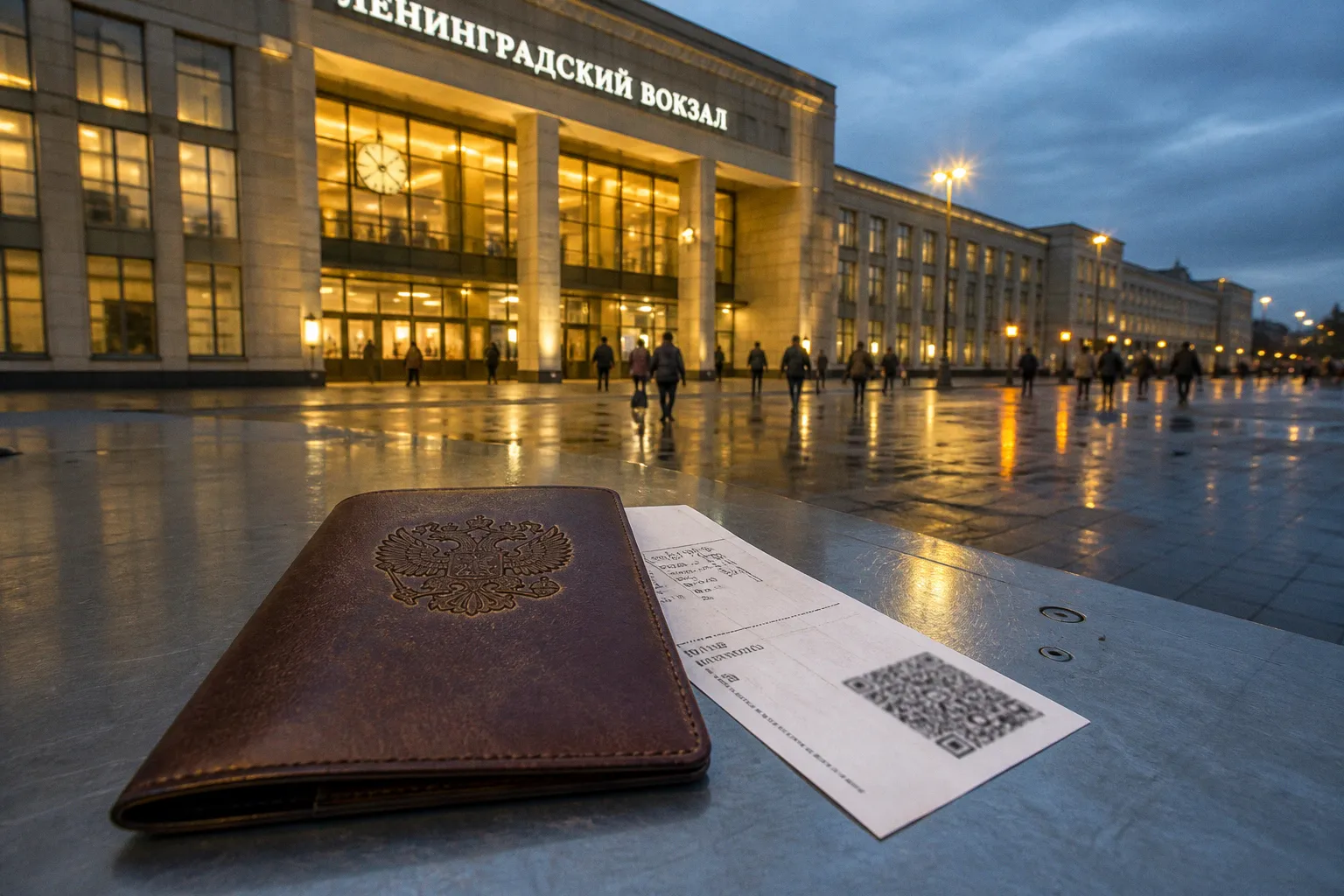
A passport number that does not match the booking, an unavailable e-ticket, or luggage outside the permitted limits can turn a straightforward rail segment into a problem at the platform.
For foreign passengers, the useful approach is not to memorise every station routine. It is to separate the journey into three control layers: the identity document used for the booking, the travel documents required during your stay in Russia, and the physical conditions of boarding. Once those layers are checked in advance, the Sapsan is usually exactly what it promises: fast, predictable transport between the two cities.
The document stack: what has to match
The central rule for boarding Sapsan train as a foreigner is simple: bring the original identity document used when the ticket was issued, and make sure its details correspond to the booking.
That sounds obvious, but international itineraries create several opportunities for a mismatch. A traveller may book with one passport and later renew it, enter Russia using a second document, or ask an assistant to enter a number from an old visa application. The discrepancy may not matter at the hotel desk. It can matter at the railway gate.
Keep the following documents accessible:
- The original passport used for the booking. The passenger details on the ticket are linked to the document information entered during purchase. A scan or photograph on a phone may help as a backup, but it should not be treated as a substitute for the original passport at the gate.
- The Russian visa or other entry document applicable to your trip. The category and validity should correspond to the purpose and dates of your stay. The railway ticket does not replace immigration documents, and a domestic train journey does not extend the validity of a visa.
- The migration card issued when you entered Russia. Keep it with your passport or in another secure, accessible place. It is part of your immigration paperwork for the stay, even though it is not normally the document used for routine Sapsan boarding.
- The Sapsan ticket or booking confirmation. If electronic registration is available and has been completed, keep the e-ticket ready on your phone and, where practical, carry a paper or offline copy as a backup.
The passport is the document that normally anchors the railway check. The visa and migration card belong to a wider compliance file: they matter during the trip, at accommodation registration, and if your documents are requested by an authorised official. Treating them as interchangeable is the wrong mental model.
The ticket, the passport, and the passenger details form one operational set. Check them together before leaving for the station, not one by one at the gate.
Passport registration and booking details
The phrase “Sapsan train passport registration” can sound like a separate procedure that a foreign traveller must complete at the station. In practice, it usually refers to the passenger-document data recorded during ticket purchase and the identity check performed before boarding.
Review the booking confirmation for:
- the spelling of your name;
- the passport number;
- the date of birth, where shown;
- the departure station and date;
- the carriage and seat;
- the registration status of the ticket.
Use the same passport for boarding whenever possible. If you have renewed your passport, changed documents, or discovered an error in the passenger data, do not wait until the departure platform to find out whether the ticket can be amended. Contact the ticket issuer or the relevant RZD service while there is still time to clarify the procedure.
A visa is not a replacement for the passport number entered in the railway booking. Nor is a different valid passport automatically acceptable simply because it belongs to the same traveller. The safest position is to resolve any document change before the journey and carry the document that the ticket actually references.
How Sapsan boarding works
The exact passenger flow can vary by station and service, but the logic is consistent: arrive at the correct terminal, pass the station access controls, present the required travel document, and reach the carriage before departure.
Electronic registration
If electronic registration has been completed, the usual boarding package is:
1. the original passport used for the booking;
2. the electronic ticket on the phone or a printed version, if required or preferred.
Electronic registration removes the need to collect a separate paper ticket at a station counter. It does not remove the identity check. The passport remains the critical item.
A phone is a weak single point of failure. Screens break, batteries run down, roaming data fails, and booking applications may require a login at the least convenient moment. Save the ticket so that it can be displayed offline, take a screenshot if the service permits it, and keep the booking reference in an email or on paper. These precautions do not replace the official document; they simply prevent a technical problem from becoming a second problem.
The same principle applies to a printed ticket. A printout is useful when the phone is unreliable, but it does not compensate for an absent or mismatched passport.
When a paper ticket is required
If electronic registration was not completed, the ticket may need to be collected or issued in paper form before you proceed to boarding. The relevant procedure depends on how and where the ticket was purchased, so read the booking conditions rather than assuming that every Sapsan ticket follows the same path.
This is one reason not to build a journey around arriving at the last possible minute. A paper-ticket procedure can involve:
- finding the correct ticket office or service desk;
- waiting for assistance;
- presenting the passport used for the purchase;
- resolving a transliteration or document-data issue;
- allowing enough time to reach the platform after the transaction.
The station counter is the place to resolve ticket administration. The platform gate is the wrong place to discover that the booking information is incomplete.
Timing at the station
Sapsan boarding is not a long airport-style process, but it is still a sequence with dependencies. You need time to find the right terminal, orient yourself inside the station, pass access controls, locate the departure area, and reach your carriage. Moscow and St. Petersburg stations can be busy, particularly around morning and evening departures, weekends, holidays, and major events.
A practical arrival buffer should reflect the passenger, not just the train. A solo traveller with a ready e-ticket and one compact bag has a different risk profile from a family with several suitcases, a group transfer, or a passenger who needs a ticket office.
Allow additional time if:
- you are unfamiliar with the station;
- you are travelling with children or a large group;
- you need to collect a paper ticket;
- you have luggage that may require verification;
- you are connecting from an airport or another railway service;
- you need to coordinate with a driver, guide, or tour operator;
- your itinerary has a time-sensitive hotel, meeting, cruise, or flight connection.
The aim is not to spend half a day at the station. It is to avoid making the final minutes before departure carry every possible uncertainty at once.
Travelling as a group
For a corporate or family group, the most useful preparation is administrative rather than theatrical. Assign one person to hold the consolidated booking information, but make sure each passenger has their own passport and can present it without searching through a shared folder.
Before arrival, confirm:
- that each name and passport number is correct;
- whether each ticket has electronic registration;
- which carriage and seat belong to each traveller;
- where the group will meet if mobile reception is poor;
- who is responsible for children, luggage, and onward transfers.
Do not assume that a person without a Sapsan ticket can accompany the group all the way to the carriage. Access arrangements are controlled by the station and the service. If a driver or assistant needs to help with luggage, confirm the permitted access in advance and plan for the possibility that the meeting point will be before the controlled boarding area.
Luggage: calculate before you travel
The published Sapsan luggage conditions should be checked for your specific ticket and departure, but the commonly stated hand-luggage parameters are a maximum weight of 36 kilograms and a maximum combined dimension of 180 centimetres, calculated as length plus width plus height.
That formula is easy to underestimate. A suitcase may look ordinary while exceeding the combined measurement once its wheels, handles, and outer pockets are included. Measure the packed item, not the manufacturer’s nominal size.
The 180 cm dimension rule is not a visual impression made at the booking desk. If railway staff need to verify the size, the relevant check takes place at the platform access point and can involve a measuring tape. Do not plan around a presumed grace period at the gate: if the luggage does not comply with the applicable conditions, there may be no practical opportunity to repack it and still board comfortably.
A useful luggage review covers four questions:
- Is the bag within the stated weight limit?
- Does length plus width plus height remain within the permitted total?
- Can one person move the bag through the station without assistance?
- Are essential documents and medication in a smaller personal bag rather than inside the large suitcase?
The last question is operationally important. Your passport, visa paperwork, migration card, phone, charger, medicines, and valuables should remain accessible throughout the station transfer. Do not put them in luggage that may be placed away from your seat or opened for inspection.
What the 180-centimetre total means in practice
The rule is not a statement that every suitcase must be a particular shape. It is a combined measurement. A relatively narrow but tall case may produce the same total as a wider, shorter one. Two bags that are individually manageable can still become awkward when combined with a larger suitcase.
Before leaving the hotel:
1. Pack the bags completely.
2. Measure the longest, widest, and highest points, including fixed wheels and handles where applicable.
3. Add the three measurements.
4. Weigh the bag with the items actually inside.
5. Remove non-essential items before travelling to the station if the result is close to the limit.
If your equipment is unusual — sports gear, professional cases, musical instruments, or bulky specialist luggage — consult the current carrier terms rather than treating it as ordinary hand luggage. The general allowance may not answer the question for every category.
The carriage number matters on longer formations
Some Sapsan services may operate with coupled train units. When that happens, the train can be physically longer than a standard formation, and passengers should pay attention to the carriage number printed on the ticket.
Do not assume that two passengers travelling on the same service can simply walk from one end of the train to the other. Internal movement between coupled units may be restricted or unavailable. If colleagues or family members are seated in different sections, agree on the carriage plan before boarding. The simplest solution is to meet in the station before access control or to arrange seats in the same carriage during booking.
This is a small detail, but it is exactly the kind of detail that disappears when a group treats the train as one continuous space.
Station facilities and the lounge question
Station facilities, lounge access, and opening arrangements can change. This is particularly relevant at Leningradsky Station in Moscow, where Sapsan passengers may encounter a business lounge or other controlled waiting facilities depending on the station’s current operation and the conditions attached to the ticket.
Do not assume that every Sapsan ticket includes lounge access. Eligibility may depend on the ticket class, the service, the station, or the rules in force on the day of travel. Check the current information from the railway operator or the ticket issuer, and keep the ticket available when asking station staff about access.
A lounge can be useful for practical reasons:
- it gives you a quieter place to check documents;
- it may provide seating and device-charging facilities;
- it separates preparation time from the main passenger flow;
- it can make a group departure easier to coordinate.
The value is not that the lounge magically creates more time. Its value is that it can turn waiting into a more controlled interval instead of leaving you to manage documents, phones, luggage, and colleagues in the busiest part of the station. The duration of access and the exact services should be confirmed locally rather than assumed from a general description.
For travellers departing from St. Petersburg, the same principle applies: check the current station layout and access instructions before the day of departure. Station names can be confusing in a two-city itinerary, and “Moscow station” or “St. Petersburg station” is not precise enough for a transfer driver or a first-time visitor. Use the exact terminal shown on the ticket.
A lounge is useful when it reduces uncertainty, not when it becomes another assumption in the itinerary. Verify access, then use the space to prepare for boarding.
What happens if boarding fails
A refused boarding is not simply a delayed departure. It can affect the rest of the itinerary, but the financial result depends on the reason for refusal, the ticket conditions, the timing, and the applicable RZD procedure.
Do not rely on the idea that a refused passenger can automatically rebook on the next train at the original fare. A same-day replacement at the original price is not a guaranteed outcome. Refunds, exchanges, deductions, deadlines, and availability are governed by the relevant fare and carrier rules; a replacement ticket may have to be purchased separately and may be sold at the fare available at that moment.
The safest way to manage this risk is to prevent an avoidable document problem:
- compare the passport with the booking before travelling to the station;
- check whether electronic registration has been completed;
- keep the ticket available offline;
- measure and weigh luggage in advance;
- leave time for a ticket office or station clarification;
- contact the ticket issuer before departure if any detail is uncertain.
If an issue still arises at the station, ask staff to explain the available procedure and document the interaction where appropriate: note the time, service number, reason given, and any instructions about refund or rebooking. This is not a promise that the carrier will change the decision. It gives you a clear record for the next administrative step.
The schedule cost
The direct ticket cost is only one part of a failed boarding. A missed Sapsan can disrupt:
- hotel arrival arrangements;
- a pre-booked transfer;
- a business meeting;
- a guided tour;
- a cruise or river itinerary;
- a domestic flight or international connection;
- a group’s coordinated movement.
The more tightly the itinerary is packed, the less useful it is to calculate the train as an isolated purchase. A small amount of preparation at the departure station can protect several linked bookings.
At the same time, do not create false certainty by assuming that a generous buffer will solve every problem. A buffer helps with queues, orientation, and ordinary delays. It does not legalise an invalid document or override a ticket condition. The right order is document accuracy first, station timing second.
A practical departure review
Before leaving the hotel, run through the following sequence rather than relying on memory:
- Take the original passport used for the Sapsan booking.
- Check the passenger name and passport number against the ticket.
- Confirm that the visa or other entry document remains valid for the planned journey.
- Keep the migration card with your travel documents.
- Open the e-ticket while you still have a reliable connection.
- Save the booking information offline and carry a backup where practical.
- Check whether the ticket shows electronic registration or requires paper collection.
- Confirm the exact departure station, date, time, carriage, and seat.
- Weigh the packed luggage.
- Measure the packed luggage and calculate length plus width plus height.
- Put documents, medication, valuables, and charging equipment in an accessible personal bag.
- Confirm the meeting plan with every member of a group.
- If the train uses more than one coupled unit, make sure everyone knows their carriage.
- Verify lounge eligibility instead of assuming it.
- Allow enough time for the station, the passenger flow, and any ticket-office procedure.
The review should be completed before the taxi leaves. Checking the same information on the platform is possible only in theory; in practice, the platform is where your options narrow.
Final position: treat boarding as part of the ticket
The Sapsan is a highly efficient connection between Moscow and St. Petersburg, but its efficiency depends on the passenger arriving with the right document set and a realistic plan. The train does not need a complicated travel ritual. It needs accurate booking data, the original passport, valid immigration paperwork, compliant luggage, and enough time to reach the carriage without improvising.
For foreign travellers, the most important documents for Sapsan train travel are therefore not a mysterious additional certificate. They are the passport linked to the booking, the ticket in a usable form, and the immigration documents that must remain valid throughout the stay. The luggage allowance is equally concrete: check the current conditions, measure the packed bags, and do not assume that a borderline item will be waved through.
The financial point deserves equal clarity. If boarding is refused, a same-day rebook at the original price should not be treated as an entitlement. The available remedy depends on the carrier’s rules and the ticket conditions, while a replacement seat may be subject to current availability and fare.
A disciplined boarding plan is not overkill. It is a small piece of logistics that protects the expensive parts of the itinerary: the hotel, the meeting, the transfer, and the connection at the other end. Check the documents before the station, measure the luggage before the journey, and use station facilities only after confirming that they apply to your ticket. Then the Sapsan can remain what it is supposed to be: the uncomplicated part of the route.