Russia entry routes: land border bus or transit flight?
For travelers reaching Russia from Europe in 2026, the question is no longer simply whether a bus or a flight is cheaper. It is a question of how much uncertainty your itinerary can absorb.
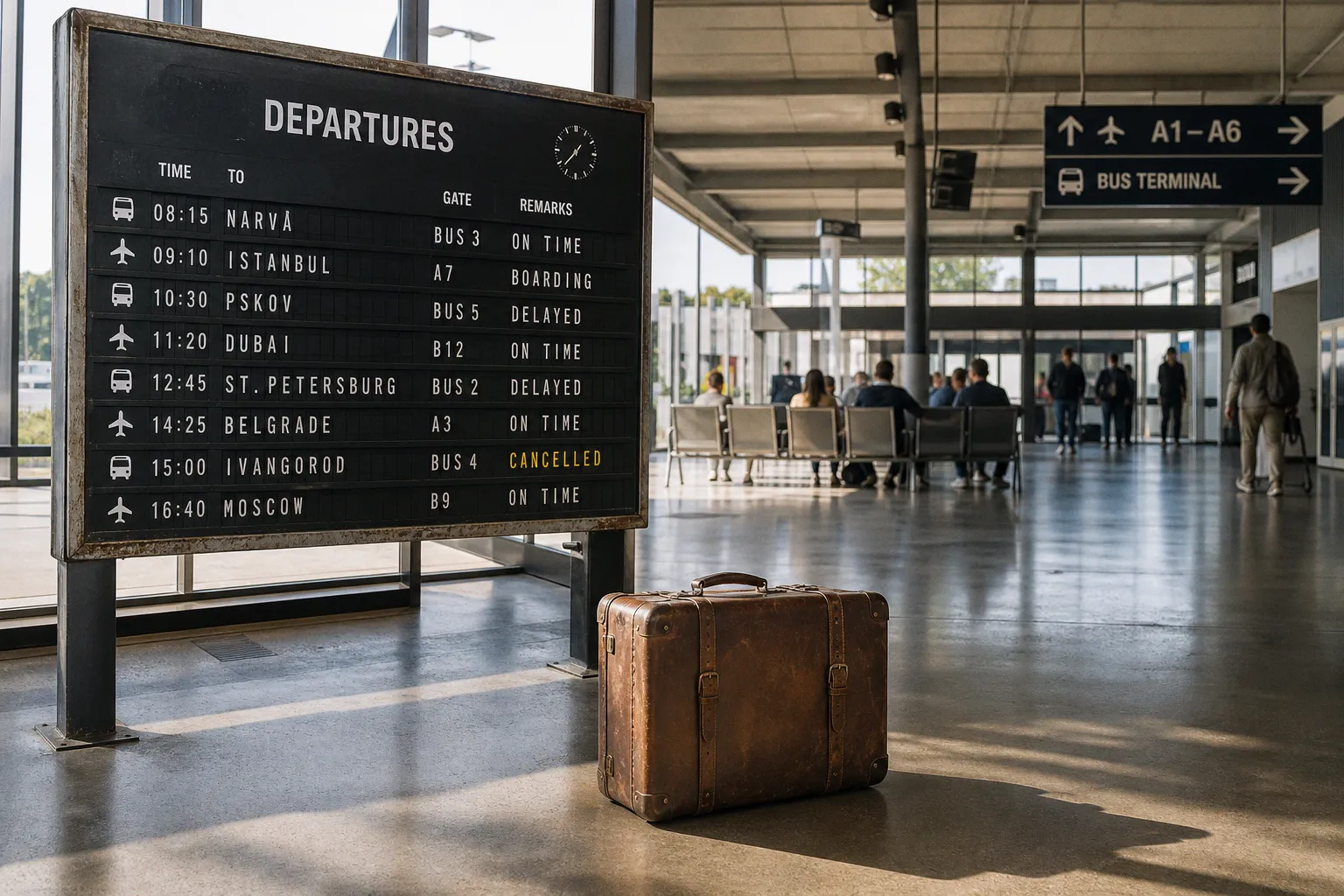
Russia Entry Routes: Land Border Bus vs. Transit Flights
The Finland–Russia land border remains closed indefinitely, the vehicle checkpoint at Ivangorod is still closed for reconstruction, and the overland route through Estonia now involves a pedestrian transfer across the Narva–Ivangorod bridge.
Compare car rental deals in United Kingdom
See available offersPartner link — DiscoverCars comparisonThat makes the familiar idea of taking a bus to Russia from Tallinn rather misleading. The route exists, but not as a continuous bus journey from Estonia into Russia. You travel by bus to the frontier, walk approximately 950 metres across the bridge with your luggage, and continue on another vehicle after Russian border formalities. By contrast, flights to Moscow via Istanbul, Dubai, or Belgrade cost more and often require a long airport day, but they offer a far more predictable chain of connections.
Here is the practical difference in the Russia border crossing land vs. air transit decision: the land route can reduce the ticket price, while the air route usually reduces the number of things that can go wrong.
The Narva–Ivangorod crossing is a pedestrian itinerary, not a normal bus border
The Estonia–Russia crossing at Narva is the main overland option for travelers arriving from the Schengen Area, but the physical geography of the crossing matters more than the route shown in a booking search.
The Ivangorod vehicle checkpoint has been closed for reconstruction since February 2024. Buses therefore cannot simply remain on the same side of the bridge and carry passengers through the frontier. Services such as Baltic Shuttle or Lux Express bring travelers to the Estonian side, after which passengers walk across the Narva–Ivangorod bridge for roughly 950 metres and transfer to onward transport on the Russian side.
That distance sounds modest until it is combined with real luggage, winter clothing, border queues, customs inspection, and the possibility that the bus on the other side will not wait in the way an airport transfer does. A small suitcase with smooth wheels is manageable. Two large cases, a backpack, or mobility limitations change the calculation quickly, particularly in snow, rain, wind, or icy conditions.
The crossing also has a hard temporal boundary. Estonia has restricted the operating hours of the Narva, Koidula, and Luhamaa checkpoints to 07:00–19:00 daily. This is not a detail to leave until the final stage of planning. A late departure from Tallinn, a delay on the road, or an unexpectedly slow customs inspection can push a traveler close to the operating cut-off, when there may be no practical way to continue the journey that day.
For a land itinerary, we plan the frontier as a separate travel event rather than as an ordinary stop between two bus stations:
1. Reach the Estonian border with daylight and reserve time. A schedule that arrives shortly before closing may look efficient on paper but leaves no room for road delays or a queue.
2. Pack for a short walk, not only for a bus ride. Keep passports, visa documents, medicines, warm layers, and essential electronics in a small bag that stays with you.
3. Expect to handle your own luggage. The 950-metre transfer is part of the journey, and the conditions at the bridge can be considerably less comfortable than the departure terminal.
4. Separate the border crossing from a same-day Russian connection. If you must catch a domestic train or flight after entering Russia, build a substantial buffer or spend the night near the frontier.
5. Check the route shortly before departure. Operating policies, bus schedules, and customs procedures can change with limited notice.
The land crossing is therefore most suitable for travelers who value a lower fare, can tolerate a variable timetable, and are comfortable managing their own movement through a frontier that is functioning under restrictions.
The Narva route is not a single bus journey with a border stop; it is a bus, a walk, a customs process, and another onward connection.
What the overland route saves—and what it asks from you
A land crossing can be attractive when the alternative is an expensive multi-leg flight. It may also fit travelers already moving through the Baltic region, especially those who have reached Tallinn or eastern Latvia by rail or bus and are not starting their journey from a distant European airport.
The apparent saving, however, should be measured against the full itinerary rather than the first ticket price. A lower-cost bus may require:
- an overnight stay in Tallinn, Narva, or another departure city;
- additional food and accommodation if the crossing is delayed;
- a separate Russian bus or taxi after immigration;
- a contingency night if the frontier closes before you complete the transfer;
- a longer onward journey to Moscow, St. Petersburg, or another region.
There is also a physical cost. Transit fatigue accumulates differently on land. On a flight, the most tiring elements are airport security, waiting, and the time spent changing planes. At Narva, fatigue is distributed across the road journey, the walk between checkpoints, customs queues, luggage handling, and the uncertainty of not knowing precisely when the Russian section will begin.
For travelers going onward to Moscow, the geography becomes especially important. Narva is near the northwestern frontier, but Moscow is still a substantial journey away. A route that appears close on a European map can become a full day of movement once the border process and Russian domestic transport are included. St. Petersburg is geographically more natural as a first Russian destination from Estonia, but even there, a late border arrival can turn a straightforward connection into an overnight problem.
Latvia offers another possible land approach, but it is more limited than many older route guides suggest. Only Terehova and Grebņeva remain open among Latvia’s crossings with Russia, while proposals have been made to halt bus services with Russia and Belarus entirely. The exact waiting times at these checkpoints are not fixed and can fluctuate with customs activity. That makes Latvia useful as a possible route, not a dependable default.
The land option is strongest when all three conditions are true:
- your starting point is already close to Estonia or Latvia;
- your schedule has at least a half-day of flexibility around the border;
- the saving remains meaningful after hotels, meals, onward transport, and contingency costs are added.
If those conditions are not met, the cheaper ticket may simply move the expense into a different part of the journey.
Air transit through Istanbul, Dubai, or Belgrade
For most long-distance travelers, air transit remains the most reliable way to reach Russia. There are no direct flights between the European Union and Russia, so the journey normally involves a connection through a hub such as Istanbul, Dubai, or Belgrade before continuing to Moscow, St. Petersburg, or another Russian airport.
These hubs do not offer identical travel experiences.
Istanbul
Flights to Moscow via Istanbul are often the most intuitive choice for travelers departing from Europe, the Middle East, or North Africa. The route usually benefits from a broad network of feeder flights and multiple Russian destinations, although schedules and connection times vary by season.
The practical advantage is concentration: the journey is handled through an international airport connection rather than divided between a coach terminal, a pedestrian frontier, and a second land carrier. The practical disadvantage is that Istanbul Airport is large, and a short connection can be physically demanding. We prefer a connection that leaves enough time for a gate change, security procedures, and a delayed inbound flight, rather than selecting the absolute shortest itinerary.
Dubai
Dubai can be useful for travelers coming from Asia, Africa, or countries with strong Gulf connections. It is often less convenient for a European departure unless the fare is substantially better or the schedule aligns well with the starting city.
The airport itself is designed for long-distance transfers, but the route may create a longer overall flight day. A connection through Dubai can be operationally smooth while still producing high transit fatigue because of the distance, overnight timing, and time-zone shift.
Belgrade
Belgrade may offer a comparatively direct-feeling European connection and can work well when schedules align with the traveler’s departure airport. The choice depends heavily on the available onward service and whether the itinerary is issued as one protected booking or assembled from separate tickets.
That distinction matters. A single booking generally gives the traveler a clearer responsibility chain when a delay disrupts the connection. Separate tickets may be cheaper, but they turn a missed onward flight into the traveler’s problem, including possible rebooking and accommodation costs.
For air transit, we assess the journey through five practical variables:
- Connection length: short enough to avoid wasting a day, but not so short that a minor delay breaks the itinerary.
- Airport geography: large hubs can require long walks, train transfers, or another security check.
- Baggage rules: the lowest fare may include less checked baggage than a land journey, while a land traveler must physically carry every item across the bridge.
- Ticket structure: one booking is generally easier to manage than separate tickets with no protected connection.
- Arrival timing: landing late at night may reduce the usefulness of a faster itinerary if local transport or hotel check-in becomes awkward.
The air route is more expensive in direct fare terms, but it offers a tighter relationship between booked time and actual travel time. That predictability is particularly valuable when the Russian itinerary includes a domestic flight, a fixed-date tour, a river cruise departure, or a regional train that cannot easily be moved.
| Factor | Narva–Ivangorod land route | Transit flight via Istanbul, Dubai, or Belgrade |
|---|---|---|
| Main advantage | Potentially lower transport cost, especially from the Baltic region | Greater schedule reliability for long-distance travel |
| Border movement | Approximately 950-metre pedestrian transfer between buses | Airport-based transfer through an international hub |
| Vehicle access | Ivangorod vehicle checkpoint remains closed for reconstruction | No road-border vehicle transfer required |
| Main uncertainty | Customs queues, restricted hours, service changes, and bus coordination | Flight delays, missed connections, and fare volatility |
| Luggage experience | Passenger carries luggage across the bridge and frontier zone | Baggage may be checked through, depending on ticket and airline |
| Best geographic fit | Travelers already in Estonia or Latvia | Travelers beginning farther away in Europe or overseas |
| Planning buffer | Substantial buffer around the border and a possible overnight stay | Generous connection time and protection against missed flights |
| E-visa checkpoint issue | Must use a crossing authorized for the Russian unified e-visa | Must arrive at an airport authorized for the visa and itinerary |
| Overall character | Lower-cost but operationally exposed | More expensive but easier to pace and coordinate |
Russian entry requirements: the visa is only one part of the route
The Russian unified e-visa is accepted at 109 authorized checkpoints as of August 2026, including the pedestrian crossing at Ivangorod and the land checkpoints at Kunichina Gora, Shumilkino, and Burachki. It is not accepted at the Storskog crossing on the Norway–Russia border.
This is one of the places where route and visa planning cannot be separated. A traveler may hold a valid e-visa and still choose an unsuitable border if the intended checkpoint is not authorized for that document. The checkpoint must be matched to the actual itinerary, not to a general assumption that all Russian international borders operate under the same entry rules.
The unified e-visa currently takes up to four days to process, costs approximately €50 or $53, and is free for children under six. It allows a stay of up to 16 days within a 60-day validity window. Those figures make it useful for a compact cultural itinerary, but the 16-day stay limit requires careful pacing if you plan to combine Moscow, St. Petersburg, and a distant regional destination.
We usually separate the visa calendar into three dates:
1. Application date: when the application is submitted with enough time for processing.
2. Validity window: the period in which entry must take place.
3. Permitted stay: the maximum number of days available after entry.
Confusing the validity period with the permitted stay is a common planning error. A document valid for 60 days does not mean that the traveler can remain in Russia for 60 days. The permitted stay under this e-visa is up to 16 days.
The same distinction matters when comparing a land border crossing with an airport arrival. If a border delay pushes entry into a later date, the visa’s validity window and the rest of the itinerary may be affected. A traveler using a fixed-date tour or pre-paid domestic transport should avoid placing the e-visa start date so close to the planned crossing that one disrupted day creates a chain of cancellations.
For travelers who do not use the unified e-visa, the relevant Russian consulate or visa service may require a different document set, including a visa support letter. The support documentation, visa type, permitted stay, and entry points must correspond to the journey actually being taken. A route through Estonia, a flight through Istanbul, and an entry through a northern border are not interchangeable simply because the final destination is the same.
Customs controls and the time of day
The Baltic frontier demands more patience than older travel advice often suggests. Estonia has implemented full customs controls on all travelers, and the Narva, Koidula, and Luhamaa checkpoints operate under restricted hours of 07:00–19:00. Since June 2026, Narva’s hours have been reduced to this 12-hour window, while Luhamaa and Koidula also operate under limited schedules.
The effect is cumulative. Even if passport control itself proceeds smoothly, customs inspection can slow the line, and the traveler has little control over the number of vehicles or passengers ahead. It is unwise to plan a morning departure from Tallinn that reaches Narva just before midday and then schedule an evening train from St. Petersburg. The map may suggest that the connection is generous; the frontier timetable says otherwise.
The best land-border planning is deliberately conservative:
- arrive at the crossing early rather than targeting the final hours;
- avoid placing a non-refundable domestic connection immediately after entry;
- carry water and food that can remain with you during a long wait;
- keep documents accessible without repeatedly opening the main luggage;
- use luggage that can be lifted over uneven surfaces and carried in cold weather;
- leave room for a night near the border if the onward timetable becomes impractical.
Customs controls also affect the choice between land and air for travelers carrying specialist equipment, large quantities of personal goods, or gifts. The issue is not that one route automatically permits more than the other; it is that the land journey exposes the traveler to more points where luggage must be handled and potentially presented. Packing light is not merely a comfort preference on this crossing. It improves speed, balance, and concentration.
Russia’s own border procedures can also change. Stricter customs controls were introduced at Burachki in October 2025, and individual checkpoint conditions may differ. We therefore avoid building a route around a single report of a fast crossing. A frontier can be quiet on one weekday and slow on the next, particularly during holiday periods or when operating hours have recently changed.
Which route works for different travel patterns?
The right answer to the russia border crossing land vs air transit question depends less on a universal ranking than on the shape of the trip.
Choose the land route when your journey begins in the Baltics
If you are already in Tallinn, eastern Estonia, Riga, or another nearby Baltic location, the overland crossing may be rational. You avoid the cost and geographical detour of reaching an international air hub, and the 950-metre pedestrian transfer may be acceptable if you are traveling with manageable luggage.
Even then, we would protect the first night in Russia rather than aiming for an ambitious same-day sequence. St. Petersburg is the natural orientation point for many travelers entering from the northwest, while Moscow generally requires more onward planning.
Choose air transit when the starting point is far from the frontier
From Western Europe, North America, the Gulf, or Asia, reaching Estonia or Latvia only to cross by land can consume the saving. The traveler may need a separate flight, hotel, and bus connection before the border journey even begins. In those circumstances, the transit flight usually offers a cleaner spatial progression: departure airport, hub, Russian arrival airport.
Choose air transit for fixed-date itineraries
A cruise departure, a festival booking, a regional flight, or a pre-arranged expedition creates a different risk profile. If missing the connection would affect several reservations, the extra cost of air transit can be a form of schedule insurance.
Consider land travel for flexible, slower itineraries
The overland option is more defensible when the journey itself is flexible. Travelers who can spend a night near the frontier, adjust their Russian arrival city, and absorb a delay without losing a major reservation are better positioned to use it.
Treat children, heavy luggage, and mobility needs as route factors
A family with young children may find the border walk and uncertain waiting environment more demanding than the price difference suggests. The same applies to travelers with heavy luggage, reduced mobility, or medication that must remain at a controlled temperature. These are not abstract comfort concerns: they change the physical feasibility of the crossing.
Seasonal pacing: when the route feels manageable
Seasonal timing matters because the land journey is exposed to conditions that an airport transfer largely contains indoors.
In late spring and summer, daylight helps with the pedestrian transfer and leaves more room to recover from delays, but demand can increase and queues may become less forgiving. Early autumn often offers a reasonable balance of daylight and manageable temperatures, although schedules and border policies still require a final check before departure.
Winter is the season in which the difference between the two routes becomes most pronounced. Snow, ice, wind, and bulky clothing make the 950-metre bridge transfer slower and more tiring. Limited daylight also makes the 07:00–19:00 operating window feel narrower in practical terms. If using Narva in winter, we would choose an early crossing, minimize luggage, and keep a warm layer accessible rather than buried inside a suitcase.
Air transit has its own seasonal pressure points. Winter weather can affect feeder flights and airport operations, while summer schedules may offer more choices but also higher fares. A well-timed connection through Istanbul, Dubai, or Belgrade is still usually easier to manage than a land crossing that depends on several separate transport stages.
In a restricted-border landscape, the cheapest route is not the one with the lowest ticket price; it is the one whose delays you can afford.
Our practical decision
For travelers already positioned in the Baltic region, the Narva–Ivangorod crossing can remain a workable entry route, provided it is planned as a pedestrian frontier transfer with restricted hours, full customs controls, and a realistic possibility of delay. It is not a conventional bus journey, and the closed Ivangorod vehicle checkpoint should be treated as a central fact rather than a footnote.
For most travelers starting farther away, transit flights through Istanbul, Dubai, or Belgrade are the more dependable choice. They cost more, but they simplify the geography, reduce luggage handling, and make it easier to protect a timed Russian itinerary. The strongest option is usually the one that matches the scale of the journey: land for a flexible Baltic-based trip, air for a long-distance or date-sensitive route.
Before booking, we would compare the complete door-to-door journey rather than the first fare displayed: travel to the departure point, border or airport transfer, visa-compatible entry checkpoint, luggage burden, likely overnight costs, and the consequences of arriving a day late. In spring and early autumn, a well-buffered land route can be perfectly reasonable. In winter, or whenever the Russian itinerary begins with a fixed reservation, air transit generally provides the calmer pace and stronger margin that the current border landscape demands.