Kamchatka travel planning: how to avoid costly delays
Plan to lose 30% to 50% of any Kamchatka schedule to weather. That is the operating reality of the peninsula, not a worst-case scenario.
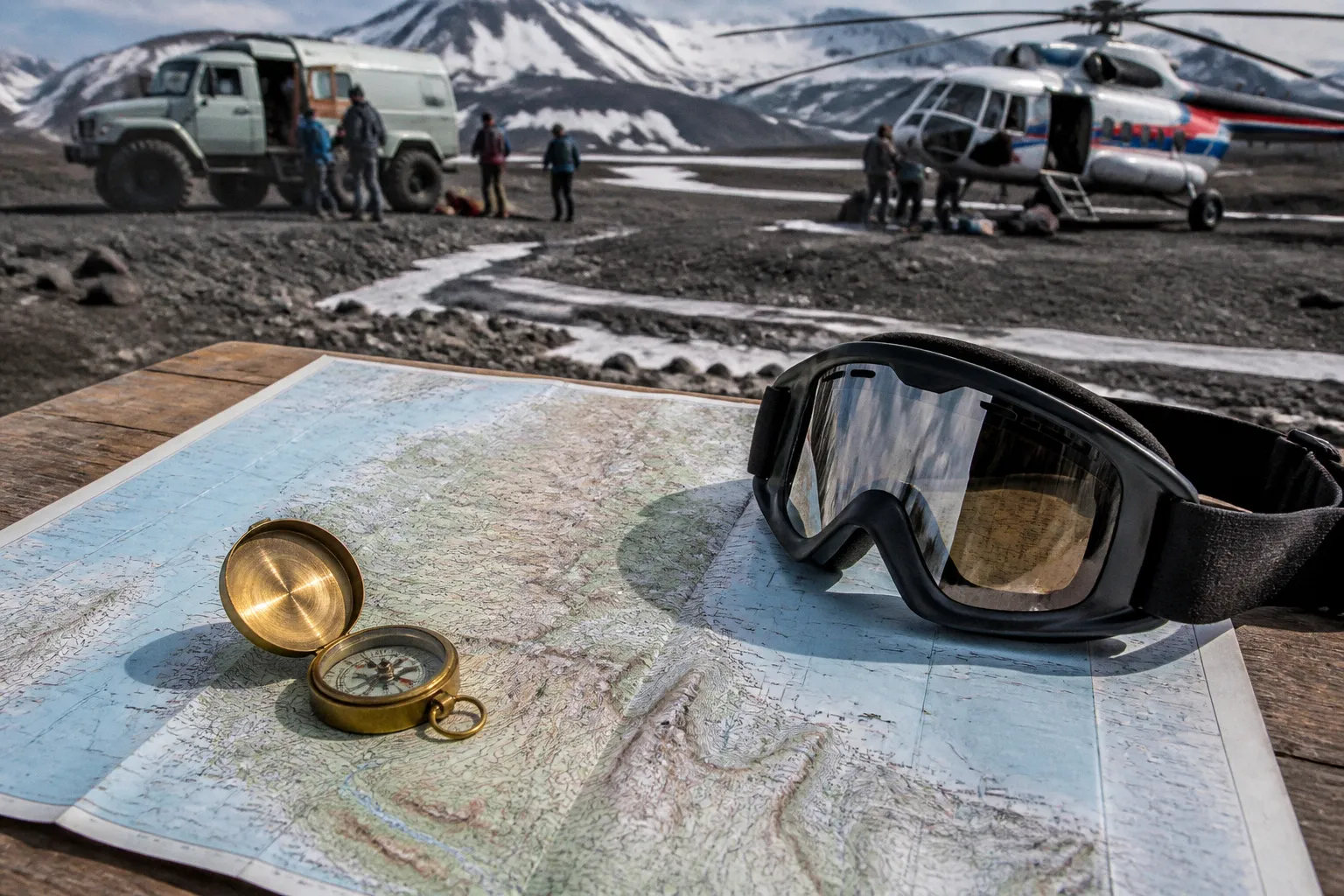
Cyclones, low cloud cover, and volcanic fog ground helicopter tours, cancel volcano treks, and rewrite itineraries built on paper assumptions. Travelers who budget without a buffer pay for it twice — once in idle days, once in rebooked charter fees.
The August 2025 expansion of the unified Russian e-Visa to 120 days of validity, with stays of up to 30 days per entry, has simplified access formalities. It has done nothing to simplify the peninsula itself. Kamchatka remains nine time zones from Moscow, eight to nine flight hours from any Russian hub, and entirely without rail access to the mainland. Every kilometer beyond Petropavlovsk-Kamchatsky is governed by specialized transport, mandatory permits, or both.
Why Standard Itineraries Fail on Kamchatka
Three structural constraints break most first-time plans: geography, meteorology, and a permit regime that does not bend to tourist schedules.
Geography
Petropavlovsk-Kamchatsky (Yelizovo Airport, PKC) is the only practical air gateway. The flight from Moscow covers eight to nine hours across nine time zones. Operations are constrained by daytime flying windows and weather minima at PKC. Local clock desynchronization alone produces arrival-day fatigue that most planners underestimate.
Meteorology
The peninsula sits at the intersection of the Sea of Okhotsk, the Pacific, and the Bering Sea. Weather systems stack against coastal cliffs and erupting volcanoes with little warning. A single day can move from over +25°C in central inland valleys to around +5°C on coastal lines and elevated volcanic slopes — a 20°C single-day spread that shapes clothing, acclimatization, and helicopter fuel margins.
Permits
Standard tourist entry documents and the e-Visa do not open protected zones. Foreign nationals entering border areas, nature parks, and restricted fishing territories must secure separate permits through the FSB and nature reserve authorities. Operators confirm this at booking. Travelers who arrive expecting document-free access hit hard walls.
The Planning Mistake Matrix
The mistakes below account for the bulk of cost overruns logged on Kamchatka trips. Each carries a specific corrective protocol.
1. No buffer in the schedule. A ten-day plan with ten days of fixed bookings collapses on the first weather day. Corrective: allocate 30% to 50% of total trip duration as unscheduled reserve, distributed across the middle and late portion of the trip — not front-loaded against arrival-day fatigue.
2. Treating helicopter tours as fixed-time tickets. Mi-8 rotations and volcano flyovers operate on weather-permitting windows, not on pre-booked hourly slots. Corrective: confirm refund and reschedule terms in writing before deposit; treat the booking as a voucher with a weather clause, not a guaranteed departure.
3. Single-mode transport planning. Relying solely on helicopter access leaves travelers stranded when ceilings drop. Corrective: pair helicopter transfers with 6x6 truck or motorboat redundancy for the same destination or a fallback access point.
4. Skipping the FSB permit. Border-zone visits and certain nature parks require permits processed weeks in advance. Corrective: file permit applications at least 30 to 60 days before arrival; carry the original document at all times when inside restricted territory.
5. Underestimating single-day temperature swings. A 20°C day-night and valley-to-summit spread requires layered technical clothing, not a single-season jacket. Corrective: pack base, mid, and shell systems rated for both +25°C and +5°C conditions.
6. Booking day-zero arrival activities. Long-haul arrival days consume the first 18 hours with transit, customs, and time-zone recovery. Corrective: reserve day one for logistics and sleep, not for tours.
7. Ignoring the operational season. Helicopter and bear-viewing programs concentrate in July through September. Outside that window, helicopter availability contracts sharply and key excursions may not run. Corrective: match activity type to season; verify operator schedules before committing deposit.
8. Assuming refund flexibility. Domestic carriers and local operators apply non-refundable logic to deposits. Corrective: read cancellation terms line by line; pay deposits only after the worst-case weather scenario is priced in.
The most expensive line in any Kamchatka budget is the line that pretends weather delays are rare. Operators who quote 30% to 50% buffer are quoting reality, not padding the estimate.
Buffer Engineering — How to Actually Reserve the Days
Buffer time is not downtime. Buffer is a compliance mechanism with operational meaning.
Distribute the reserve. Front-loaded buffer absorbs the first weather event and leaves the back half of the trip exposed. Mid-trip and late-trip buffer protects the helicopter and bear-viewing days that anchor the plan.
Pair buffer with charter guarantees. Confirm that helicopter operators rebook on a weather-permitting basis without a fresh deposit. Confirm that 6x6 trucks remain available on short notice. Buffer without operational flexibility is just idle time.
Build in a fail-safe day. Reserve at least one full unscheduled day inside the protected season window. That day absorbs single-day cancellations and serves as the trip's contingency reserve.
| Trip Length | Minimum Buffer | Recommended Buffer | Distribution Logic |
|---|---|---|---|
| 7 days | 2 days | 3-4 days | 1 mid-trip, 1-2 late-trip |
| 10 days | 3 days | 4-5 days | 1-2 mid-trip, 2-3 late-trip |
| 14 days | 4-5 days | 6-7 days | 2 mid-trip, 3-4 late-trip, 1 fail-safe |
Permit Compliance — FSB, Nature Reserves, Fishing Territories
Three permit categories apply to most foreign travelers moving beyond the standard Petropavlovsk-Kamchatsky corridor. None of them are covered by the e-Visa.
FSB Border-Zone Permits
Required for areas designated as border zones under federal legislation. Processing windows typically run 30 to 60 days for foreign nationals. Operators arrange most filings, but the traveler signs the application. The original permit document must be carried at all times inside the zone.
Nature Reserve Permits
The Kronotsky Nature Reserve and certain nature parks require separate entry permits issued by the managing authority. Visitor slots are capped. Peak summer dates book out weeks in advance. A standard tourist entry is not the credential here.
Restricted Fishing Territories
Certain river and coastal stretches require permits from regional fisheries authorities. Angling programs and some wildlife-viewing boat routes pass through these areas.
| Permit Type | Issuing Authority | Standard Processing | Carry Requirement |
|---|---|---|---|
| Border zone | FSB | 30–60 days | Original permit + valid ID |
| Nature reserve | Reserve authority | 14–30 days | Permit voucher |
| Fishing territory | Regional fisheries | 7–21 days | Permit + license copy |
A standard tourist entry unlocks Petropavlovsk-Kamchatsky. It does not unlock the rest of the peninsula. Build the permit chain before the air booking.
Transport Matrix — Helicopter, 6x6, Maritime Charters
Standard rental vehicles cannot navigate the peninsula's roadless interior. Three specialized transport modes cover the operational access points.
| Mode | Primary Use | Capacity | Weather Sensitivity | Booking Logic |
|---|---|---|---|---|
| Mi-8 helicopter | Volcano flyovers, remote valley access, bear-viewing | 12-22 passengers | High — low ceiling, fog, crosswind | Window-based, weather-permitting |
| 6x6 off-road truck | Ash-field tracks, river crossings, base-camp transfer | 6-10 passengers | Moderate — river level, snow, erosion | Day-rate charter, partial-day |
| Motorboat | Coastal bays, sea-lion rookeries, marine mammal tours | 6-12 passengers | Moderate-High — wind, swell, fog | Window-based, boat-day rates |
Mi-8 Helicopter
Fastest access to active volcanoes and remote ridges. Strict weather minima apply: low cloud ceiling, reduced visibility, and crosswind ground operations outright. Bookings operate as weather windows, not scheduled departures. Operators confirm slots 12 to 24 hours in advance based on forecast.
6x6 High-Clearance Truck
Used for tracks such as the approaches to Mutnovsky or Gorely volcanoes, and for river-crossing routes into the interior. Charter is typically daily or per transfer. Limited by river level, snow, and road erosion.
Motorboat
Required for marine tours along the Avacha Bay coast, sea-kayak support crossings, and access to certain wildlife colonies. Sensitive to swell, wind, and fog.
Combination Logic
Helicopter bookings pair with 6x6 fallback options on the same date. A grounded heli-day converts to a track-day without losing the routing logic. This redundancy is set at the booking stage, not improvised after arrival.
Seasonal Windows and Single-Day Temperature Dynamics
Kamchatka divides into two operational seasons and one transitional band.
Primary Season: July to September
Helicopter operations run at full schedule. Bear-viewing peaks. Volcano treks accessible. Coastal marine tours stable. Most competition for slots. Highest per-day rates. This is the window where buffer engineering pays the highest dividend, because every fixed booking competes with peak demand.
Winter Season: December to April
Snowmobile and heli-skiing operations. Bear-viewing reduced. Distinct access profile; equipment and guide ratios differ from summer. The summer helicopter structure does not apply.
Peripheral Windows: May-June and October-November
Transitional weather. Many operators suspend helicopter and certain trekking programs. Flights remain stable but excursion availability contracts.
Across all three windows, a 20°C single-day temperature swing is the rule rather than the exception. Layered technical clothing is mandatory kit regardless of season — coastal wind chill and volcanic slopes shift temperature bands within hours.
The Fail-Safe Backup Plan
Three controls determine whether a Kamchatka trip survives weather or cascades into failure.
One. Reserve 30% to 50% of trip length as buffer, distributed mid-trip and late-trip. No exceptions for short itineraries.
Two. Pair every helicopter booking with a 6x6 or motorboat fallback on the same date. Redundancy set at the booking stage, not improvised on arrival.
Three. File FSB and nature-reserve permits at least 30 to 60 days before entry. Treat permits as a hard prerequisite to the air booking, not a parallel task.
These three protocols absorb the bulk of cost differences between a recoverable delay and a cascading failure. The peninsula does not negotiate around them.