Moscow to Kazan: night train or domestic flight?
The distance between Moscow and Kazan looks manageable on a map—roughly 718 to 793 kilometres by rail, depending on the routing—but the choice between a night train and a domestic flight changes the shape of the entire journey.
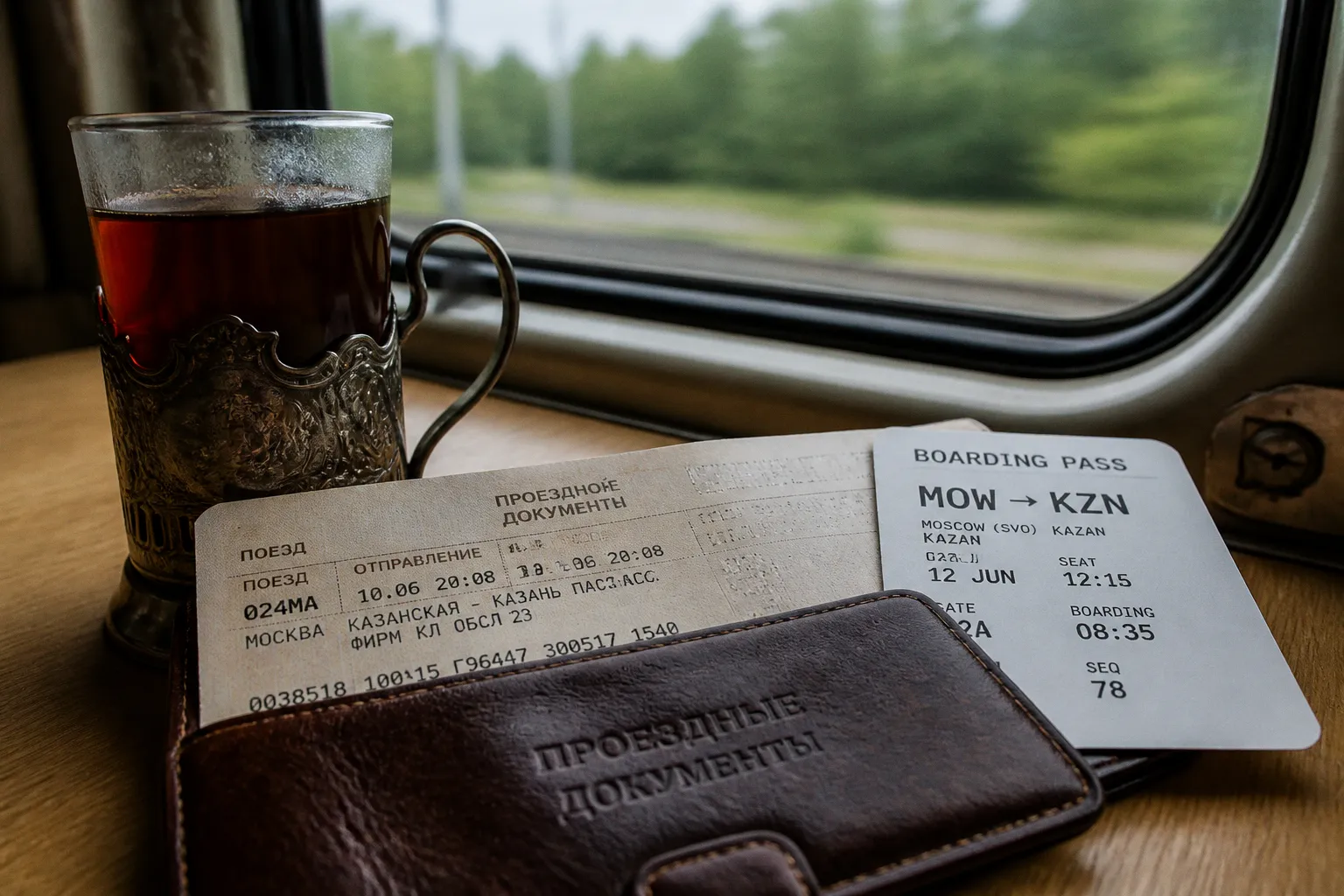
A train can take 11 to 13 hours yet carry us from the centre of Moscow to the centre of Kazan while we sleep. A flight spends only about 1 hour 30 minutes to 1 hour 45 minutes in the air, but the airport geography, security procedures, baggage collection, and ground transfers add a second timetable around the first.
Compare car rental deals in United Kingdom
See available offersPartner link — DiscoverCars comparisonThat is the central point in the Moscow to Kazan train vs flight decision: we are not comparing 12 hours with 90 minutes. We are comparing two different kinds of travel fatigue. One is a long but continuous overnight movement; the other is a shorter flight enclosed within a much more fragmented day.
For most itineraries, the night train works best when we want to preserve a hotel night, avoid Moscow’s outlying airports, and arrive ready to explore from the middle of the city. Flying is the sharper choice when Kazan is one stop in a tightly timed route, when we need a daytime arrival, or when an overnight journey would disrupt the rhythm of a family or business trip.
The real distance is measured from the hotel door
Moscow’s airports are not interchangeable with the city centre. Sheremetyevo, Domodedovo, and Vnukovo each sit outside the central districts, and the transfer time depends heavily on where we are staying, the hour of departure, and the condition of the road network. Even before reaching the terminal, we need to allow time for the airport journey, check-in or document checks, security, and the walk to the gate. On arrival in Kazan, the same process runs in reverse: aircraft taxiing, baggage collection, and the transfer from Kazan International Airport into the city.
The train begins in a more forgiving part of the map. The Moscow–Kazan services depart from Kazansky Railway Station, which is connected to the central transport network, and arrive at Kazan-Pass, close to the urban core. We still need to reach the station with luggage, but there is no equivalent airport perimeter to cross and no requirement to report several hours before departure.
Here is the catch: the railway’s headline duration is longer, but much of it can replace accommodation and sleep. The flight’s headline duration is shorter, but its surrounding logistics usually occupy a substantial portion of the day.
A useful comparison looks like this:
| Journey factor | Overnight train | Domestic flight |
|---|---|---|
| Main travel time | Approximately 11–13 hours | Approximately 1 hour 30 minutes–1 hour 45 minutes in the air |
| Departure point | Kazansky Railway Station, central Moscow | Sheremetyevo, Domodedovo, or Vnukovo |
| Arrival point | Kazan-Pass, near the city centre | Kazan International Airport, outside the city |
| Hotel requirement | Can remove one night of accommodation | Usually requires a hotel night before or after travel |
| Sleep quality | Depends on carriage, berth, and fellow passengers | Usually poor if the airport schedule requires an early start |
| Luggage handling | Taken directly into the carriage | Check-in, hold baggage, collection, and possible restrictions |
| Payment for foreign travellers | Official RZD payment may require a Russian bank card or intermediary | Domestic airline websites generally present similar payment limitations |
| Best use | City-centre-to-city-centre overnight movement | Time-sensitive daytime travel |
Neither option is automatically superior. The route is long enough for the train to be a practical overnight segment, but short enough for flying to remain attractive when the schedule matters more than the accommodation saving.
What the Moscow–Kazan night train is actually like
Russian domestic trains on this route are not all identical. Russian Railways operates several services from Kazansky Station, including popular branded double-decker trains such as No. 023/024 and premium services such as No. 001/002. The equipment, departure time, arrival time, carriage layout, and fare structure can vary, so we should choose by the whole timetable rather than by the word “premium” alone.
The overnight train experience is built around a simple spatial advantage: once we board in Moscow, the route becomes a single contained sequence. Our luggage stays with us. There is no transfer between terminals. We can settle into the berth, keep documents and valuables close, and let the railway carry us east while the city lights thin out beyond the window.
The carriage type matters more than many first-time travellers expect. Sleeping arrangements range from more open compartments to enclosed compartments, with different levels of privacy and comfort. A private compartment is usually easier for travellers who need uninterrupted sleep, are carrying substantial luggage, or are navigating the journey with children. More open arrangements can be perfectly workable, but they make the night less predictable: lights, movement in the corridor, station stops, and the habits of other passengers all become part of the sleeping environment.
For a long-distance journey, pacing begins before departure. We normally recommend eating in Moscow or buying provisions at the station rather than relying entirely on onboard food. A practical rail kit is modest but useful:
- A light meal and water, especially if the departure is late and arrival is early.
- Earplugs and an eye mask, because carriage lighting and corridor movement are difficult to control.
- A small bag for documents, medication, phone, charger, and toiletries, kept within reach rather than buried under larger luggage.
- Clothing that works across Moscow’s station, the heated carriage, and Kazan’s weather on arrival.
- A luggage arrangement that can fit beneath or beside the berth without blocking the corridor.
The train’s strongest benefit is not luxury. It is continuity. We leave one city in the evening and wake in another without giving up a morning to airport procedures.
The night train is slower on the timetable and often faster on the itinerary, because it combines transport with a night of accommodation.
There is, however, a difference between being transported overnight and sleeping well overnight. Light sleepers may arrive in Kazan functional rather than refreshed. A late departure can also create an awkward first day if the train reaches Kazan very early, before the hotel can provide a room. We should check the scheduled arrival against the hotel’s luggage-storage policy and early check-in terms instead of assuming that the room will be ready.
Some travellers find the rhythm of the train restorative; others experience transit fatigue from a night of interrupted sleep. The decision therefore depends not just on the number of hours, but on how much energy we need after arrival. If Kazan begins with a walking-heavy day, a museum booking at a fixed hour, or a transfer onward to another region, the quality of sleep becomes a serious planning variable.
Flights from Moscow to Kazan: fast in the air, more complex on the ground
Direct flights from Moscow’s principal airports to Kazan cover an aerial distance of around 741 kilometres, with flight time generally in the 1 hour 30 minutes to 1 hour 45 minutes range. That is genuinely quick once the aircraft is airborne. For travellers with a carefully chosen schedule and a hotel near the departure airport, flying can be the cleanest way to protect a day.
The airport, though, is part of the journey whether we enjoy it or not. We need to build a realistic departure sequence:
1. Travel from the Moscow hotel to the correct airport, allowing for traffic, road conditions, or the relevant airport rail connection.
2. Arrive with enough margin for airline check-in, baggage drop, and document checks.
3. Pass security and reach the gate, which may involve a long walk across a large terminal.
4. Repeat the arrival process in Kazan, including baggage collection if luggage has been checked.
5. Continue from Kazan International Airport into the city.
The exact duration will depend on the airline schedule, luggage, and the location of our accommodation, so we should not attach a single universal door-to-door figure to the flight. A traveller staying near a convenient airport route and travelling with hand luggage may move efficiently. Someone leaving central Moscow during a congested period, checking a suitcase, and arriving before a hotel’s normal check-in time will experience a very different journey.
Early-morning flights deserve particular scrutiny. An apparently convenient departure may require leaving a central hotel while the city is quiet but public transport options are limited, or paying for a longer private transfer. An evening flight can preserve the day in Moscow, but it may push arrival in Kazan into the period when a meal, hotel check-in, and onward planning become the only realistic activities.
For this reason, flights are most useful when the schedule is strategically aligned with the rest of the route. If we have a fixed meeting in Kazan, a connecting journey, or only a short stay in the city, the time saved in the air may justify the additional airport handling. If we are simply moving between the two city centres and have no urgent appointment, the train’s geography often feels calmer.
Hotel savings versus airfare: the cost is not only the ticket
Exact fares fluctuate according to season, demand, booking date, carriage class, airline, luggage, and currency conditions. We should therefore be cautious with comparisons based on a single advertised price. The more useful calculation is the full overnight movement.
With a night train, the ticket can replace one night in a Moscow or Kazan hotel, depending on the structure of the itinerary. That does not mean the train is always cheaper in absolute terms. A private compartment or premium service may cost more than the lowest available flight fare. The point is that the train includes a usable overnight segment, while a flight normally requires us to pay for accommodation separately unless our schedule is arranged around an existing hotel night.
The financial comparison should include:
- The transport fare in the class or cabin we would genuinely use, not the cheapest category we would immediately reject.
- Checked-baggage charges and seat fees on the flight.
- The cost of a hotel night that the train might eliminate.
- Transfers to and from Moscow’s airports.
- The transfer from Kazan International Airport into the city.
- Food purchased during airport waiting time or late-night travel.
- The value of the first morning in Kazan if poor sleep reduces our ability to follow the itinerary.
A train ticket can also simplify luggage economics. We bring our bags into the carriage and avoid the separate decision about whether to check them. That matters for longer Russia itineraries, when winter clothing, boots, camera equipment, or layered clothing can quickly exceed a minimal cabin-bag allowance.
On the other hand, travellers who are comfortable with a small hand-luggage setup may find that flying removes the physical effort of moving through a sleeping carriage. Families may also prefer to compare the total price of several berths with the total price of several air tickets, because the most comfortable rail arrangement may require more than one compartment.
The right question is not “Which ticket is cheaper?” It is “What does this movement replace?”
Payment obstacles for foreign travellers
Transport planning and payment planning are closely linked in Russia. Official Russian Railways websites and domestic airline sites generally require payment with Russian bank cards, and foreign-issued Visa or Mastercard cards are not generally accepted directly in the standard purchase flow. This means that an itinerary can appear straightforward until the final payment screen refuses the card.
For foreign travellers, tickets may need to be arranged through a third-party travel agency, a specialist booking service, or another legitimate intermediary that accepts the available international payment method. The trade-off is usually a service fee, a different cancellation process, or less flexibility than booking directly. We should read the fare conditions carefully and confirm whether the issued document is a final ticket or only a reservation requiring further action.
The booking channel also affects support. If a train time changes or a flight is retimed, the party that issued the ticket may control the rebooking process. We should keep the booking reference, passenger names exactly as shown in the travel document, departure station or airport, and baggage conditions together in one accessible record.
The same caution applies to station and airport names. Moscow has several railway stations, and the route to Kazan departs from Kazansky Railway Station. It is not enough to write “Moscow train station” in a transfer plan. Likewise, “Moscow airport” is not a useful instruction for a taxi driver or hotel receptionist; the ticket will specify Sheremetyevo, Domodedovo, or Vnukovo, and each has a different position on the city map.
For the railway, ticket sales usually open around 90 days before departure. That window is particularly relevant for popular travel periods, private compartments, and the most convenient arrival times. We should not wait until the last few days if the itinerary depends on a specific cabin type or a group travelling together.
Booking strategy: choose the timetable before the transport mode
Many travellers decide “train” or “flight” too early. A better method is to sketch the itinerary around usable hours in each city.
Suppose we spend several days in Moscow and want to reach Kazan without losing a daytime block. An overnight train leaving in the evening can preserve the departure day and make the arrival day available, although the early arrival and sleep question still need handling. If the train arrives before the hotel room is available, the plan should include luggage storage and a gentle first morning rather than an ambitious sequence of distant sights.
If we fly, we should first identify which Moscow airport serves the practical departure time. A midday flight may look slower than an early departure once the airport transfer is included, but it may be far more comfortable and reduce the risk of arriving exhausted. Conversely, an evening flight can work well when the day in Moscow is free and the Kazan hotel accepts late arrival.
For a route continuing beyond Kazan, the decision changes again. The night train may provide a useful transition if Kazan is a substantial stop. If Kazan is only a brief connection, flying can protect the limited hours available, provided that the airport-to-city transfer does not consume the connection margin.
We can sort the decision through the following practical sequence:
1. Mark the hours that matter in both cities. If a full morning in Kazan is essential, compare an overnight train arrival with a flight that lands early enough for the hotel and local transport to work.
2. Measure the transfer geography. Locate the Moscow hotel, departure station or airport, Kazan accommodation, and any onward departure point on the same map.
3. Decide how much sleep is non-negotiable. A private compartment, a premium train, or a hotel before a flight may be worth more than a lower headline fare.
4. Add luggage to the calculation. Heavy or bulky luggage often makes the central-station-to-central-station train more convenient.
5. Resolve payment before building the final itinerary. A theoretically available fare is not useful if the booking channel cannot accept the traveller’s payment method.
6. Book around the 90-day rail window when possible. Earlier planning gives more choice, especially for preferred berths and travel dates.
7. Leave flexibility around the arrival. Avoid placing an important timed activity immediately after a night train or an airport transfer unless the schedule has generous margin.
This approach also prevents a common mistake: treating Kazan as though it were a short extension of Moscow. The cities are connected efficiently, but the movement between them occupies a complete travel phase. We should give that phase the same attention as accommodation and sightseeing.
Which option suits different travellers?
The night train is usually the stronger fit for:
- Travellers who want to avoid paying for an additional hotel night.
- Visitors carrying more luggage than they would comfortably take through airport procedures.
- People staying centrally in Moscow and Kazan who value station-to-station movement.
- Couples or families who can reserve a private or more comfortable sleeping arrangement.
- Itineraries with enough flexibility for a slow first morning in Kazan.
- Travellers who enjoy seeing domestic rail travel as part of the journey rather than treating transport as dead time.
A flight is generally more suitable for:
- Business travellers or visitors with fixed appointments.
- Itineraries where Kazan is a short stop and every daytime hour matters.
- Travellers who sleep poorly on trains and would rather protect overnight rest in a hotel.
- Those who have a convenient connection to the chosen Moscow airport.
- Passengers travelling light and comfortable with airport procedures.
- Routes where an onward flight or other timed departure makes the shorter airborne journey valuable.
There is no universal answer for families, because the variables multiply. A child who sleeps well in a compartment may make the night train surprisingly manageable. A child who needs predictable routines may find the carriage movement and early arrival difficult. Families should consider not only the number of seats or berths, but also whether everyone can sleep in the same space and where luggage will be placed.
For older travellers or anyone with limited mobility, station access, platform changes, carriage steps, and the position of the berth deserve attention. Airports involve longer walking distances and more formal procedures, while trains involve their own physical demands when boarding and settling into a compartment. The practical comfort of the specific service matters more than the abstract label of train or plane.
The best choice is the one that protects the next important block of the itinerary, not the one with the shortest number printed beside “travel time.”
Seasonal timing changes the balance
Seasonality affects both the comfort and the risk profile of the route. In winter, Moscow and Kazan can have demanding cold-weather conditions, with icy surfaces, heavy clothing, and greater sensitivity to delays or exposed transfers. The train keeps most of the journey indoors once we board, but we still need to move from hotel to station and from Kazan-Pass to the first destination. An early-morning arrival can be especially tiring when daylight is limited and the city feels much colder than the heated carriage.
Summer brings longer daylight and often a more forgiving arrival experience, but it can also increase demand on popular travel dates. A flight may be attractive when we want to preserve a long summer evening in Kazan, while a night train may be appealing when accommodation prices rise and the overnight berth provides practical value.
The shoulder seasons are often the easiest time to balance the two. We can make use of an overnight journey without arriving in the deep cold, and airport transfers are less likely to become the defining experience of the day. Still, the booking strategy remains the same: look at the full schedule, the accommodation check-in, and the weather-sensitive parts of the itinerary rather than choosing by season alone.
Our seasonal preference would be:
- Winter: favour the train when central access and protected overnight movement outweigh concerns about sleep; favour the flight when a daytime arrival and reliable hotel rest are more important.
- Spring: compare schedules closely, because changeable weather can make a simple, contained rail journey appealing.
- Summer: fly when daytime sightseeing hours are scarce and the airport schedule fits; take the train when hotel savings and central arrival are more valuable.
- Autumn: use the train for a measured transition between cities, especially when the itinerary has room for a slower first morning in Kazan.
Our practical verdict
For most independent visitors travelling from a central Moscow hotel to a central Kazan hotel, the overnight train is the more integrated journey. It takes 11 to 13 hours, but it can remove a hotel night, avoid Moscow’s outer airports, carry luggage without a separate check-in process, and deliver us close to Kazan’s urban centre. It is especially effective when we can reserve a sleeping arrangement that matches our tolerance for noise, privacy, and interrupted rest.
Flights from Moscow to Kazan are the better instrument when time is genuinely scarce. The 1.5- to 1.75-hour airborne journey is compelling if the airport transfer is convenient, the schedule aligns with the day, and the cost of accommodation and baggage does not erase the advantage. We should simply treat the flight as an airport-based journey rather than imagining that the aircraft time represents the whole movement.
In practice, we would book the night train when the itinerary is paced around cities, evenings, and accommodation savings. We would book the flight when a fixed appointment, short stay, or onward connection makes daytime time more valuable than central-to-central simplicity. In both cases, the best results come from planning the departure geography, payment method, ticket-release window, and first hours in Kazan together.
The seasonal choice is straightforward: use the train most confidently when an overnight transition protects the itinerary and the arrival can be gentle; choose the flight when daylight, sleep, or a fixed schedule matters more. Moscow and Kazan are close enough to connect efficiently, but not so close that the movement deserves to be treated as an afterthought.