Russian train tickets: booking checklist for tourists
Foreign-issued Visa and Mastercard no longer route through rzd.ru. That single fact, dating to 2022, has quietly reshaped the entire cost structure of booking Russian rail from abroad.
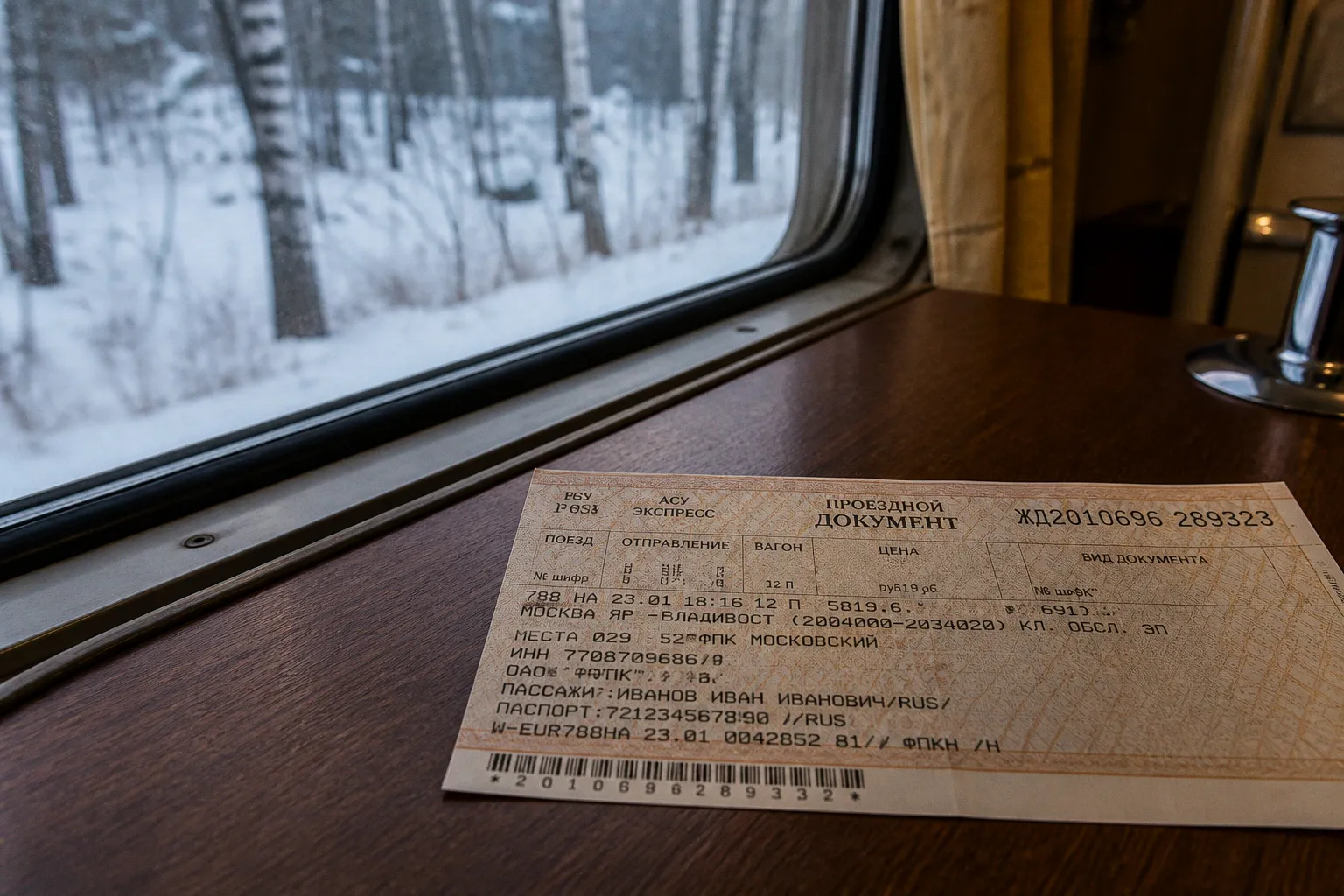
The 25% surcharge sitting between you and the Sapsan
What used to be a frictionless second-person checkout now routes through authorized subagents who layer a 20–30% commission over the base fare, or requires you to acquire a Russian MIR card before you can transact with the official carrier at all. For a traveler planning a Moscow–St. Petersburg itinerary in peak season, that translates into a real budget leak — not a rounding error. The booking window, the passport rules, and the electronic registration protocol each add their own layer of liability. Treating this as a logistics problem rather than a romance about trans-Siberian travel is the first move. Here is the operational checklist.
Bottom line: you are not buying a ticket, you are buying a workaround. Price the workaround into the trip from the start.
Payment barriers and what actually works at the checkout
The official Russian Railways portal (rzd.ru) and its app process only Russian MIR cards. Visa, Mastercard, and American Express issued outside Russia are declined at the payment gateway. This is not a temporary outage — it is the working state of the system, and your decision tree starts here.
Three paths exist for a foreign traveler:
| Payment path | Works on rzd.ru | Works on subagent sites | Hidden friction |
|---|---|---|---|
| Russian MIR card | Yes (only practical option) | Yes | Requires a Russian bank account or a sponsor in Russia to issue the card |
| Foreign Visa / Mastercard | No — gateway rejection | Yes (where accepted) | 20–30% commission layered on the base fare |
| Cash at station ticket counter | N/A | N/A | Requires physical presence, queue at the window, language barrier |
| Russian Railways app (mobile) | MIR only | Limited subagent support | Same geo-block as desktop site |
A separate operational risk: rzd.ru is geo-blocked across several European countries. If your itinerary is being planned from a desk in Berlin, Paris, or Amsterdam, you may need a VPN terminating on a Russian server before the portal even loads. That is two layers of friction before you have paid anyone a cent.
If you cannot get a MIR card, the subagent channel is your only realistic path. Treat the commission as cost of access, not as a penalty.
Booking windows: 90 days is the default, 120 days is the exception
Most long-distance domestic Russian trains open for online sale 90 days before departure. That is the figure you should plan around unless you are booking a specific premium service. The Sapsan high-speed service between Moscow and St. Petersburg, the Red Arrow #1/2 overnight, and the Express #3/4 sleeper all open 120 days ahead — a window expanded on April 1, 2019 for these select routes only.
The 30-day gap matters. If your group is targeting August departures and you begin planning in May, you have missed the Sapsan low-friction window entirely. Inventory on the premium trains moves faster than inventory on overnight regional services, and the subagent commission does not insulate you from a seat being sold out.
| Train category | Booking window opens | Operational implication |
|---|---|---|
| Standard long-distance (most routes) | 90 days | Default planning horizon; reasonable availability 60+ days out |
| Sapsan (Moscow–St. Petersburg) | 120 days | Book as early as the calendar permits for peak season |
| Red Arrow #1/2 (Moscow–St. Petersburg) | 120 days | Premium overnight; limited sleeper inventory |
| Express #3/4 (Moscow–St. Petersburg) | 120 days | Premium overnight; limited sleeper inventory |
If the route you need is not on the 120-day list, do not assume a longer window will open. The 90-day rule is the operational truth for the rest of the network.
The subagent channel: where the 20–30% commission lives
Authorized third-party booking platforms — RussianTrain and Anyday Travel LLC are the commonly cited English-language operators — issue official RZD e-tickets using foreign credit cards. The friction they remove is real: card acceptance, English-language interface, geo-block workaround, customer support in a language you actually understand. The friction they introduce is financial.
The commission ranges from roughly 20% to 30% over the base RZD fare. On a peak-season Sapsan ticket that can mean a meaningful absolute number per seat. For a corporate group of twelve, it is a line item that belongs in the budget memo, not buried in the per-diem allowance.
A few negotiating points worth raising before you commit:
- Ask whether the subagent's quoted price is the final delivered price, including the booking fee. Some platforms show the base fare and then add the commission at the final step.
- Confirm whether the e-ticket is issued through official RZD infrastructure (and therefore valid for boarding) or as a separate voucher that requires exchange at a station counter. The former eliminates a failure point; the latter reintroduces one.
- Check the agency's cancellation terms against the 72-hour standard window. Subagents layer their own fee structures on top of RZD's cancellation rules, and the variance is real.
The subagent is not the enemy. The subagent is the price you pay for a channel that accepts your card. Negotiate that price explicitly.
Passport requirements and the electronic registration protocol
Two failure points burn foreign travelers more often than any other: passport-name mismatch and missing electronic registration.
The rule is strict but simple. The passport you present at the boarding gate must be the exact document used during the online booking — same full name, same identity document number, same spelling. No substitutions, no "but this is my second passport." If the booking was made under your old passport and you have renewed since then, the conductor's scanner will reject the ticket. Re-booking at the station counter is possible but introduces cost, delay, and a language barrier during a time-sensitive boarding window.
The electronic registration protocol is where the time savings live. An e-ticket issued with electronic registration allows you to board directly with the electronic voucher and your passport — no queue at the station ticket window, no paper exchange. Confirm this at the moment of booking. Most long-distance domestic services support e-ticket with electronic registration, but the option is sometimes presented as a separate add-on rather than as the default, and skipping it forces you into a station counter visit on arrival.
Practical sequence at the station:
1. Arrive at least 45 minutes before departure for major stations (Leningradsky, Moskovsky, Finlyandsky).
2. Confirm your coach and berth number on the platform departure board — Russian rail does not always post this at the gate.
3. Have your passport and the e-ticket PDF (printed or on phone) ready for the conductor's check on board.
4. If you do not have electronic registration, locate the ticket counter window before boarding — these often close 30 minutes before departure.
Managing cancellations and itinerary adjustments
The standard cancellation window for online ticket purchases sits at 72 hours before departure. After that, the refund terms deteriorate in steps. Subagents add their own fee structure on top of this, and the two layers are not always transparent at the moment of booking.
A few non-obvious rules to factor in:
- Cancellations made more than 8 hours before departure typically return roughly the full fare minus a small RZD processing fee.
- Cancellations within 8 hours but before departure incur a meaningful penalty — usually around 50% of the fare is retained.
- No-shows (failure to board without cancellation) typically forfeit the entire ticket value.
- Subagent commissions are rarely refundable even on a fully cancelled booking — the booking fee is the booking fee, regardless of whether you ride the train.
- Date and time changes are treated as a cancellation and re-booking, not an edit. You pay the cancellation penalty and then buy the new ticket at the prevailing fare, including any new subagent commission.
For a corporate group, this is where the operational risk concentrates. Build a cancellation policy into your internal travel approval workflow before tickets are issued, not after. The 72-hour window is short, and the penalty curve is steep.
Treat every booking as a non-refundable line item until the rule structure says otherwise. Plan accordingly.
Vendor negotiation tip: where to push back
The subagent commission is not a fixed market price. It is a spread between the official RZD fare and what the subagent charges, and there is room to move it on volume, on route, and on lead time. A few angles worth raising in writing before you confirm the booking:
- Ask for a flat per-transaction fee rather than a percentage mark-up on a multi-leg itinerary. The percentage compounds as the base fare grows; the flat fee does not.
- Confirm whether group bookings (typically 6+ passengers on the same train) trigger a reduced commission tier. Subagents do not always advertise this on the retail site.
- Request written confirmation of the cancellation fee structure before payment. If the answer is vague, the answer is unfavorable.
- If the route allows a 120-day booking window, push for the earliest possible reservation. Subagents prefer locked-in fares; lock-in gives you leverage on the commission conversation.
Executive summary
Booking Russian train tickets from abroad is a logistics problem with five moving parts: payment routing, booking window, subagent selection, passport compliance, and cancellation exposure. The cheapest path requires a MIR card and direct access to rzd.ru. The most accessible path routes through an authorized subagent at a 20–30% premium. The non-negotiable rule is passport-name consistency from booking to boarding. Everything else — commission tier, cancellation window, e-ticket format — is negotiable, but only if you raise it before the transaction closes, not after.
Plan the workaround, price the workaround, and document the workaround. The train ride itself is the easy part.