Kazan itinerary options: routes for different trip lengths
Kazan is often underestimated on the map. The historic center looks compact, and a first-time visitor can cover the principal sights on foot in a single day, but that does not mean the city is best understood as a one-day stop.
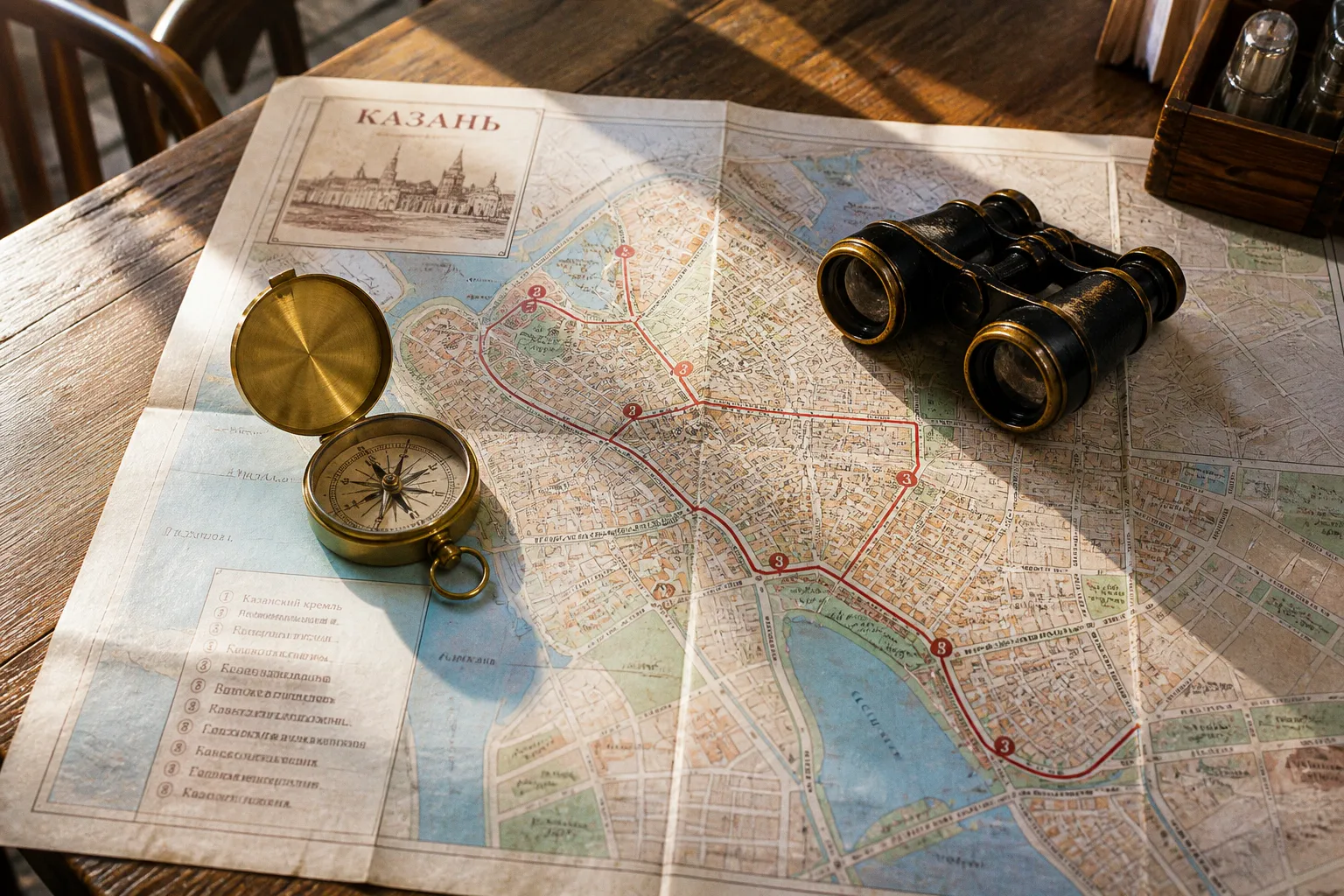
Kazan Travel Itinerary Options: Routes for Different Trip Lengths
The core walking route is approximately 8–10 kilometers, beginning at the Kazan Kremlin and continuing through Bauman Street, the Old Tatar Quarter, and the Lake Kaban area. That is manageable, but only if we allow for mosque visits, museum interiors, meal stops, pedestrian detours, and the slower pace required by a city where Russian and Tatar cultural landscapes overlap at street level.
Compare car rental deals in United Kingdom
See available offersPartner link — DiscoverCars comparisonHere is the catch: Kazan travel itinerary options are less about adding more sights than about deciding how much spatial and cultural context you want around the central landmarks. A compact day works for a first impression. Two days make the city considerably more breathable. Three days allow a proper cultural sequence, while four or five days open the route towards Sviyazhsk, Bolgar, and the Temple of All Religions without turning every morning into a race for transport.
The one-day route: an 8–10 km introduction to central Kazan
The one-day itinerary is the right choice when Kazan forms part of a wider Russian route—perhaps between Moscow and the Volga region, or as a carefully chosen stop on a longer Trans-Siberian railway trip. It gives us a coherent geographic progression rather than a loose collection of attractions, and that matters because Kazan’s center is walkable but not entirely flat in experience: the visual rhythm changes from fortress walls to pedestrian retail streets, then into older residential quarters and open water.
Begin at the Kazan Kremlin, ideally in the morning. The Kremlin grounds, Kul Sharif Mosque, and the Annunciation Cathedral complex are free to enter, although individual museums within the wider complex may have separate ticket arrangements and prices can change. The main value of starting here is orientation. From the elevated and fortified center, we can immediately understand the relationship between the historic core, the river plain, and the newer city beyond it.
Allow enough time for both the mosque and the cathedral. They are not interchangeable stops: one is an active Islamic religious space, the other an Orthodox cathedral, and the juxtaposition is central to the character of Kazan. Inside Kul Sharif Mosque, women should have their heads covered, and visitors are expected to dress respectfully. A scarf is easy to carry, and clothing that covers shoulders and knees avoids an awkward pause at the entrance.
From the Kremlin, continue towards Bauman Street, Kazan’s principal pedestrian artery. This is not simply a corridor between monuments. It is where the city’s practical life becomes visible: cafés, bookshops, souvenir stalls, street performers, and a steady mixture of residents and visitors. The route is at its most useful when we resist the temptation to treat Bauman Street as a checklist of façades. Use it as a decompression interval after the formal spaces of the Kremlin, with time for coffee or an early lunch.
The next stage is the Old Tatar Quarter, where the city’s architectural and cultural texture becomes more residential. Wooden houses, historic mosques, and lower-rise streets create a different scale from the Kremlin and central commercial district. This is where pacing becomes important. A one-day route should not be packed with every museum available; the point is to notice how the city changes as we move through it.
Finish around Lake Kaban, where the route opens out again. Depending on the season, light and temperature can make this a pleasant late-afternoon or evening conclusion, especially after several hours on foot. The full circuit is approximately 8–10 kilometers, so comfortable footwear is not an optional detail. Transit fatigue begins not with a dramatic collapse but with the gradual shortening of attention: the last museum becomes a blur, and the final meal is chosen solely because it is close. The better approach is to keep the final section open and let the lake area absorb whatever time remains.
A workable one-day sequence
1. Morning: Kazan Kremlin, Kul Sharif Mosque, Annunciation Cathedral, and selected museum interiors.
2. Late morning or early afternoon: Walk towards Bauman Street, stopping for a meal rather than treating lunch as an afterthought.
3. Afternoon: Continue through the Old Tatar Quarter, allowing for slower architectural observation and short indoor breaks.
4. Late afternoon or evening: Lake Kaban and a nearby dinner, with the option of using a local taxi if weather or fatigue has changed the plan.
This is one of the most efficient Kazan tourist routes because it follows the city’s historic spine. It also avoids the common mistake of starting with an outlying attraction and reaching the Kremlin when the day is already half gone.
The one-day route works because it is geographically disciplined: Kazan rewards a sequence through the city more than a scattered hunt for individual landmarks.
Kazan in two days: the better balance for first-time visitors
A Kazan 2 day itinerary gives us a more generous relationship with the center. Rather than extending the first day until the walking route becomes physically tedious, we can divide the city into a historic core and an outer-city sequence.
The first day can follow the Kremlin–Bauman Street–Old Tatar Quarter–Lake Kaban route described above, but at a less compressed pace. The second day then becomes available for places that sit outside the central walking circuit, including the Temple of All Religions, also known as the Universal Temple, in the village of Staroye Arakchino. It is approximately 20 minutes from central Kazan by taxi or bus, although actual travel time depends on traffic, departure point, and service conditions.
The Temple of All Religions requires a different kind of visit from the Kremlin. It is visually distinctive and sits outside the central historic fabric, so it should be treated as an excursion rather than something to squeeze between two city-center stops. The entrance fee is approximately 150 RUB according to current planning information, but operational prices should be confirmed close to departure.
After returning towards the city, the Kazan Family Center observation area can provide a contrasting view. The point is not to collect another elevated viewpoint simply because one exists. It is to shift the perspective: after seeing Kazan from within its historic center, we look back at the city as a layered urban landscape, with the older core positioned within a much larger modern settlement.
A two-day plan also creates room for the practical interruptions that are inevitable in regional travel. A delayed breakfast, rain across the Volga plain, a museum closed for a private event, or a long meal in the Old Tatar Quarter no longer destroys the entire schedule. This is particularly valuable during the shoulder seasons, when opening hours and outdoor comfort can fluctuate more than the timetable suggests.
Comparing the main itinerary lengths
| Route length | Geographic focus | Best for | Main pressure point |
|---|---|---|---|
| 1 day | Kremlin, Bauman Street, Old Tatar Quarter, Lake Kaban | A short stop within a larger Russian journey | Around 8–10 km of walking leaves little room for delays |
| 2 days | Central Kazan plus one outer-city excursion | First-time visitors wanting a balanced introduction | The outlying attraction needs a dedicated half-day |
| 3 days | Historic center, outer-city sights, and a slower cultural day | Travelers who want museums, food, and architectural context | Requires choosing rather than trying to include every venue |
| 4–5 days | Kazan plus regional excursions such as Sviyazhsk or Bolgar | Visitors using Kazan as a Volga-region base | Excursion logistics begin to shape the entire trip |
The three-day cultural itinerary: giving Kazan room to speak
Three days is the most adaptable format for travelers who want more than a quick visual introduction. It permits a natural division between the city’s major cultural zones, while preserving enough time for meals, weather changes, and the unplanned pauses that make an itinerary feel lived-in rather than mechanically completed.
Day one: the historic core
Keep the first day concentrated. Start at the Kremlin, then move through Bauman Street and into the Old Tatar Quarter before ending near Lake Kaban. The route is familiar, but the difference lies in how much time we assign to each section. A three-day visit allows us to enter selected museums rather than simply photographing their exteriors, and to return to a street or square later when the light and pedestrian flow have changed.
For lunch and dinner, Kazan’s food culture deserves deliberate attention. The city is a meeting point of Tatar, Russian, and broader Volga influences, so meals are not merely a logistical pause between attractions. Build in enough time for traditional Tatar dishes, but do not turn the search for one particular dish into a second itinerary. A flexible reservation strategy is usually more useful than a rigid restaurant pilgrimage.
Day two: the outer city and contemporary perspective
Use the second day for the Temple of All Religions and the Kazan Family Center observation area, or reverse the order if the day’s transport conditions make that more sensible. The Temple is around 20 minutes from central Kazan by taxi or bus under normal conditions, but we should not treat that estimate as a guarantee. Local traffic, waiting time, and the availability of a suitable return ride all affect the real duration.
For local taxis, services such as Yandex Go are standard in Russia. We should plan around locally used transport applications rather than assuming that an international ride-hailing account will provide familiar coverage or pricing. This is a small logistical point, but it can determine whether an outer-city visit remains a calm half-day or turns into an unnecessarily long negotiation.
The second day can also absorb the kind of sight that is difficult to schedule precisely: a market visit, a longer lunch, a return to a mosque or quarter seen briefly on day one, or an additional museum whose opening hours did not fit the initial plan. This flexibility is not wasted time. It is the buffer that protects the rest of the itinerary.
Day three: depth rather than distance
The third day should not automatically become another list of distant locations. Kazan is large enough that we can spend a full day within a relatively limited radius and still encounter new layers. Use this day for the interiors and subjects that were passed over earlier: religious architecture, regional history, Soviet and contemporary urban development, or the food traditions of the city’s Tatar communities.
A useful rhythm is to alternate enclosed and open-air experiences. After a museum or cathedral, walk through a neighborhood rather than immediately taking another taxi. After a long outdoor stretch, plan a warm meal or an indoor cultural stop. This is particularly important in winter, when low temperatures shorten practical walking windows, and in high summer, when heat and direct sun can make a ten-minute crossing feel much longer than it appears on the map.
The three-day format also allows us to revisit the Kremlin at a different time of day. The complex is not just a morning destination, and its relationship with the surrounding city becomes clearer when we see it after the commercial center has become busier and the light has shifted.
Four or five days: when Kazan becomes a regional base
An extended Kazan itinerary should not be built by stretching city-center sightseeing across five consecutive days. After two or three days, the more interesting question is whether we want to use Kazan as a base for regional routes.
Two of the most frequently considered excursions are Sviyazhsk and Bolgar. They are not interchangeable additions. Each requires a dedicated day and a willingness to trade the convenience of central Kazan for a longer regional excursion. The correct choice depends on the wider journey, the season, and how much transit fatigue we are prepared to absorb.
Sviyazhsk is best considered as a focused excursion with attention to its island settlement, religious sites, and landscape setting. Bolgar demands an even clearer commitment to regional travel and archaeological-historical context. Neither should be inserted casually between a morning in the Kremlin and an evening restaurant booking. The distance on the map is only one part of the calculation; departure schedules, return connections, weather, and the amount of walking at the destination matter just as much.
For travelers planning a four- or five-day stay, a practical structure might look like this:
1. Day one: Central walking route through the Kremlin, Bauman Street, the Old Tatar Quarter, and Lake Kaban.
2. Day two: Temple of All Religions and Kazan Family Center, with time reserved for transport variation.
3. Day three: Museums, religious architecture, food-focused exploration, and a slower return to the historic center.
4. Day four: Sviyazhsk as a dedicated regional excursion.
5. Day five: Bolgar, or a deliberately unhurried final day in Kazan if the previous excursions have created enough transit fatigue.
The final alternative is often the wiser one. A five-day stay does not need to prove its value by maximizing geographic coverage. If we have already traveled through Moscow or St Petersburg, or are continuing east towards Siberia and Lake Baikal, a rest-oriented day in Kazan can improve the entire journey. Long-distance travel has a cumulative effect on attention, sleep, and tolerance for complicated transfers, and the route should acknowledge that rather than pretend every day begins at full capacity.
Budgeting for a 2026 Kazan itinerary
Current planning estimates for a typical three-day trip in 2026 place the total at approximately 18,000–25,000 RUB per person, excluding major transportation to Kazan. This range assumes mid-range accommodation, ordinary meals, and local transport rather than luxury hotels, high-end dining, or extensive private excursions.
The approximate daily components are:
- Accommodation: around 4,000–6,000 RUB per night for a mid-range hotel.
- Food: around 1,500–2,500 RUB per day, depending on how often we choose sit-down restaurants and how generously we structure meals.
- Local transport: around 300–500 RUB per day for ordinary city movement, with outer-city taxi journeys adding to the total.
- Temple of All Religions: approximately 150 RUB for entrance, subject to operational updates.
- Museums inside the Kremlin complex: variable; the free access to the main grounds, Kul Sharif Mosque, and Annunciation Cathedral should not be confused with universal free admission to every museum.
The budget becomes less predictable when regional excursions are added. A dedicated trip to Sviyazhsk or Bolgar changes the transport profile, and the cost depends on the chosen mode, departure arrangements, and whether the excursion is self-guided or organized. It is better to keep a separate regional-transport allowance than to hide these journeys inside an overly optimistic city budget.
Accommodation location also affects the real cost of a visit. A cheaper room far from the central route may save money on paper but increase daily transit time and reduce flexibility. For a one-day itinerary, staying near the historic center has particular value because it protects the walking loop from being consumed by morning and evening transfers. With four or five days, a slightly farther location can work if it has reliable public transport and easy access to local taxi services.
Access, etiquette, and the practical texture of the route
Kazan’s major attractions are straightforward to combine, but the city is more comfortable when we plan for cultural spaces as functioning places rather than decorative stops. The Kremlin contains both Islamic and Orthodox religious sites, and visitors should move through them with the same basic respect expected in any active place of worship.
For the mosque, women should carry a head covering and all visitors should dress modestly. These requirements are simple to accommodate, particularly if the day includes several indoor visits. A scarf, comfortable layers, and shoes that are easy to remove when required can save time and avoid inconvenience.
The central route is walkable, but the walking distance should be interpreted honestly. Eight to ten kilometers may sound modest to experienced hikers, yet city walking includes hard surfaces, pauses at crossings, stairways, queues, and frequent changes in pace. Add the elevation changes around the central districts, weather exposure, and the mental effort of navigating unfamiliar streets, and the day can feel longer than the distance suggests.
We should also leave space around the most important transitions:
- Do not schedule an outlying attraction immediately before a timed museum entry in the center.
- Keep the first morning light if arriving after an overnight train or a long flight; transit fatigue rarely disappears because the itinerary says it should.
- Use a local taxi application for journeys that would otherwise require multiple connections, especially when returning from Staroye Arakchino.
- Treat museum ticket details as changeable and verify them close to the visit rather than relying on an old itinerary.
- In winter, shorten the outdoor sections and build in warm indoor pauses; seasonal river transport assumptions should not be carried over from summer planning.
- In summer, protect the middle of the day from over-scheduling, particularly when the route includes long open stretches and little shade.
The best way to visit Kazan is not to fit every landmark into one day; it is to match the route length to the amount of walking, waiting, and cultural attention the day can actually support.
Choosing the right route for the season
Seasonal timing changes the balance between the itinerary options more than it changes the list of sights. In late spring and summer, the one-day central loop is at its most comfortable for travelers who enjoy long walks, and Lake Kaban or the observation area can provide a natural evening finish. Daylight supports a slower pace, although heat and sun exposure still require sensible breaks.
Early autumn is particularly well suited to the two- or three-day format. The city can be explored on foot without forcing every outdoor section into the hottest part of the day, and a regional excursion can sit naturally within a longer cultural stay. The exact conditions vary, so the route should remain adjustable rather than built around a single outdoor attraction.
Winter calls for a different itinerary architecture. The Kremlin, museums, mosques, cathedrals, restaurants, and indoor cultural spaces become the anchors, while extended walks through Bauman Street, the Old Tatar Quarter, and around Lake Kaban should be divided into shorter segments. Outer-city excursions can still be worthwhile, but we should not assume that summer transport patterns, river options, or daylight conditions will carry over unchanged.
For most first-time visitors, three days offer the strongest balance: the historic center remains coherent, the Temple of All Religions and the Kazan Family Center can be incorporated without haste, and there is still room for a museum, a long meal, or a weather-related adjustment. One day is sufficient when Kazan is a carefully chosen stop on a larger route. Two days are better for an introduction without pressure. Four or five days make sense when the wider region—not only the city itself—is part of the purpose.
Kazan rewards that kind of calibrated planning. Its geography is manageable, but its layers are not superficial, and the itinerary should give them time to register. Start with the Kremlin, move through the city’s central streets, allow the Tatar quarter and the lakeside districts to change the scale of the journey, and only then decide whether the Volga-region excursions belong in the same trip. With the pacing set correctly, Kazan becomes less a stop between destinations and more a grounded, navigable chapter in a journey across Russia.