Casa Batlló tickets: Blue vs Gold entry options
The catch that catches most first-time visitors to Casa Batlló on Barcelona’s Passeig de Gràcia is this: the building is open from nine in the morning to ten at night, every day of the week, and yet it is not one product.
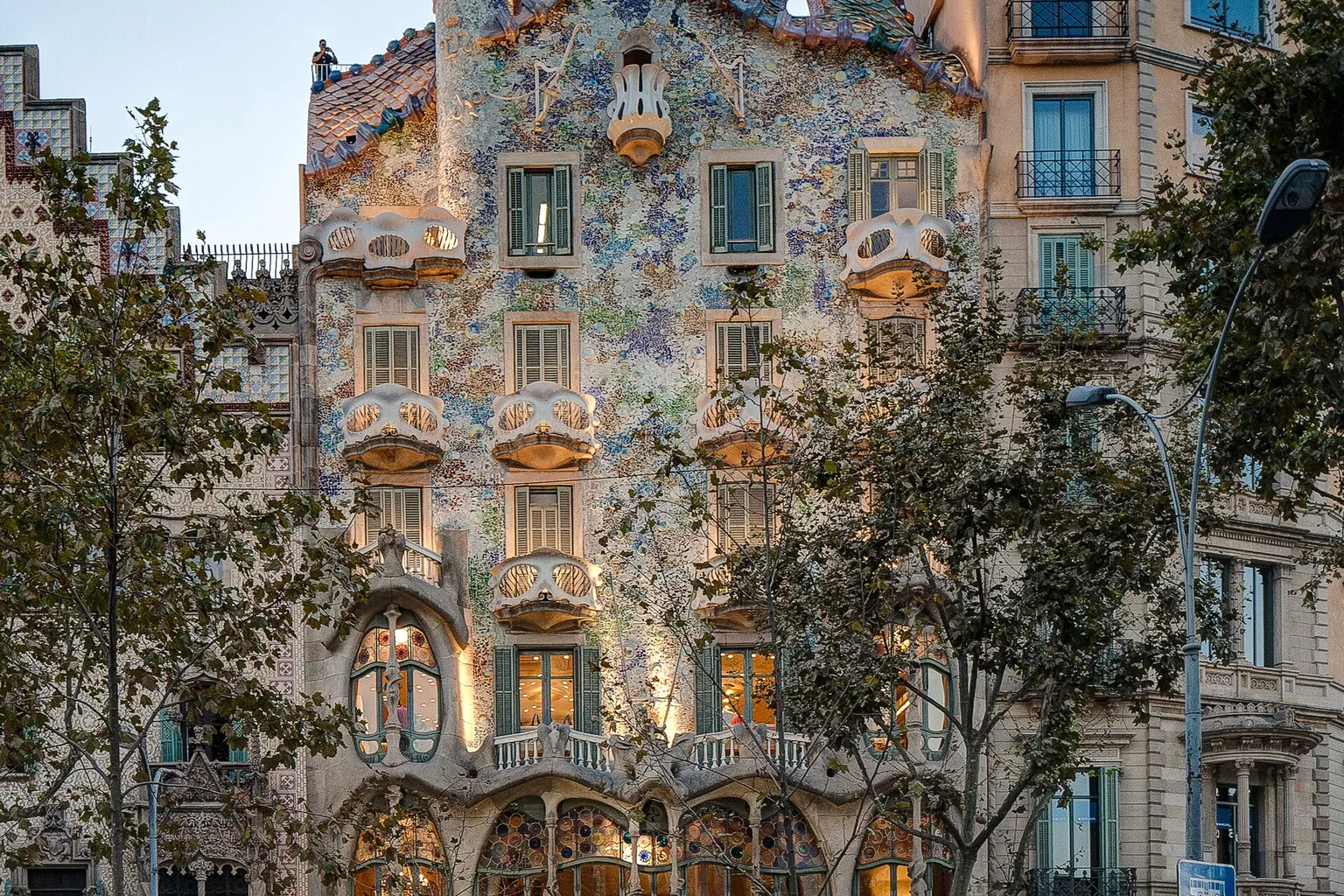
It is four products stacked like the layers of a Gaudí cornice. The difference between them is not merely a matter of adding a guide or paying for a slightly better view; each tier opens a different part of the building and shapes the pace of the visit.
Tickets and prices
Casa Batlló
I
Save
Box office and online booking
- Adult €35
- Child €6
- Reduced €3
€35
Official websiteII
Our pick · guided tour
Self-guided tour with audio guide
This self-guided tour includes entry and an audio guide to learn about the architect.
€29
Check availabilityIII
guided tour
Self-guided tour with live rooftop music
This two-hour self-guided tour includes entry and an open-air concert on the rooftop terrace with views of the city.
€59
Check availabilityThis is the single most useful thing to know before you book: the ticket you pick determines which Casa Batlló experience you are actually buying. Blue gives you the main architectural visit and the audio guide. Silver adds the Dragon’s Rooftop. Gold expands the route into the immersive rooms and private spaces. Platinum keeps the Gold itinerary but adds booking flexibility and priority access at the entrance.
Below, we walk through the four tiers in the order you actually experience the rooms — from the threshold inward.
Decoding the Blue Tier: Standard Access and the Audio Guide
The Blue tier is the entry-level admission, and it earns its place in any honest comparison because it is more substantial than the name suggests. Blue covers general entry to the main floor, the Noble Floor, the attic — the famous bone-vaulted loft where the laundry lines once hung — and the lower galleries that lead you through the building’s spine. Crucially, Blue also includes the Gaudí Cube, the 360º immersive room that wraps the architecture around you before you even start climbing the staircase.
That route already contains the parts of Casa Batlló most visitors come to see: the undulating rooms, the coloured light, the unusual ventilation details, the skeletal attic and the building’s carefully choreographed vertical movement. Blue is not a glimpse through the lobby or a shortened corridor tour. It is the standard visit, with the central architectural sequence intact.
The audio guide, which is bundled into the Blue ticket, runs in 15 languages. This matters more than it sounds. Gaudí’s organic geometry is the kind of detail that rewards narration, and the commentary gives context to what might otherwise appear as a series of beautiful but disconnected surfaces. A curved wall becomes part of a ventilation solution; a fragment of blue tile relates to the building’s broader colour system; the attic’s structural rhythm starts to read as a deliberate piece of engineering rather than an eccentric decorative choice.
For travellers who are moving quickly through Barcelona — one morning slotted between the Sagrada Família and an afternoon flight — Blue delivers the bones of the visit without committing the entire day. It is also the sensible choice when Casa Batlló is one stop in a broader Modernisme itinerary and you want time for Casa Milà, the surrounding Eixample streets or another museum.
What Blue does not include is equally important. The rooftop terrace, the AR tablet, the Gaudí Dôme immersive room, the Original Concierge Room and the Private Residence of the Batllós all sit outside this tier. None of those omissions makes Blue incomplete, but they do define its limits.
The Blue ticket is a full museum visit, not a preview. Its decisive omission is the rooftop — and that is the boundary that separates Blue from Silver.
The best way to read Blue is therefore not as the “cheap” version of every other ticket. It is the focused version: the principal rooms, the audio commentary and the main Gaudí Cube experience, without the additional spaces or the more elaborate technology.
The Silver Upgrade: Adding the Dragon’s Rooftop
Silver is the first meaningful step up from Blue because it changes the physical route through the building. It includes everything Blue covers and adds the Dragon’s Rooftop, the wraparound terrace where Gaudí’s chimneys rise like a procession of helmeted warriors and the curved trencadís back of the dragon lies open to the sky.
That is the cleanest answer to the Casa Batlló Blue vs Gold question as well as to the more immediate Blue-versus-Silver choice: Blue takes you through the principal interior visit; Silver adds the rooftop. Gold then adds further rooms and technology to the Silver itinerary. The rooftop is not a feature that suddenly appears only in Gold.
For most first-time visitors, this is where the decision becomes real. Do you want to stand on the rooftop, or are you content to have looked at it from the street? Everything else in the comparison flows from that answer. Silver is the value choice for travellers who came to Casa Batlló specifically for Gaudí’s architecture rather than for a museum-with-tech experience. The rooftop is what makes that focus feel complete.
The terrace is not simply an elevated photo stop. It explains the building’s famous exterior from the inside out. From the street, the roof reads as a colourful dragon’s spine, but at close range its chimneys, ceramic fragments and curved surfaces become a sequence of individual design decisions. The roof is also where the building’s theatrical quality is most obvious: the architecture is functional, but it is never content to look merely functional.
If the weather is clear, the rooftop gives the visit an additional relationship with the Eixample. Casa Batlló stops being an isolated façade and becomes part of the block: the ordered streets, the neighbouring Modernista buildings and the dense urban grid all appear behind Gaudí’s more fluid forms. That wider view is one reason the Silver upgrade feels more consequential than a minor add-on.
In practical terms, the rooftop visit is paced by the same one-way flow as the rest of the building. You do not loop back through the interior once you have completed the route; you exit through the rooftop staircase into the gift shop. That means the time you spend up there counts against your overall visit, and the terrace has a tendency to hold visitors — phones out, sunlight shifting over the Eixample block grid — longer than expected.
If you have a hard lunch reservation a few doors down on Passeig de Gràcia, build a small buffer into the timing. The risk is not that the route is complicated. It is that Casa Batlló offers too many details that are easy to stop for: a tile pattern, a chimney, a view over the avenue, another angle of the dragon’s back. Silver works best when the rooftop is treated as part of the visit rather than as an optional photograph squeezed in at the end.
Gold and Platinum Tiers: Immersive Tech, Private Rooms, and Priority Access
Gold is the tier to consider when the rooftop is no longer the destination but only the beginning. Gold includes everything Silver covers, then layers on the Augmented Reality tablet, the Gaudí Dôme immersive room, access to the Original Concierge Room and the Private Residence of the Batllós — the rooms where the family actually lived, preserved in a way that the main visit only hints at.
This changes the emphasis of the experience. Silver is primarily an architectural route with a decisive exterior component. Gold is more expansive: it asks you to spend longer with the interpretive layer, the immersive technology and the domestic history of the house.
The AR tablet is the feature most worth understanding before paying for the upgrade. It is not a substitute for the audio guide. Instead, it adds a visual layer to the rooms you are already standing in, using digital reconstruction to show how certain spaces and details can be understood in relation to Gaudí’s original ideas. For travellers who already know the Sagrada Família and want to understand how the same architect worked at a domestic scale, this is where Casa Batlló opens up differently.
The distinction matters because the building can be admired in two ways. You can follow the physical sequence — room, staircase, attic, rooftop — and allow the materials to do most of the work. Or you can spend more time asking how the building was conceived, how the spaces were used and how the finished surfaces relate to the architect’s planning. Gold is designed for the second kind of visit.
The Original Concierge Room and the Private Residence of the Batllós add another layer. Casa Batlló is often discussed as an exterior landmark, but it was also a home. The private rooms make that domestic scale more visible: the building was not created only to be seen from the avenue, and its famous theatrical details were integrated into everyday residential life.
For a first visit, Gold is most defensible when you have enough time to use those additions rather than simply moving through them because they are included. If your schedule allows only a quick morning visit, Silver may provide a more coherent experience. Gold becomes stronger when Casa Batlló is one of the main cultural stops of the day.
Platinum sits on top of Gold and keeps the same expanded itinerary. Its additional value is logistical rather than architectural: priority pass access that skips the standard entry queue, a flexible date change and free cancellation.
The priority pass should be understood precisely. It gives you priority access through the standard entrance queue; it does not mean that every other stage of the visit disappears or that entry is guaranteed at any moment without regard to the ticket’s conditions. In a busy period, that reduction in queue exposure can make the arrival considerably easier, particularly for travellers working around timed plans elsewhere in Barcelona.
The flexible date change is the more practical benefit for many international visitors. When a trip has been planned months in advance, an itinerary can shift because of flights, weather, a delayed train or a change to another timed attraction. Platinum gives the booking more room to absorb that change. Free cancellation provides a further layer of protection, subject to the conditions attached to the booking.
Platinum does not give you a different Casa Batlló. It gives the Gold itinerary more breathing room: priority access at the entrance, plus flexibility when the rest of the trip refuses to stay fixed.
| Tier | Rooms and route | Tech layer | Rooftop | Logistics edge |
|---|---|---|---|---|
| Blue | Main floor, Noble Floor, attic and Gaudí Cube 360º | Audio guide in 15 languages | Not included | Standard timed entry |
| Silver | All Blue rooms plus the Dragon’s Rooftop | Audio guide | Included | Standard timed entry |
| Gold | All Silver spaces plus the Gaudí Dôme, Original Concierge Room and Private Residence of the Batllós | Audio guide and AR tablet | Included | Standard timed entry |
| Platinum | Gold itinerary with Platinum booking benefits | Audio guide and AR tablet | Included | Priority access at the entrance, flexible date change and free cancellation |
Essential Logistics: Opening Hours, Age Rules, and the Night Visit Option
Casa Batlló runs daily from 9:00 AM to 10:00 PM, with last entry at 9:00 PM. Those hours make it easier to fit the building into a crowded Barcelona itinerary, but they can also make the ticket choice feel less urgent than it is. A late opening window does not mean that every tier or every time slot will remain equally convenient.
Children aged 0 to 12 enter free across the general-visit categories. That makes the building unusually workable for a family itinerary, although the route still needs to be paced sensibly. The attic and rooftop include stairs and changes in level, and younger visitors may not experience the building at the same speed as adults who are stopping mainly for photographs and architectural details.
For families, Blue can be an efficient way to see the principal interiors without overloading the day. Silver is the more natural choice when the rooftop is the part the children are most interested in. Gold may be worthwhile if the adults in the group want the additional interpretive material, but the technology does not automatically make the visit easier for a family with limited time. More included features can also mean more decisions about where to stop.
The 2026 calendar is a special case. Antoni Gaudí’s centenary year is drawing additional programming, including temporary exhibitions and evening events, with longer evening hours on certain dates. That can affect both availability and the way visitors distribute themselves across the day. The official booking calendar is therefore more useful than relying on a general assumption that a late slot will always be available.
Booking the tier you actually want a few weeks out is the sensible hedge against either price changes or your preferred time disappearing. This is particularly relevant if the rooftop is non-negotiable. Choosing Blue because it is available and hoping to upgrade later may leave you with a less convenient arrangement, depending on the conditions of the booking and the availability of the higher tier.
There is also an evening alternative worth knowing about: the Night Visit with Live Music on the Roof Terrace, which runs as a separate timed experience and may be available through third-party providers. This is not a substitute for the day tiers. It is a different shape of visit, focused on the rooftop after dark with a live set beneath the trencadís chimneys.
For travellers who have already completed a daytime Casa Batlló visit on a previous trip, or for those whose only window in Barcelona is after dinner, the night experience can be a good way to return to the building without repeating the full daytime route. It should not, however, be treated as a replacement for Gold if your priority is the AR tablet, the Gaudí Dôme or the private rooms. Those are different products with different purposes.
Within the 9:00 AM to 10:00 PM opening window, timing still affects the feel of the visit. The morning opening, roughly between 9:00 and 11:00, tends to be the calmer choice in shoulder season. Late afternoon, roughly between 4:00 and 6:00, can be more exposed to accumulated visitor traffic at the entrance. These are planning tendencies, not guarantees, and special programming or seasonal demand can change the pattern.
If your tier does not include priority access, arriving with enough time before the rest of the itinerary matters more than trying to predict the exact length of the queue. Platinum reduces exposure to the standard entry line, but it does not remove the need to respect the timed booking or the operational flow of the attraction.
Strategic Booking: Matching the Tier to the Kind of Day You Have
We think about this less as “which ticket is best” and more as “which day are you actually planning?” The four tiers map onto four different shapes of visit, and the choice gets easier when you name what the day is for.
For the first-time visitor with one morning in the Eixample and a Sagrada Família ticket booked for the afternoon, Silver is usually the right answer. You want the rooftop; you do not necessarily need the AR tablet; and you would rather keep enough time to walk through the neighbourhood, stop for lunch or look at La Pedrera’s chimneys from the street.
Blue works when the schedule is tight or when Casa Batlló is one part of a larger architectural day. It is also appropriate for travellers who are more interested in the main sequence of rooms than in the additional private spaces. The audio guide gives the visit structure, while the Gaudí Cube provides a strong immersive element without turning the entire experience into a technology-led tour.
For the Gaudí-focused traveller — someone who has read about the architect, knows the difference between the Casa Milà attic and the Casa Batlló attic, and plans to spend a substantial part of the morning in the building — Gold is the tier that lets the house deliver more of what it contains. The AR tablet and the private rooms are not essential to understanding Casa Batlló, but they make the visit broader and more interpretive.
Gold is also the better fit when you want to compare the public image of the house with its residential reality. The façade may be the reason you arrive, but the private spaces explain how the building functioned as a home. The additional rooms are most valuable when you are willing to slow down rather than treat them as a list of inclusions.
For the family or the traveller booking from abroad several months out, Platinum is the option to examine first. Its flexible date change can be useful when the rest of the itinerary is still vulnerable to change, while priority access at the entrance makes arrival less dependent on the standard queue. The point is not that Platinum guarantees an effortless entry under every circumstance; it is that it reduces one source of uncertainty.
For the repeat visitor, the Night Visit with Live Music on the Roof Terrace is the most honest use of a second evening. It is not the same product as any of the day tiers, and it is not trying to be. It is the rooftop after dark, with music and a different atmosphere. If you have already seen the principal interiors, that distinction is an advantage rather than a limitation.
A simple way to make the choice is to ask four questions:
1. Is the rooftop essential? If yes, start with Silver rather than Blue.
2. Do you want the interpretive technology and private rooms? If yes, Gold is the relevant upgrade.
3. Is the booking likely to move? If yes, compare Platinum’s flexible date change and cancellation terms with the lower tiers.
4. Are you visiting again at night? If yes, consider the Night Visit as a separate experience rather than trying to force it into the day-ticket comparison.
If we were closing with a single piece of seasonal advice, it would be this: choose the tier before you choose the time. A calm early slot cannot turn Blue into Silver, and a late visit cannot replace the private rooms included in Gold. First decide which part of Casa Batlló you want to enter; then fit that choice into the day you have.
The four tiers are not simply upsells of one another. They are four doors into the same building. Blue gives you the central architectural visit. Silver adds the Dragon’s Rooftop. Gold expands the route with immersive technology and private rooms. Platinum keeps that full itinerary but adds priority access and booking flexibility. What changes is the part of the house you stand inside — and how much room the rest of your Barcelona day has to move around it.
Practical info
Currency: EUR
Driving: on the right
Emergency number: 112
Key facts
Built: 1877
Architect: Antoni Gaudí
Heritage status: bien de interés cultural
Official website: casabatllo.es
FAQ
What is included in the Blue Casa Batlló ticket?
Does the Silver Casa Batlló ticket include the rooftop?
What is the difference between Casa Batlló Silver and Gold tickets?
What does the Platinum Casa Batlló ticket add?
What are Casa Batlló’s opening hours?
Do children enter Casa Batlló for free?
Photo: ChristianSchd / CC BY-SA 3.0 — Wikimedia Commons