Superblue Miami tickets: booking traps that cost you money
Walk-in ticket counters at Superblue Miami operate with limited inventory. Timed-entry sessions may sell out before the day of the visit, particularly when demand is high or a large number of visitors are planning around the same dates.
Arriving without a pre-booked ticket can therefore leave you with two unattractive options: pay a higher on-site rate if inventory remains, or leave without entering.
Tickets and prices
Superblue Miami
I
Save
Box office and online booking
- Adult USD32
- Reduced USD5
USD32
Official websiteII
entry ticket
Entry ticket · 2 hours
This two-hour entry ticket allows you to explore a mirrored maze, interact with digital works, and see your heartbeat to the glow of 3,000 lights.
€32
Check availabilityThat is the basic mistake behind most expensive Superblue Miami booking decisions. Visitors treat a 50,000-square-foot immersive art venue in Allapattah like a conventional museum where the next available ticket is usually waiting at the door. Superblue does not work that way. The date, entry time, ticket channel, refund terms and exhibit inclusions all affect the real cost of admission.
The booking process contains several separate traps. None is especially difficult to avoid, but each one depends on reading the offer carefully before payment rather than relying on assumptions. The cheapest-looking ticket is not always the least expensive choice once a missed visit, an omitted add-on or a family booking is taken into account.
The Hidden Cost of Dynamic Pricing and Walk-ins
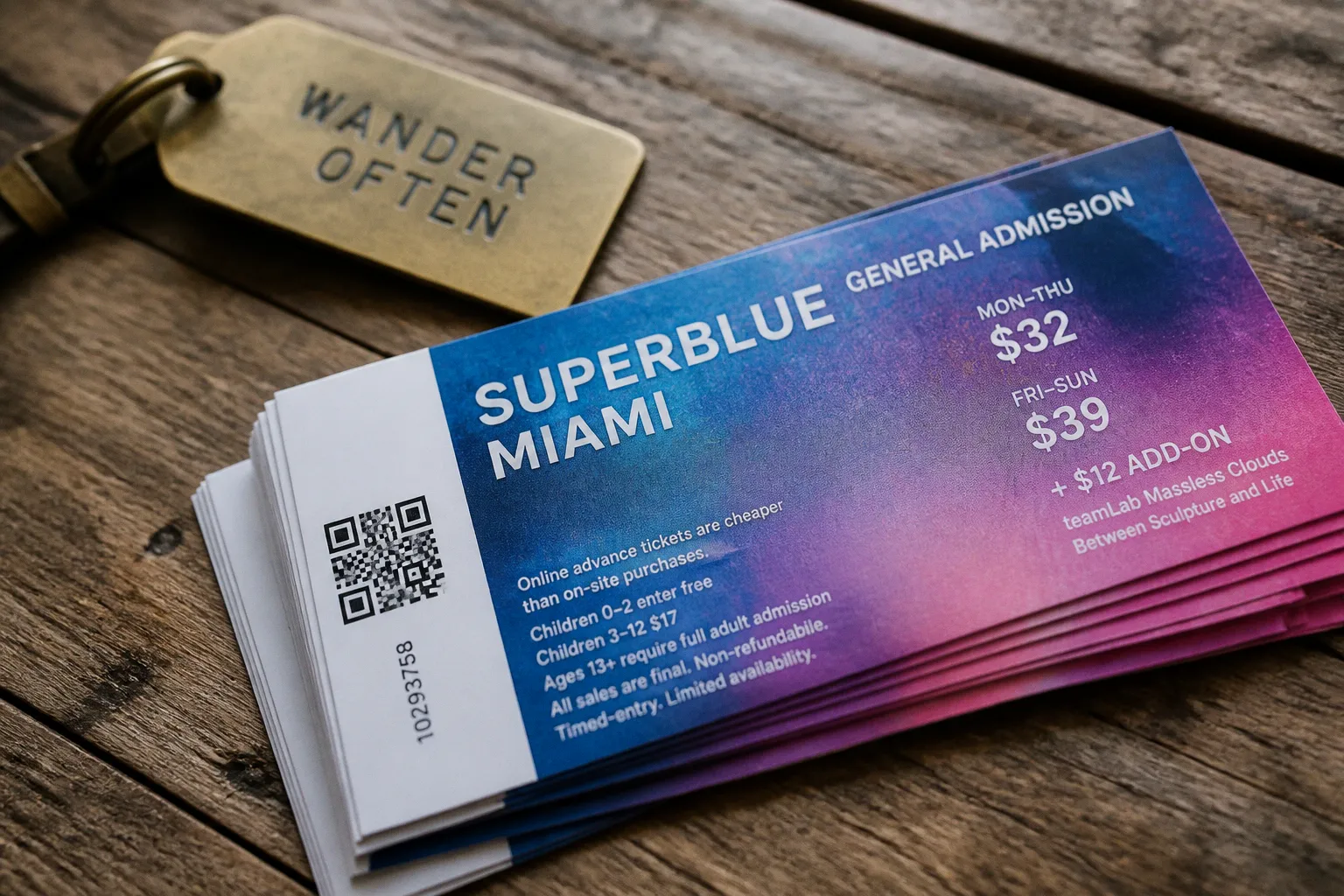
Superblue Miami uses tiered daily pricing. The week is divided into a lower-cost weekday tier, covering Monday through Thursday, and a higher-cost weekend tier, covering Friday through Sunday. The structure applies to standard adult admission purchased online.
The difference between the two tiers can be meaningful. If your itinerary has even a small amount of flexibility, moving the visit from a weekend to a weekday may reduce the cost of every adult ticket in the group. For a solo visitor, that may be a modest saving. For a family or a larger party, the same shift affects the entire booking.
This is the first calculation to make when comparing Superblue Miami ticket prices:
- Start with the dates you can actually visit.
- Compare the weekday and weekend rates for those dates.
- Multiply the difference by the number of paid visitors.
- Add any exhibit or experience upgrade before deciding which option is cheaper overall.
A lower weekday ticket is useful only if the day works with your transport, hotel and other reservations. A nominal saving can disappear if changing the visit creates a separate cost elsewhere. The point is not to force every trip into a weekday slot; it is to avoid paying the weekend premium by default when the itinerary does not require it.
Walk-in purchases create a second layer of risk. On-site tickets may carry higher rates than advance online bookings, and the box office is still limited by the availability of timed-entry sessions. Staff cannot create a place in a full session simply because a visitor has arrived in person. If the preferred time is unavailable online, there is no reason to assume that the counter has a hidden reserve.
Current availability should decide the fallback. If the official booking page shows open sessions, compare the available online option with any on-site alternative before leaving for the venue. If the date is busy or your schedule cannot absorb a failed attempt, a walk-in should be treated as a contingency rather than a booking strategy.
Online advance booking gives you the clearest view of the available time slots and usually avoids the extra cost and uncertainty of buying at the door.
The practical rule is straightforward: book online, compare the weekday and weekend tiers, and treat a walk-up purchase as a last resort. The most reliable way to buy Superblue Miami tickets is not necessarily the cheapest headline price; it is the option that secures the right session before the inventory changes.
Official vs. Third-Party: Navigating Refund Policies
The price on the first ticket page you find is only one part of the decision. The more consequential difference between channels is often the cancellation policy.
Superblue Miami tickets may be available through an official partner platform such as Fever and through third-party resellers such as Viator or GetYourGuide. Those channels can present different prices and different rules for cancellation, date changes and service fees. A ticket that costs less at checkout may also expose you to the full loss of the purchase if your plans change.
The two approaches can be understood as a trade-off:
Official partner platforms, such as Fever
- The base price is generally lower than the price offered by a reseller.
- Sales are final under the stated terms.
- Refunds and cancellations are not available under the standard non-refundable conditions.
- Date changes are not automatically permitted.
- The offer is often the simplest route when the date and time are already certain.
Third-party resellers, such as Viator or GetYourGuide
- The listed price may be higher.
- Some offers include free cancellation within a stated period, commonly up to 24 hours before the scheduled entry time.
- A full refund may be available when the cancellation meets that platform’s terms.
- Service fees or different booking conditions may apply.
- Date changes depend on the individual listing, not on the general reputation of the reseller.
The exact terms belong to the specific offer. Do not assume that every ticket sold by one platform has identical conditions, or that a reseller’s cancellation policy applies to every Superblue listing. Open the cancellation and inclusions sections before entering payment details. If the wording is unclear, the price difference is not yet meaningful enough to compare.
| Parameter | Official partner offer | Third-party reseller offer |
|---|---|---|
| Base price | Often lower | Often higher |
| Cancellation | Usually non-refundable under the stated terms | May include a cancellation window |
| Date changes | Generally restricted | Depends on the individual listing |
| Service fees | Usually shown within the booking total | May be presented separately or included in the final total |
| Suitable for | Fixed travel plans | Itineraries with some schedule risk |
The choice depends on the stability of your trip. If your flights, hotel and local schedule are confirmed, the lower-cost official option may make sense. If the visit depends on weather, a changing itinerary or an uncertain connection, the cancellation feature can justify paying more. It is not a discount, but it can protect the value of the booking.
Read three things before payment:
1. The final total, including taxes or service fees shown at checkout.
2. The deadline for cancellation, expressed in the platform’s local time if applicable.
3. Whether the ticket can be changed, or only cancelled and refunded.
A common mistake is to notice the words free cancellation in a search result and stop reading. The booking may have a deadline, a different rule for late cancellations, or restrictions on date changes. Another mistake is to compare a refundable reseller ticket with a non-refundable official ticket as if the two products were identical. They are not. One includes flexibility as part of the price.
A non-refundable ticket is cheaper only when you are confident you will use it. Otherwise, the cancellation window is part of the ticket’s value, not an unnecessary surcharge.
For anyone searching for Superblue Miami discount tickets, a reseller with flexible terms is not automatically a bargain. Calculate the complete price against the amount you could lose if the trip changes. The right choice is the one that matches the level of risk in your itinerary.
The Massless Clouds Add-on Trap
Standard general admission to Superblue Miami does not automatically mean access to every experience presented at the venue. TeamLab’s Massless Clouds Between Sculpture and Life is handled as a separate add-on in the booking flow. Depending on the platform and the offer, it may be sold separately or included in a package.
That distinction matters because the add-on is charged per visitor. For a family, the additional cost is multiplied across the group. A ticket that looks affordable in the first search can become considerably more expensive after the exhibit is added for everyone who needs access.
The booking page may display the standard admission price first and present the upgrade later. On another platform, the same experience may appear in the title or inclusions list of a bundled ticket. The names are not always presented in the same order, which is why the final comparison has to be made using the complete inclusions list rather than the first price displayed.
Before completing a purchase, establish four points:
- Whether Massless Clouds Between Sculpture and Life is included in the selected ticket.
- Whether the add-on is required for each visitor or only for selected members of the party.
- Whether children in the group need their own add-on.
- Whether the upgrade can be purchased later, subject to availability and the platform’s terms.
If the exhibit is important to your visit, adding it during the original booking is the safer approach. On-site availability should not be assumed. A venue may have capacity for general admission while the additional experience has different availability or booking conditions. Even if an upgrade is available at the door, buying it separately can make it harder to keep the group on the same schedule.
The opposite mistake is also possible: paying for an add-on that not everyone in the party intends to use. For adults, children and companions with different interests, examine the ticket types individually. The goal is not to attach every available upgrade automatically. It is to make sure the people who expect to see the installation have access to it, while the rest of the group is not charged by accident.
A useful way to read any offer is to ignore the large headline price until you have answered these questions:
- What does general admission cover?
- What is listed under exclusions?
- Is the named installation included or optional?
- Does the total update when the number of visitors changes?
- Are all members of the party assigned to the same entry session?
Do not use the word included loosely. A package may include the exhibit but still apply separate rules to cancellation, timed entry or age-based pricing. The add-on and the refund policy must be checked together.
Maximizing Savings for Florida Residents and Families
Florida residents and families have different ways to reduce the cost of admission, but neither saving is automatic. The booking method, age of each child and proof required at entry all matter.
Florida resident rates
Discounted Florida resident rates are available through online booking and are not intended to be purchased at the box office. Valid state identification is required when you arrive. The offer may apply across both weekday and weekend pricing tiers, with the weekday resident rate representing the lowest adult price point in the structure described here.
If you hold a Florida ID and can visit from Monday through Thursday, compare that combination first. It gives you two separate price advantages: the resident rate and the lower weekday tier. If your schedule only allows a weekend visit, the resident rate may still reduce the cost, but do not assume that it will match the weekday price.
The resident offer also requires careful handling when the group includes visitors who do not qualify. Booking platforms may support mixed-rate reservations, while others may require separate orders. A split booking can create a logistical problem if one order receives a different entry time from the other.
Before separating a family reservation, check:
- Whether all tickets can be assigned to the same timed-entry session.
- Whether the platform allows resident and non-resident tickets in one cart.
- Whether the resident guest must be present with identification at entry.
- Whether the add-on is selected for the same members of the group in both orders.
The lowest rate is not useful if the booking leaves part of the family outside the same session. If the platform requires two transactions, compare the available times immediately before paying for either order.
Children’s tickets
Age categories affect both the base admission and any associated add-on. Under the terms used in the draft booking structure:
- Children aged 0–2 enter free and do not require a standard ticket.
- Children aged 3–12 require a reduced child-rate ticket.
- Visitors aged 13 and above are charged the adult admission rate.
Check the child’s age on the date of the visit, not merely at the time of booking if the birthday falls near the travel date. The booking system may ask for the number of children rather than their individual birth dates, but the responsibility for selecting the correct category remains with the buyer.
The same attention is needed for Massless Clouds. General admission and exhibit access are separate decisions. If children aged 3 and above are joining the installation, confirm that the add-on is selected for them as well. Do not assume that a free admission category automatically includes every paid experience, and do not assume that a child ticket includes an upgrade simply because an adult ticket in the same package does.
Booking the family without losing the timing
The cleanest arrangement is usually a single transaction with one session for the whole group. Splitting tickets between different orders introduces the possibility of different times, different cancellation rules or different inclusions.
When a single transaction is not possible, build the reservations in parallel:
1. Select the preferred session and note the remaining availability.
2. Complete the resident or special-rate booking only after confirming that the same session is still available for the other visitors.
3. Check the final confirmations for identical dates and entry times.
4. Save every confirmation in the same place, including separate add-on details.
5. Recheck the terms before making a later change; a modification to one order may not update the other.
This is especially important for families with young children. A small price saving can be outweighed by a long wait between separate entry times. The booking should be judged as a group arrangement, not as a collection of isolated tickets.
For families, the real price is the total for the group at one workable entry time. A cheaper ticket in a separate session can create the more expensive day.
Timed-Entry Logistics and Venue Capacity
Superblue Miami operates on timed entry. The ticket is tied to a particular session, and the existence of a ticket does not mean that you can arrive at any point during the day.
Arriving early does not normally provide automatic access to an earlier session. You may have to wait for the time printed on the booking. Arriving late can also create a problem: entry may depend on current capacity and the venue’s operating rules, and there is no reason to plan around an assumed grace period.
The safest approach is to treat the entry time as an appointment. Build enough margin into the route to account for traffic, parking, public transport and finding the entrance in the Allapattah area. Superblue Miami is not located in the Beach or Brickell corridors, so visitors staying in those areas should not estimate the journey by neighborhood familiarity alone.
Aim to arrive around 15 minutes before the scheduled entry time. That buffer is not a promise of early admission; it is protection against arriving after the relevant session has begun. Keep the confirmation accessible and make sure every member of the group knows which session they are using.
Choosing a session
There is no universal best time for every visitor. Crowd levels and available inventory depend on the date, the day of the week, the season and the number of people trying to book at that moment. Current availability is more reliable than a fixed rule about which weekday or hour is always quietest.
Morning sessions may appeal to visitors who want to begin the day at the venue and avoid building the rest of their itinerary around a late appointment. Afternoon sessions may fit better with hotel checkouts, family schedules or other activities. Late-afternoon entry can be convenient for some itineraries, but it should not be described as consistently quieter or easier to book. The available sessions and their capacity change with demand.
Use the booking calendar as a practical signal:
- If several sessions remain open, choose the time that gives you the most comfortable route and the least risk of rushing.
- If only isolated times remain, secure a workable session before arranging transport around an ideal one.
- If a preferred date is nearly full, compare adjacent dates rather than assuming the box office will have extra inventory.
- If a later session is available but conflicts with dinner, a performance or a transfer, remember that the ticket is not a flexible day pass.
The installations reward unhurried movement. Most visitors should allow roughly 90 to 120 minutes for the visit, while leaving additional time for arrival and any queue at the entrance. The exact duration depends on pace and interest, but planning a rapid visit between two tightly spaced reservations is a poor use of a timed ticket.
Capacity, queues and re-entry
A timed-entry session controls the flow of visitors; it does not guarantee that every installation will be empty. Interactive works can attract visitors at different speeds, and a popular room may feel slower even when the overall venue is operating normally. If photography or extended observation matters to you, allow time rather than trying to optimize the visit down to the minute.
There is no re-entry. Once you leave, the ticket is treated as used. Bring what you need before entering, including water or any essential items permitted under the venue’s current rules. Plan a meeting point outside if your party may separate, because leaving to find someone can end the visit for the person who exits.
The same principle applies to late arrival. Do not book a session that requires a perfect connection from the airport, a distant attraction or a restaurant reservation immediately beforehand. A ticket can be inexpensive and still become a wasted purchase if the itinerary gives you no margin.
A Practical Backup When Your Preferred Session Disappears
Availability can change between the moment you compare tickets and the moment you are ready to pay. If the preferred date or time is no longer available, work through the options without abandoning the booking terms that matter.
First, check the official partner listing again and then compare legitimate third-party platforms. Inventory can differ by channel, but a different listing may also have a different cancellation policy, service fee or exhibit inclusion. Do not treat a newly available ticket as equivalent until those details are visible.
Next, look at adjacent dates and nearby sessions. The best alternative is often not a particular weekday or a supposedly predictable low-demand time. It is the first session that is available, compatible with your itinerary and sold under terms you are prepared to accept. Demand varies, so current inventory should guide the choice rather than an unsupported ranking of days.
If you choose a refundable platform, returned inventory may appear when another visitor cancels. That is a possibility, not a guarantee. Do not cancel an existing workable reservation in the hope that a preferred time will reappear unless the original booking can be recovered under its own terms.
Avoid unofficial social media sellers and scalpers. Superblue tickets are tied to timed-entry validation, and a transferred or counterfeit ticket may fail at the door. The apparent discount is irrelevant if the seller cannot provide a verifiable booking through an established platform.
The final purchase check should take less than a minute:
1. Confirm the venue, date and timed-entry session.
2. Compare the final total rather than the headline price.
3. Check whether the Massless Clouds add-on is included for the intended visitors.
4. Read the cancellation and date-change terms.
5. Confirm resident or child eligibility and the identification required.
6. Save the confirmation and any separate add-on details.
Buying tickets to Superblue Miami is not complicated, but it is less forgiving than a walk-up museum visit. The cost is shaped by the day, the booking channel, the cancellation policy, the people in your group and the experiences included in the ticket. Check those elements before paying, and the decision becomes much clearer: choose the lowest valid rate when your plans are firm, pay for flexibility when they are not, and never leave the timed-entry session or exhibit access to assumption.