POLIN Museum Tickets: Booking Paths for Different Visitors
The main mistake visitors make when planning a visit to the POLIN Museum of the History of Polish Jews is not choosing the wrong ticket. It is underestimating the time and concentration required once they are inside.
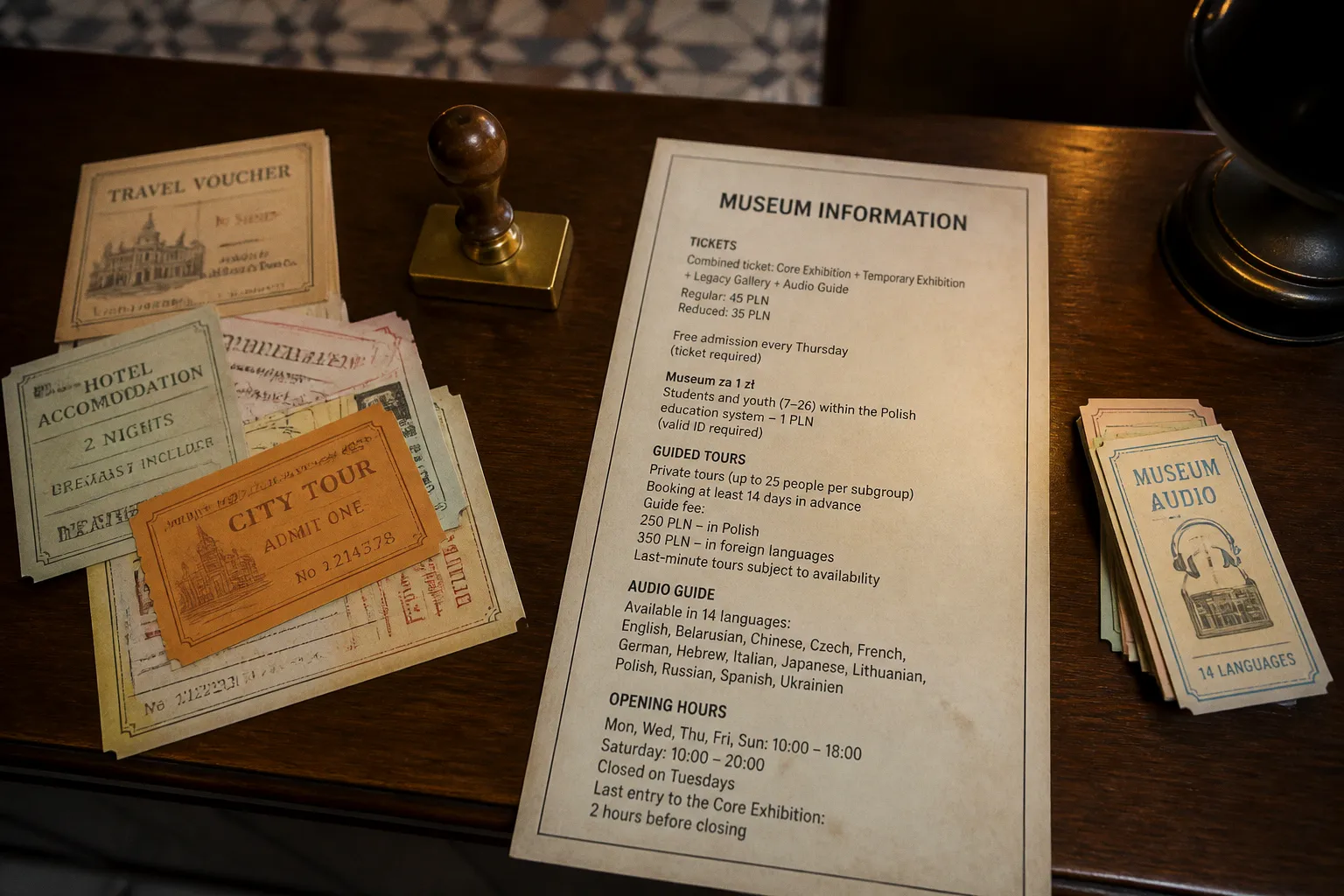
The museum stands at 6 Mordechaja Anielewicza Street, on the site of the former Warsaw Ghetto, and its Core Exhibition is not a quick stop between the Old Town and another appointment. It is a substantial historical journey, with a carefully paced sequence of galleries, reconstructed spaces, documents, objects, and testimonies.
Tickets and prices
POLIN Museum of the History of Polish Jews
I
Save
Box office and online booking
- Adult PLN20
- Child PLN1
- Reduced PLN15
PLN20
Official websiteII
guided tour
Guided tour · 3 hours
This 3-hour guided tour lets you discover the social, religious, and political diversity of the Polish Jews.
PLN348.80
Check availabilityIII
entry ticket
Entry ticket · Interactive installations
This entry ticket lets you discover the 1000-year old history of the Polish Jews through a variety of exhibitions and interactive installations.
PLN43.06
Check availabilityThat makes the booking route part of the itinerary rather than a minor administrative detail. A combined pass, a temporary exhibition ticket, a free Thursday ticket, an audio guide, or a private group tour each suits a different kind of visitor. Here is the catch: the most convenient option on the booking page is not automatically the best one for your day in Warsaw.
Start with the shape of your visit
The POLIN Museum offers several ways to arrange entry. Visitors can book online through the official ticketing portal, purchase admission at the museum cash desk, select a combined ticket covering several exhibition areas, or reserve a guided visit for a group. The right decision depends less on the museum’s ticket categories than on the actual rhythm of your travel party.
A visitor with only a short window in Warsaw may prefer to focus on the Core Exhibition, which presents the 1,000-year history of Polish Jews. Someone returning to the museum, or already familiar with the permanent display, may want only the temporary exhibition. A family or independent traveller may value an audio guide, while a corporate or educational group will usually need a reserved time, a designated guide, and a realistic plan for dividing the party into smaller subgroups.
The museum’s location also deserves practical attention. Because it is associated with the history of the Warsaw Ghetto and sits near the Monument to the Ghetto Heroes, many visitors combine the indoor visit with nearby places of remembrance. That can create a demanding sequence: an emotionally intense outdoor walk, followed by several hours inside the Core Exhibition, followed by a return journey across the city. We recommend planning the museum as the central activity of that part of the day, not as an interchangeable attraction placed into a narrow gap.
The best POLIN ticket is the one that matches your available attention, not simply the one that covers the largest number of rooms.
The broad booking choices look like this:
| Visitor profile | Most practical route | What to plan for |
|---|---|---|
| First-time independent visitor | Combined exhibition ticket with audio guide | Reserve enough time for the Core Exhibition and avoid compressing it between fixed appointments |
| Visitor focused on a temporary display | Temporary exhibition admission | Check whether the Core Exhibition is included before assuming the ticket covers both |
| Budget-conscious traveller | Thursday admission or an eligible concession | A free or reduced route still requires the correct ticket or valid documentation |
| Polish pupil or student aged 7–26 | Museum for 1 zloty scheme | A valid Polish educational student card is required |
| Family or small private party | Online booking with an audio guide or standard admission | Allow for different walking speeds and concentration levels |
| Corporate, school, or cultural group | Advance group or guided-tour reservation | Keep the party within the permitted subgroup size and book early |
The table is a planning tool, not a substitute for checking the current ticket calendar. Availability, temporary exhibitions, and booking conditions can change, and the museum’s own portal remains the most reliable place to confirm what is offered for your date.
Navigating the official POLIN online booking portal
For most visitors, online booking is the cleanest way to organise a visit. The official POLIN Museum ticket portal allows you to select an available date and choose among the admission types offered for that day. This is particularly useful when your Warsaw itinerary includes timed transport, a restaurant reservation, a walking tour, or an onward departure.
When booking, read the description of the ticket as carefully as the title. A combined pass may include the Core Exhibition, the temporary exhibition, the Legacy Gallery, and an audio guide, while a temporary exhibition ticket may cover only one part of the museum. These distinctions matter because the Core Exhibition is the element that most strongly determines how long your visit will take.
We suggest checking five details before completing the reservation:
- Which exhibition areas are included. Do not assume that a ticket mentioning the museum includes every current display.
- Whether an audio guide is part of the selected option. If it is not included, decide whether you want to add one or explore independently.
- The entry date and practical arrival window. A museum visit can be disrupted by a late train, a long lunch, or an over-ambitious morning route.
- The conditions for reduced admission. Eligibility may depend on specific documentation rather than age alone.
- The cancellation or change conditions shown at the time of booking. These are especially relevant when arranging a multi-city journey or a group programme.
The online route is also helpful for comparing the standard admission types before you arrive. If your preferred time appears unavailable, do not immediately rebuild the entire day. First consider whether another exhibition combination, another arrival time, or the cash desk could work. At the same time, we would not recommend relying on walk-up entry when the museum is the anchor of a tightly timed itinerary, particularly during busy periods or on a Thursday.
The on-site cash desk remains an option for visitors who prefer to decide on the day. It offers flexibility, but that flexibility comes with uncertainty: the ticket type or entry time you want may not be available when you reach the museum. In a city where transit fatigue can accumulate quickly, arriving at the building only to adjust your plans at the last minute is an avoidable strain.
Online booking versus buying at the museum
Online booking and on-site purchase serve different travel styles.
The official online portal is better when:
- you have only one suitable day in Warsaw;
- you are travelling with several people;
- you want to secure a particular exhibition combination;
- your itinerary includes a guided walk or another timed activity;
- you need to communicate the plan clearly to clients, colleagues, or family members.
The cash desk is more useful when:
- your schedule is deliberately open;
- you are already staying close to the museum;
- you are willing to adapt the duration of the visit;
- you are deciding between a temporary exhibition and the larger museum experience on the day.
Neither route eliminates the need to read the ticket conditions. A confirmed booking can still be poorly timed if it follows a long cross-city transfer or leaves no margin before a train departure.
Combined passes, temporary exhibitions, and the audio guide
The combined ticket is designed for visitors who want the fullest standard museum visit. It brings together the Core Exhibition, the temporary exhibition, the Legacy Gallery, and an audio guide. This is often the most coherent option for a first visit because the museum’s different elements then sit within one planned route rather than being treated as separate, optional rooms.
However, a combined pass does not mean that every visitor should attempt to move through the museum at maximum speed. The Core Exhibition covers a long historical period and changes scale repeatedly, moving from broad chronology to intimate personal histories and from architectural reconstruction to individual objects. The reconstructed wooden synagogue of Gwoździec, for example, is experienced differently from a gallery built around documents or recorded testimony. The physical pacing changes with the subject matter, and the itinerary should leave room for that.
The audio guide is available in fourteen languages, including English, Polish, German, French, Spanish, Italian, Hebrew, Russian, Ukrainian, Belarusian, Chinese, Czech, Japanese, and Lithuanian. For international visitors, this can make the difference between recognising the outline of a gallery and understanding the context that connects one section to the next.
We generally see three sensible ways to use the audio guide:
1. Follow it closely from beginning to end. This suits visitors who want a structured, chronological account and have enough time for a sustained visit.
2. Use it selectively. Choose key galleries or objects, then move independently through sections that are already familiar.
3. Share listening strategically within a group. This can work for couples or families, although it is less suitable when everyone wants to move at a different pace.
A combined pass is less useful when your day is already crowded with other emotionally or physically demanding activities. If you have spent the morning walking through the former ghetto area, visiting memorial sites, and crossing Warsaw in changing weather, adding every exhibition to the afternoon may turn the museum into a sequence of rooms rather than a meaningful experience.
When a temporary exhibition ticket makes more sense
A temporary exhibition ticket is the more focused choice for returning visitors, specialists, or travellers who have already seen the Core Exhibition and want to concentrate on a current programme. It may also suit an itinerary in which the museum visit must remain relatively short.
The key is to confirm exactly what the selected admission includes. Temporary exhibitions have their own rhythm and may be possible to visit within a tighter window, but that should not be confused with a guarantee that the entire museum can be covered quickly. If you are booking for someone else, especially a client or a small delegation, describe the ticket plainly: temporary exhibition only, or combined access with the permanent display.
The Legacy Gallery can also be significant for visitors interested in the continuity of Jewish life and memory beyond the chronological structure of the main exhibition. Whether it is included in the ticket you select should be checked in the booking details rather than assumed from a general museum admission label.
Free Thursdays and reduced admission
Thursday is the museum’s free-admission day for the Core and temporary exhibitions. This is an important opportunity for travellers managing a careful Warsaw budget, but the word free should not be interpreted as walk-in access without any administrative step. Visitors still need to obtain or select the appropriate free ticket.
That distinction matters in practice. A traveller may organise a Thursday visit around the assumption that no reservation is necessary, then discover that the museum requires visitors to select admission through the available ticket process. We recommend treating free Thursday exactly as you would any other timed cultural visit: check availability, select the correct ticket, and allow enough time to arrive without cutting across the city at the last moment.
Thursday may also be attractive because it allows visitors to preserve more of their cultural budget for transport, a guided walk, or another paid experience. Yet a free ticket does not reduce the intellectual scale of the Core Exhibition. If anything, visitors sometimes need to be more deliberate on a busy free-admission day, when the building may feel more active and the galleries may take longer to navigate.
The 1-zloty museum scheme
The Museum for 1 zloty scheme applies to Polish school pupils and students aged seven to twenty-six who can present a valid Polish student card. It is a specific concession tied to the Polish education system, not a general youth discount for all international visitors.
This is one of the areas where assumptions can create an awkward arrival. An international student may be within the relevant age range but still not qualify under the stated conditions. We would therefore advise carrying the required Polish educational documentation if you are relying on this option, and choosing another ticket type if you cannot demonstrate eligibility.
Other reduced-admission categories may also be available, but the exact requirements should be read in the current booking information. Ticket prices and concession rules can change more quickly than a general visitor guide, which is why we avoid turning a flexible planning article into a fixed price list.
Private guided tours and group logistics
Group visits require a different kind of preparation because the museum is not simply a large room in which twenty-five people can move as one loose cluster. Private guided tours allow groups to approach the collections with a professional structure, but they also impose advance-planning requirements.
Private group tours should be booked at least fourteen days in advance. The guide fee depends on the language and on how close to the visit the reservation is made, with last-minute bookings becoming more expensive when requested five days or less before the tour. The museum permits up to twenty-five visitors per tour subgroup, so a larger delegation must be divided accordingly.
For corporate and incentive travel, this is where itinerary architecture becomes particularly important. A group may be able to book the museum, but that does not mean the visit will feel smooth unless the surrounding schedule respects the building’s scale and the subject’s seriousness.
Planning a group visit without losing the day
For groups, we recommend working through the following sequence:
1. Establish the group’s purpose. A corporate delegation looking for cultural context will need a different level of interpretation from a school group or a specialist academic visit.
2. Choose the language of the tour early. Foreign-language guide availability should be confirmed before transport, meals, and other appointments are finalised.
3. Divide larger parties into realistic subgroups. The maximum permitted size applies to each tour subgroup, not merely to the overall booking.
4. Book well ahead of the minimum lead time. Fourteen days is a requirement to work around, not an ideal planning horizon when the visit is central to a fixed programme.
5. Build in arrival and regrouping time. Participants do not all leave a coach, hotel, or restaurant at the same speed, and a late arrival by one subgroup can affect the whole sequence.
6. Avoid placing a demanding appointment immediately afterward. The visit may prompt discussion, quiet reflection, or questions that cannot be accommodated if everyone must rush directly to the next venue.
The group discount for parties of ten or more can make a combined admission more practical, but the saving should not be the only reason to choose that format. If the group has limited time, booking a full combined pass may create pressure to cover too much. For some delegations, a guided visit to the Core Exhibition followed by an unhurried departure is more successful than adding every available area.
For a group, the booking is only the first logistical decision; the real work is protecting the museum visit from the timetable around it.
Audio guides or a live guide?
The audio guide gives independent visitors control over their own pace and language. A live guide provides a shared narrative, answers questions in real time, and can shape the emphasis for a particular group. Neither is universally better.
An audio guide is usually more adaptable when:
- people in the party have different interests;
- some visitors want to pause for longer than others;
- the group includes several language preferences;
- the museum is one element in a broader independent itinerary.
A private guided tour is usually stronger when:
- the group needs a common interpretive framework;
- the visit has an educational or professional purpose;
- the participants are unfamiliar with Polish Jewish history;
- the organisers want to reduce decision-making inside the galleries.
If your group is travelling from abroad, confirm whether the guide language and the audio-guide language meet everyone’s needs. A bilingual booking can be possible in principle but cumbersome on the ground if the participants must constantly divide their attention between explanations.
Operating hours, Tuesdays, and last entry
The POLIN Museum is open Monday, Wednesday, Thursday, Friday, and Sunday from 10:00 to 18:00. On Saturday, it remains open until 20:00. The museum is closed on Tuesdays.
The extended Saturday schedule can look attractive on a Warsaw itinerary, particularly for visitors who spend the morning elsewhere. Here is the catch: a late closing time does not automatically create a relaxed late arrival. The Core Exhibition has a last-entry rule requiring visitors to enter at least two hours before closing. In practical terms, an arrival near the end of the day may not provide enough time to begin the permanent exhibition at all.
For the Core Exhibition, we suggest thinking in terms of a substantial block of time rather than a simple opening-hours calculation. The museum’s size, the density of the material, and the emotional transitions between galleries all affect the pace. A visitor who enters shortly before the last permitted admission may technically be inside the building but still have an unsatisfactory experience.
Building the museum into a Warsaw day
The most reliable approach is to plan by geographic sequence and energy rather than by collecting isolated opening hours.
If you are staying elsewhere in Warsaw, allow for the time required to reach Mordechaja Anielewicza Street, orient yourself at the entrance, collect or confirm your ticket if necessary, and settle into the first gallery. The distance on a city map can look manageable while the real journey becomes longer through weather, public transport changes, luggage, or a late departure from a previous appointment.
A sensible day might place the museum:
- in the morning, when the group is fresh and the visit can unfold without pressure;
- after a light nearby programme, rather than after a long cross-city sightseeing circuit;
- before dinner, with enough time afterward for a quieter transition;
- as the main cultural commitment of the day, especially for first-time visitors to the Core Exhibition.
We would be cautious about combining the museum with an early airport transfer, a narrow train connection, or a sequence of distant attractions on opposite sides of Warsaw. The result may look efficient in a spreadsheet but become uncomfortable through transit fatigue and repeated time checks.
The site’s connection with the former Warsaw Ghetto also means that many visitors will want to spend time outdoors before or after entering. This can be valuable, but it changes the pacing. A visit to the Monument to the Ghetto Heroes and the museum itself should not be treated as two unrelated items to be completed as quickly as possible. Give the outdoor route its own margin, then enter the museum with enough time to engage with the Core Exhibition rather than carrying the pressure of the next booking into every gallery.
Which booking path suits your itinerary?
The decision becomes simpler when matched to the traveller rather than to the ticket name.
For a first visit to Warsaw
Choose a combined ticket if you have enough time for the Core Exhibition and want the museum’s wider offering in one visit. Add the audio guide if you prefer a chronological structure or are visiting without a specialist guide. Avoid placing the museum at the end of an already overloaded day.
For a return visit
A temporary exhibition ticket may be the most precise option, particularly if you have already spent several hours in the Core Exhibition. Check whether the Legacy Gallery or another area is included in the selected admission before finalising the plan.
For a Thursday visit
Use the free-admission route, but still select the required ticket. Do not arrive assuming that free entry means no booking step. Keep the schedule flexible enough to accommodate a busier building and a slower route through the galleries.
For eligible Polish pupils and students
Use the Museum for 1 zloty scheme only if you can present a valid Polish student card. Age alone is not enough, and an international student should not assume that an overseas university card will meet the stated condition.
For corporate and incentive groups
Reserve the guided visit as early as possible, confirm the language, and divide the party into subgroups of no more than twenty-five people. Keep the museum as a central programme element rather than an activity squeezed between transport and a formal meal.
For visitors with limited time
Choose one clear objective. The Core Exhibition deserves priority for a first visit, while a temporary exhibition may be more appropriate for someone returning to the museum. A short, focused visit is better than a rushed attempt to cover every included area.
Seasonal timing and the final decision
Warsaw’s seasons alter the practical shape of this visit. In colder months, the museum offers a useful indoor anchor, but coats, wet footwear, and reduced daylight can slow the transitions before and after entry. In warmer weather, visitors may be tempted to pack too many outdoor sites around the museum, although heat, sudden rain, and the accumulated distance of a walking itinerary can still change the pace. Saturday’s later closing time is useful in any season, provided the last-entry rule is respected.
Thursday can be attractive throughout the year for visitors watching their budget, while advance online booking is especially valuable when your itinerary depends on a fixed sequence of trains, tours, or group movements. For a private tour, the season matters less than the lead time: a language-specific guide and a well-coordinated subgroup plan should be arranged before the rest of the day becomes crowded with commitments.
Our practical preference is straightforward. For most first-time visitors, book the appropriate combined admission online, allow a generous block of time, and use the audio guide in the language that lets you remain attentive rather than constantly translating. For repeat visitors, compare the temporary exhibition option with the areas you have not yet seen. For Thursday, secure the free ticket instead of treating admission as entirely unstructured. For groups, begin with the guide reservation and build the day around it.
The POLIN Museum is not difficult to book once the distinctions are clear. The challenge is designing a visit whose geography, opening hours, language needs, and emotional pacing work together. Choose the ticket after deciding what kind of encounter you can realistically give the museum, and the rest of the Warsaw itinerary will be easier to place around it.
Practical info
Currency: PLN
Driving: on the right
Emergency number: 112