Peterhof or Catherine Palace: St Petersburg tour choice
Choosing between a Peterhof or Catherine Palace tour is less a question of which palace is more impressive than of what kind of day you want to build outside St Petersburg.
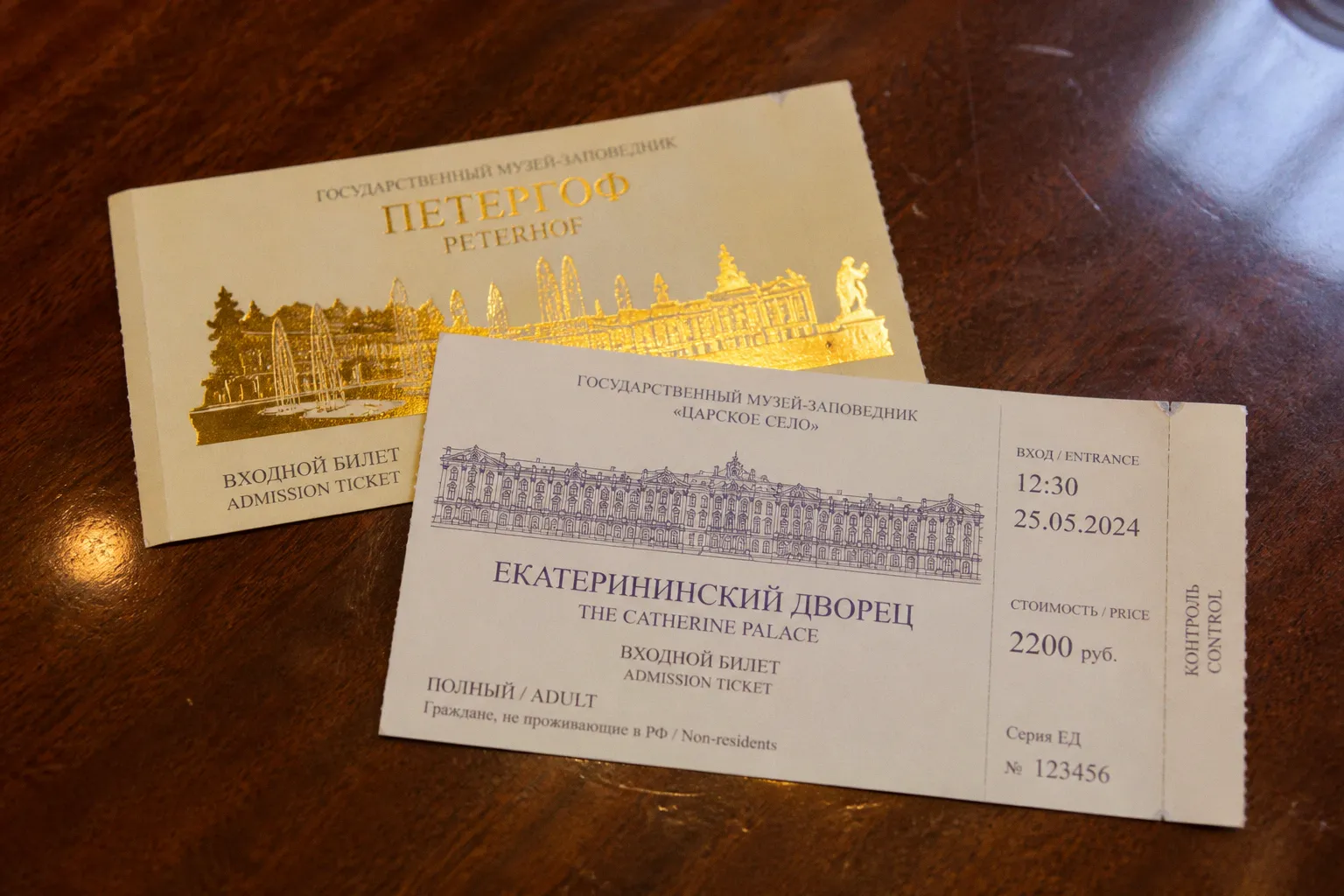
Peterhof takes you west towards the Gulf of Finland, where the visit unfolds through open terraces, long garden axes, sea air, and the engineered spectacle of gravity-fed fountains. Catherine Palace takes you south to Tsarskoye Selo, now the town of Pushkin, for a more concentrated sequence of ceremonial interiors culminating in the reconstructed Amber Room.
Compare car rental deals in United Kingdom
See available offersPartner link — DiscoverCars comparisonThe two estates lie at a similar headline distance from the city—approximately 30 kilometres to Peterhof and roughly 25 kilometres to Catherine Palace—but they do not feel similar on the ground. One is an outdoor landscape visit shaped by weather, walking and fountain schedules; the other is a timed interior experience shaped by entry slots, room sequence and the pace of a guided group. Here is the catch: distance alone is a poor way to choose between them.
Choose Peterhof for movement, water and the Gulf of Finland; choose Catherine Palace for interiors, ceremony and the Amber Room.
Peterhof: a palace visit built around landscape
Peterhof is positioned on the shore of the Gulf of Finland, west of central St Petersburg. The main attraction is not only the Grand Palace but the relationship between the palace, the Upper and Lower Parks, the terraces and the water system that carries the visit downhill towards the gulf.
During the fountain season, typically from late April through mid-October, the estate becomes a large-scale outdoor composition. The fountains operate without mechanical pumps, using gravity to move water through the system. Depending on how the estate’s features are counted, Peterhof is described as having approximately 147 to 173 active fountains. That range is not a contradiction so much as a reminder that the complex includes major cascades, smaller jets and individual water features spread across the grounds.
For travellers arriving from the centre, the most distinctive approach is the Meteor hydrofoil from the Hermitage pier. The crossing takes approximately 45 minutes, carrying passengers across the Gulf of Finland directly towards Peterhof. This is not merely a faster-looking line on a map. It changes the rhythm of the excursion: instead of sitting in road traffic, you begin the day with open water, a gradual shift from the dense centre of St Petersburg to the lower, more spacious coastal landscape, and a clear sense that Peterhof is an estate outside the city rather than another museum quarter within it.
Once ashore, the walking begins. The Lower Park is broad, axial and deliberately theatrical, with the Grand Cascade forming the visual and hydraulic centre of the visit. The gardens are not difficult in the mountaineering sense, but the estate has enough scale to expose poor pacing. A visitor who tries to absorb every fountain, pavilion and view in one sweep can become physically tired before reaching the details that make the place rewarding.
What the Peterhof experience feels like
Peterhof is strongest when the weather supports an outdoor itinerary. In mild sunshine, the gilded sculpture, white balustrades, dark water channels and clipped avenues have a clarity that photographs only partly convey. In wind or persistent rain, the same spatial openness becomes a practical factor: there is less shelter, more walking between points of interest, and a greater need for waterproof layers rather than optimistic urban clothing.
The fountains also impose a calendar. Outside the operating season, the estate can still be visited for its architecture, parkland and historical atmosphere, but the famous water display is not running in winter. Travellers who place the fountains at the centre of their decision should therefore plan around the season rather than assume that the visit is identical throughout the year.
The Grand Palace itself is comparatively compact beside the grounds. It provides the formal interior counterpart to the exterior spectacle, but Peterhof is not best understood as a palace where the gardens happen to be attached. The gardens are the itinerary. The palace is one important layer within a much wider composition.
This makes Peterhof particularly suitable for:
- Travellers who enjoy walking through designed landscapes rather than moving only from room to room.
- Visitors travelling between late April and mid-October who want to see the fountains operating.
- Families and mixed-interest groups who benefit from an excursion with changing visual environments.
- First-time visitors who want a strong sense of imperial scale without spending the whole day inside a single building.
- Those who appreciate arrival as part of the journey, especially when the hydrofoil is operating and sea conditions are comfortable.
The hydrofoil itself should not be treated as a guaranteed part of every itinerary. Ticket availability, weather, seasonal operation and the chosen tour format can vary, so a package that includes the Meteor crossing should be checked as a specific transport arrangement, not assumed from a general Peterhof description.
Catherine Palace: an interior sequence with a timed centre
Catherine Palace lies approximately 25 kilometres south of St Petersburg in Tsarskoye Selo, the historic estate complex associated with Pushkin. The approach is overland, and the visit has a more concentrated architectural focus than Peterhof: the Golden Enfilade of state rooms, the Baroque interiors and the Amber Room create a sequence in which decoration, ceremony and controlled movement matter more than open distance.
The palace is known above all for its opulent interiors. Visitors move through rooms designed to create transitions in scale, colour, ornament and light, with gilded surfaces and formal perspectives repeatedly extending the visual field. The experience is less dependent on the weather than Peterhof’s, although the wider Tsarskoye Selo estate still rewards time outdoors if conditions allow.
The Amber Room is the emotional centre of the visit for many international travellers, but it deserves precise language. The room seen today is a meticulous reconstruction, completed in 2003; it is not the original eighteenth-century installation. That distinction does not make the room irrelevant or ordinary. It simply places the visitor’s experience in the correct historical frame: what survives is a reconstructed interpretation of a lost interior, produced through extensive conservation and craft.
Why the Catherine Palace visit requires more planning
Admission to Catherine Palace is based on timed entry, and tickets are named. An adult ticket for non-residents has been listed at 2,200 RUB, although prices and access conditions should be confirmed for the intended travel date. The timed system is not a minor administrative detail. It shapes the entire day, particularly for travellers arranging a private guide, combining the palace with other stops, or arriving by road from central St Petersburg.
A late arrival can create a disproportionate problem because the palace is not an attraction where one simply joins the next available queue and adjusts the day casually. A well-designed Tsarskoye Selo tour leaves a buffer for traffic, security procedures, ticket collection where applicable and the slower pace of an escorted group.
Inside, the route can also feel more demanding than expected. The rooms are visually dense, and the visitor’s attention is repeatedly drawn towards gilded carving, painted ceilings, parquet floors, mirrors and furnishings. After several richly decorated chambers, concentration can flatten into what experienced guides sometimes recognise as interior fatigue: the palace is still elaborate, but the eye is no longer registering each layer separately.
That is why the best Catherine Palace tours are not simply timed transfers with a room list. They establish a narrative rhythm, pausing over the rooms that explain the estate’s political and ceremonial purpose rather than treating every decorated surface as an equal fact to memorise.
Catherine Palace is particularly suitable for:
- Travellers whose priority is Baroque architecture and imperial ceremonial interiors.
- Visitors travelling outside the Peterhof fountain season.
- Those who prefer a more weather-resilient cultural excursion.
- Travellers with a specific interest in the Amber Room and the history of its reconstruction.
- Visitors who value a guided sequence through a complex interior rather than a large open park.
Peterhof vs Catherine Palace: the practical differences
The two estates are close enough to be compared, but different enough that a direct winner is misleading. The table below is a more useful starting point for building a St Petersburg palace itinerary.
| Parameter | Peterhof | Catherine Palace |
|---|---|---|
| Direction from St Petersburg | Approximately 30 km west, on the Gulf of Finland | Approximately 25 km south, in Tsarskoye Selo/Pushkin |
| Main visual strength | Lower Park, terraces, cascades, fountains and coastal setting | Golden Enfilade, Baroque interiors and reconstructed Amber Room |
| Best-known seasonal feature | Gravity-fed fountains operating typically from late April to mid-October | Interior visit available as the central attraction throughout the year, subject to access schedules |
| Character of the day | Outdoor, spacious and walking-intensive | Indoor, concentrated and highly structured |
| Distinctive arrival option | Approximately 45-minute Meteor hydrofoil from the Hermitage pier | Overland transfer by road or organised excursion transport |
| Weather sensitivity | High, because the fountains and parks define much of the experience | Lower inside the palace, though transfers and estate walking still depend on conditions |
| Ticket structure | Park and palace access may be handled separately depending on the chosen programme | Timed, named admission; a listed non-resident adult price is 2,200 RUB |
| Best match for | Landscape, water engineering, open air and maritime atmosphere | Decorative interiors, palace ceremony and the Amber Room |
The choice becomes clearer when we describe the actual day rather than the landmark’s reputation. Peterhof asks whether you are comfortable with a long outdoor circuit and whether the fountain season is active. Catherine Palace asks whether you are willing to plan around a fixed entry time and whether highly ornate interiors hold your attention for several hours.
Travel time is not the same as excursion time
The map can make both estates look like straightforward half-day additions to a St Petersburg city break. In practice, the transfer is only one part of the calculation. Departure from the city, traffic, entry procedures, guiding, walking between zones and the return journey all contribute to transit fatigue.
For Peterhof, the hydrofoil can make the outward journey feel efficient, but it does not eliminate the scale of the estate once you arrive. The forty-five-minute crossing is followed by an excursion that may involve substantial walking through the Lower Park, time at the cascades, a palace visit and the return transfer. The day has a clear spatial progression, but it is not a short museum stop.
For Catherine Palace, the road distance is shorter in absolute terms, yet the timed admission makes the day less forgiving. A private car or organised tour can provide control over departure time, but road traffic remains part of the calculation. Public transport may reduce cost while adding transfers and waiting, which can matter more than the nominal distance if the itinerary is already dense.
When planning guided tours in St Petersburg, we generally work backwards from the fixed element. For Catherine Palace, that is the entry time. For Peterhof in fountain season, it may be the preferred arrival window, the hydrofoil schedule or the need to see the Lower Park before the day becomes crowded. The city-centre programme should then be arranged around the excursion rather than squeezed into whatever hours remain.
A sensible day usually has one major imperial estate as its anchor. If you also add a long museum visit, a formal dinner reservation across the city and an evening performance, the problem is not that any one activity is unreasonable. The problem is the accumulation of transfers, standing, security queues and attention shifts. A route can be geographically possible and still be unpleasant.
The same-day question
Visiting both Peterhof and Catherine Palace on the exact same day is technically possible with private transport and carefully managed admissions, but it is rarely a comfortable choice for casual travellers. The two estates demand different kinds of attention: Peterhof requires outdoor movement and spatial orientation, while Catherine Palace requires sustained concentration inside a richly decorated sequence of rooms.
There is also the problem of transfer geometry. You are not simply moving between two nearby palaces. You are crossing back through or around the metropolitan area while coordinating timed access and the opening rhythm of the fountain park. Even when the route works on paper, the day can dissolve into vehicle time and hurried photography.
A combined programme can make sense for a specialist group with limited time, a dedicated driver, pre-arranged entries and a clear agreement that neither estate will be explored comprehensively. For most visitors, separate days produce a stronger result. The first visit remains distinct in memory, and the second does not arrive under the weight of physical and visual exhaustion.
Two imperial estates in one day may satisfy a map, but a well-paced itinerary satisfies the traveller.
Seasonal timing: when each estate makes the strongest case
Seasonality is not a decorative detail in this comparison. It changes what Peterhof actually offers, while Catherine Palace remains more consistent as an interior-focused excursion.
Late spring and summer
From late April through mid-October, Peterhof’s fountains give the estate its full hydraulic theatre. The warmer months also make the Lower Park easier to navigate at a comfortable pace, although weather on the Gulf of Finland can shift quickly. A clear morning does not guarantee a windless afternoon, and the coastal microclimate can feel cooler than the city centre.
Summer therefore favours Peterhof when the traveller is prepared for an outdoor day: shoes suitable for extended walking, a light waterproof layer and enough time to move without turning every stop into a timed sprint. The estate is especially rewarding when the itinerary leaves room for pauses rather than treating the fountains as a checklist of individual features.
Catherine Palace remains an excellent summer choice for visitors who prefer architectural detail or who have already spent several days in parks and open-air sites. Its timed entry can be easier to manage when booked as part of a structured tour, especially during periods of high demand.
Autumn
Early autumn can provide a more restrained atmosphere in both locations, but the practical decision depends on the exact date. Peterhof’s fountain season typically extends to mid-October, not indefinitely through the colder months. If the fountains are central to your choice, confirm the operating calendar before booking a package around them.
Catherine Palace becomes increasingly attractive as daylight shortens and the weather turns less predictable. The palace’s interiors provide a stable cultural focus, while Pushkin’s surrounding estate can still be included if the conditions are comfortable.
Winter
Winter is the clearest case for Catherine Palace. Peterhof’s fountains are shut down outside the operating season, so a winter visit should be planned for the palace, parks and architectural setting rather than for running water. Snow, wind and limited daylight also change the pace of the Lower Park, making it a different experience from a summer excursion.
Catherine Palace does not become effortless in winter—road conditions and timed entry still matter—but the primary attraction is indoors. For a short Moscow–St Petersburg combination or a compact city break, this stability can be valuable: fewer itinerary elements depend on the weather remaining generous for several hours.
A seasonal decision in brief
- Late April to mid-October: Peterhof has the strongest case if the fountains and outdoor landscape are central to your trip.
- Outside the fountain season: Catherine Palace is usually the more coherent choice for a first palace excursion.
- Changeable weather: Catherine Palace reduces outdoor exposure, while Peterhof requires more deliberate clothing and pacing.
- Long summer daylight: Either estate can work, but that does not automatically justify combining both on one day.
- Travellers sensitive to cold or wind: The interior-led Catherine Palace itinerary is generally easier to manage.
How to fit the choice into a wider St Petersburg itinerary
A palace excursion works best when it contrasts with the rest of the trip. If your preceding day has already included long walks along the Neva, the Hermitage and several historic interiors, Peterhof offers a valuable change of scale. The fountains and gardens allow the eye and body to move differently, even though the excursion remains physically demanding.
If your programme has been dominated by outdoor sightseeing, riverfront walks or long transfers, Catherine Palace provides the opposite kind of concentration. It is a day for architectural reading, guided interpretation and carefully controlled movement through the state rooms.
This is also where the format of the tour matters. A large group excursion can be practical and economical, but its fixed rhythm may leave little room for adapting to weather, crowding or personal stamina. A private tour guide in Moscow is not relevant to this specific excursion, but a private or small-group guide in St Petersburg can make a considerable difference at either estate because the guide can adjust the depth of explanation and the speed of movement.
For international visitors, an organised package may also coordinate transport, entry windows and language support in one arrangement. That can be particularly useful at Catherine Palace, where named timed tickets and admission procedures create more administrative friction than the distance suggests. At Peterhof, a package can help decide whether the hydrofoil is practical for the chosen date or whether a road transfer offers better control.
When comparing Russian travel packages, look for the actual structure rather than a grand label such as an imperial tour. Ask whether the price includes the palace interior, the park, transport, a guide, entrance arrangements and any hydrofoil segment. Peterhof and Catherine Palace are not interchangeable line items: an itinerary that includes only the Lower Park is a different product from one that includes the Grand Palace, and a Catherine Palace transfer without a confirmed timed entry is not a complete solution.
Which one should you choose?
Choose Peterhof if the idea of the visit is an expansive estate shaped by water, gardens and the Gulf of Finland. It suits travellers who want the journey to have a physical progression: leaving central St Petersburg, crossing the water by Meteor when available, arriving at the coastal estate and walking through the Lower Park towards the cascades. The visit is at its most complete during the fountain season, typically from late April through mid-October.
Choose Catherine Palace if you want an interior-led day with a strong architectural focus. The Golden Enfilade and reconstructed Amber Room provide a more concentrated experience, and the palace is less dependent on warm weather than Peterhof. It is the more predictable choice in late autumn and winter, provided you organise the timed entry and allow enough margin for the overland journey.
Choose both, but preferably on separate days, if your trip has enough time and you genuinely want to understand the difference between imperial landscape design and imperial interior ceremony. They complement one another precisely because they do not offer the same experience. Peterhof gives you scale through distance, water and open air; Catherine Palace gives you scale through ornament, perspective and controlled architectural sequence.
Our seasonal recommendation is straightforward: place Peterhof high in the itinerary when the fountains are running and the forecast supports a long outdoor excursion, then reserve Catherine Palace for a day when the palace itself—not the weather—can carry the experience. Outside the fountain season, reverse the emphasis. With sensible pacing, either choice becomes more than a palace transfer from St Petersburg; it becomes a route with its own geography, tempo and reason for being there.