Moscow to St Petersburg cruise: a step-by-step route guide
The first control point for a Moscow to St Petersburg river cruise is the sailing date. The second is the route length. Express itineraries run for about 8 days and 7 nights. Standard programs usually occupy 10–13 days. Extended voyages can reach 15 days.
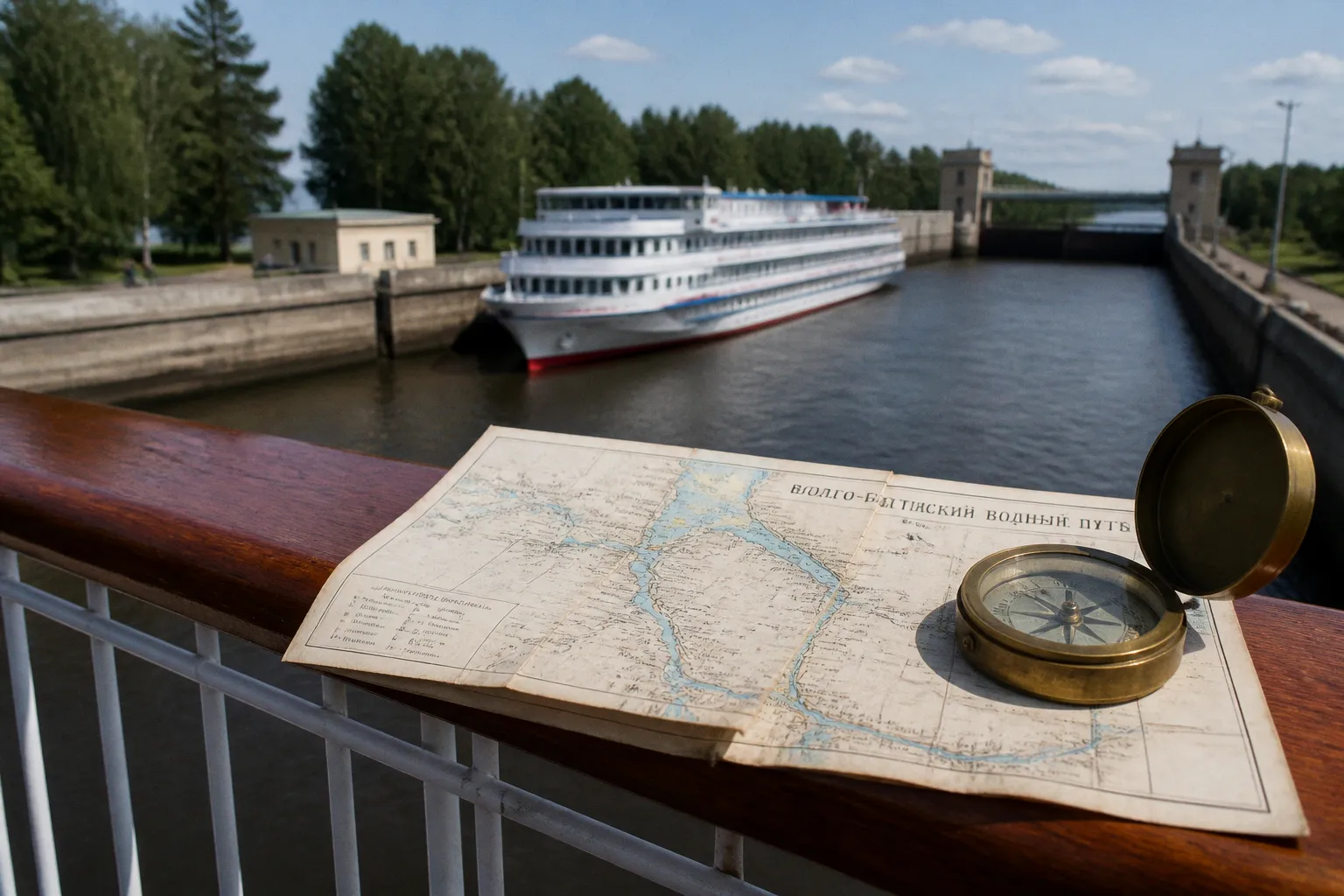
These are not equivalent products with different prices. They use the same broad waterway corridor but allocate different time to Moscow, St Petersburg, and intermediate ports.
The route is also not a direct passage down one river. It is a transit corridor of canals, locks, rivers, and large lakes: the Moscow Canal, Volga, White Lake, Lake Onega, the Svir, Lake Ladoga, and the Neva. Every additional segment creates another navigation dependency. A delayed lock passage can affect an excursion. A late arrival at the embarkation point can invalidate the entire booking.
This guide sets out the route in operating order. It covers the Russian river cruise route stops, the division between sailing and shore time, the documentation buffer, and the failure points that require a backup plan.
1. Select the itinerary before selecting the cabin
Begin with the itinerary document. Do not start with deck plans, cabin categories, or promotional descriptions. First establish what the program actually includes.
A Moscow to St Petersburg cruise itinerary normally falls into one of three operating formats:
| Itinerary format | Typical duration | Operational profile | Best use |
|---|---|---|---|
| Express cruise | 8 days / 7 nights | Short port windows and limited reserve time | Travellers with a fixed schedule |
| Standard cruise | 10–13 days | More balanced sailing and sightseeing allocation | First-time visitors requiring both capitals and intermediate stops |
| Extended cruise | Up to 15 days | Additional time for excursions, capital stays, or slower navigation | Travellers prioritising coverage over speed |
The duration affects more than the number of hotel nights on board.
An express program may still list the same headline ports as a longer voyage. That does not mean the sightseeing experience is identical. Time at Uglich, Goritsy, Kizhi, or Mandrogi may be compressed. Moscow and St Petersburg may be handled as pre-cruise and post-cruise stays rather than as full excursion blocks within the vessel schedule.
Check the following fields in the operator’s current program:
- Embarkation date and local time.
- Embarkation location in Moscow.
- Final disembarkation location and time in St Petersburg.
- Number of nights on board.
- Number of shore excursions included.
- Excursions requiring separate payment or pre-registration.
- Meal coverage during port days.
- Transfer coverage between airport, hotel, and ship.
- Visa documentation requirements for the complete itinerary.
- Cancellation and date-change rules.
- Whether the advertised vessel and route are confirmed for the selected season.
The last point requires direct compliance control. Current operating schedules can change because of sanctions, border conditions, fleet allocation, or domestic operator policy. Do not assume that an international cruise line continues to operate a pre-2022 schedule. Treat the current sailing confirmation as the controlling document.
The route name is not the itinerary. The itinerary is the sequence of confirmed dates, ports, transfers, and shore permissions.
2. Build the Moscow departure sequence
Cruises departing from Moscow typically use the North River Station, also known as Severny Rechnoy Vokzal. The ship does not immediately enter the main Volga corridor. It first uses the Moscow Canal and passes through multiple lock chambers before reaching the Volga.
This creates a basic timing rule: arrive in Moscow before embarkation day.
A same-day international arrival can create a transit failure even when the flight is technically scheduled before departure. The risk is not limited to flight delay. It includes immigration processing, baggage collection, airport transfer time, hotel check-in, traffic, and the distance to the river terminal.
Use the following sequence:
1. Arrival into Moscow
- Schedule the international arrival with buffer time before the ship’s boarding deadline.
- Keep passport, visa documentation, insurance documents, hotel confirmation, and cruise confirmation in hand luggage.
- Do not place the only copy of the embarkation details in checked baggage.
2. Pre-cruise accommodation
- Use a Moscow hotel with a confirmed transfer corridor to the North River Station.
- Confirm whether the cruise package includes the hotel night or only the vessel accommodation.
- Establish the transfer pickup time in writing.
3. Terminal transfer
- Check the vessel name, pier information, boarding window, and luggage procedure.
- Allow time for traffic and terminal access controls.
- Keep a local contact number for the operator or tour manager.
4. Boarding
- Complete registration before the stated cutoff.
- Verify cabin allocation, meal schedule, excursion tickets, and emergency instructions.
- Confirm where the passport will be held if the operator uses a group document procedure.
5. Initial navigation
- Expect the first operational phase to involve the Moscow Canal and lock chambers.
- Do not schedule an independent appointment in Moscow after the stated departure time. The vessel’s movement is controlled by the navigation timetable, not by individual passenger plans.
The Moscow section can be treated as two separate products: a city stay and a departure corridor. A curated package should define both. A city tour that ends too close to boarding creates a direct conflict. A private guide booked for the wrong day is not a minor inconvenience if the ship leaves the terminal.
3. Follow the waterway corridor in sequence
The moscow to st petersburg river cruise itinerary uses a connected system rather than a single continuous river. The order of the navigation sections explains why the cruise provides a different form of access from a conventional road itinerary.
Moscow Canal and the Volga
The ship departs from the Moscow river terminal and moves through the Moscow Canal. Lock chambers control the change in water level and connect the capital with the Volga system.
This is the first technical section of the voyage. It is also the first reason to avoid treating the cruise as a flexible hotel. The vessel follows a controlled passage window. Boarding, shore access, and return times operate against that schedule.
Once the route reaches the Volga, the voyage enters the main east-west corridor. The river section links Moscow with the northern waterways and the subsequent lake crossings.
The Volga river cruise landmarks are therefore not limited to riverbank monuments. They include the infrastructure that makes the route possible: canal approaches, lock chambers, junctions, and the transition from river navigation to open-lake conditions.
Uglich
Uglich is one of the principal historical stops on the route. The town is associated with the Kremlin and the Church of St. Demetrios on the Blood.
Treat the Uglich visit as a scheduled shore operation:
- Confirm whether the walking tour starts at the ship or at a separate meeting point.
- Carry the excursion ticket or group identification if required.
- Return before the stated all-aboard time.
- Do not separate from the group without confirming the return route.
- Allow for a controlled visit rather than an open-ended city stop.
The practical value of Uglich lies in the concentration of historical sites near the port area. That does not remove the need for timing control. A delayed return can affect departure and the next port window.
Goritsy and the White Lake corridor
The route continues toward the northern water system and reaches the White Lake area, with Goritsy serving as a gateway to the Kirillo-Belozersky Monastery.
Goritsy is a transfer-sensitive stop. The port call and the monastery visit are not interchangeable. The excursion may require organised transport, group movement, and a fixed return schedule. Travellers who leave the excursion group must have a confirmed alternative plan. Mobile connectivity and taxi availability should not be treated as guaranteed recovery tools.
The monastery visit also illustrates the difference between a cruise package and a self-directed itinerary. The cruise solves the long-distance movement between regions. The excursion operator solves the local access problem. Remove one part of that chain and the visit may no longer fit the vessel schedule.
Kizhi Island and Lake Onega
The vessel then reaches Lake Onega and the Kizhi Island stop. Kizhi is known for its UNESCO-listed open-air museum of wooden architecture.
This is a major route-control point. Lake navigation differs from narrow river navigation. Shore access is dependent on the vessel’s arrival window and the local excursion program. A Kizhi visit is normally structured around the group schedule rather than independent exploration.
Prepare for the stop as follows:
- Confirm the departure time from the vessel before going ashore.
- Keep the excursion meeting instructions available offline.
- Wear footwear suitable for walking on uneven outdoor surfaces.
- Do not assume that a short list of sites means a short walking distance.
- Return to the designated meeting point before the group deadline.
The island is not simply another museum stop. It is one of the places where the route’s geographical logic becomes visible. The ship has moved from the Volga system through northern waterways into Lake Onega. The cultural program follows that transition.
The Svir River and Mandrogi
After Lake Onega, the route uses the Svir River toward Lake Ladoga. Mandrogi is a reconstructed traditional craft village and a common stop on this section.
Mandrogi is usually handled as a contained shore program. The stop can include craft demonstrations, local architecture, and a short walk through the settlement. Its function in the itinerary is different from Uglich or Kizhi. It is not primarily a major historical centre or open-air architectural museum. It is a structured cultural stop placed within the river corridor.
The operational rule remains the same: use the published shore window. Do not convert a scheduled group stop into an unsupervised regional transfer.
Lake Ladoga and the Neva
Lake Ladoga is the final major open-water stage before the vessel enters the Neva River. The Neva then provides the approach to St Petersburg.
The arrival sequence can include several separate controls:
- Lake navigation timing.
- Entry into the Neva corridor.
- Port or terminal instructions.
- Disembarkation procedure.
- Luggage collection.
- Transfer to the St Petersburg hotel or airport.
- Post-cruise sightseeing schedule.
Do not book a flight immediately after the nominal arrival time unless the operator explicitly confirms the transfer and airport timing. Nominal arrival is not the same as passenger release. Disembarkation, luggage handling, customs or port procedures, and road transfer remain in the critical path.
4. Separate sailing time from sightseeing time
A river cruise sells movement and access as one product. Planning fails when travellers treat every hour on the vessel as available sightseeing time.
The route contains four different time categories:
1. Navigation time
- The vessel is moving between ports, locks, rivers, and lakes.
- Passenger activity is controlled by the ship’s schedule.
- Independent appointments should not be placed here unless the vessel is confirmed to remain in port.
2. Lock and transit time
- The vessel passes through controlled infrastructure or narrow navigation corridors.
- Delays can affect subsequent shore windows.
- The passenger has no ability to accelerate the process.
3. Port time
- The vessel is alongside or anchored for a defined period.
- Excursions use part of this window.
- Independent movement must fit the return deadline, not merely the published arrival time.
4. Capital-city time
- Moscow and St Petersburg may be included before and after the cruise.
- These days require separate hotel, guide, and transfer coordination.
- They should not be counted as interchangeable with a shore excursion in a smaller port.
A 10–13 day program generally provides more room for this separation than an 8-day express voyage. That does not make the longer itinerary automatically superior. It makes it more tolerant of sightseeing requirements and transfer buffers.
When comparing packages, map each day against these categories. A package that advertises many destinations but gives no usable shore duration has a coverage problem. A package that includes several nights in each capital but only a limited number of intermediate stops has a different profile. Neither is defective. They serve different operating priorities.
5. Coordinate visas, transfers, and documents
A cruise itinerary creates a single compliance chain. The passport, visa, accommodation record, cruise confirmation, and transfer plan must describe the same journey.
Visa support should be arranged against the actual itinerary, not a preliminary marketing page. The documentation file should match:
- Full name as shown in the passport.
- Passport number and validity details.
- Arrival city.
- Pre-cruise hotel, if applicable.
- Embarkation date.
- Vessel name and cruise dates.
- Ports included in the program.
- Post-cruise accommodation in St Petersburg.
- Departure date and exit route.
- Any additional domestic flight or rail segment.
The ship does not remove visa obligations. It changes the movement pattern inside the country. A traveller may enter through Moscow, remain on the vessel through several regions, and exit from St Petersburg. Each part must be represented correctly in the support documentation.
Use a document control file with three layers:
Primary documents
- Passport.
- Valid Russian visa or other applicable entry authorisation.
- Cruise confirmation.
- Visa support documentation.
- Travel insurance documentation where required.
- Flight confirmations.
- Hotel confirmations.
Operational copies
- Digital copies stored offline.
- Printed copies separated from the originals.
- Emergency contact details for the cruise operator.
- Transfer instructions for Moscow and St Petersburg.
- Excursion schedule and meeting points.
Recovery copies
- A second digital location accessible without the primary phone.
- Contact details for the accommodation provider.
- Contact details for the tour manager or local representative.
- A written description of the next confirmed movement.
Avoid carrying the entire compliance file in one location. Loss of a phone, wallet, or bag should not remove access to every travel document.
For travellers using a packaged tour, confirm which party owns each task. Visa support, airport transfer, hotel booking, embarkation transfer, and shore excursions may be provided by different subcontractors. The booking confirmation must identify the responsible operator for each handoff.
6. Use a port-by-port troubleshooting matrix
A route guide is useful only when it identifies the failure point. The following matrix covers the main control areas.
| Control area | Typical failure | Required action |
|---|---|---|
| Arrival into Moscow | Flight delay reduces transfer buffer | Arrive before embarkation day or use an operator-approved recovery transfer |
| North River Station | Passenger reaches the wrong terminal or pier | Confirm vessel, terminal, and boarding instructions before departure |
| Lock transit | Departure timing shifts after canal passage | Do not place fixed appointments against navigation windows |
| Uglich excursion | Passenger leaves the group and loses the return route | Use the designated meeting point and all-aboard time |
| Goritsy transfer | Monastery visit depends on organised transport | Confirm transport inclusion and return control |
| Kizhi shore visit | Outdoor walking takes longer than expected | Follow the group schedule and carry offline instructions |
| Mandrogi stop | Passenger treats the village as an open-ended independent visit | Remain within the published shore window |
| St Petersburg arrival | Flight is booked too close to disembarkation | Add a post-cruise hotel night or a substantial airport buffer |
| Visa file | Documents do not match the final cruise dates | Reconcile the complete booking before submission |
| Schedule change | Operator changes vessel or departure date | Obtain revised confirmation and check every transfer |
The matrix should be converted into booking questions. Do not ask whether a tour is “fully organised.” Ask who performs each transfer, when the passenger is handed over, and what happens if the preceding segment is delayed.
7. Choose between a packaged cruise and a custom itinerary
A packaged cruise is efficient when the priority is controlled movement across multiple regions. The vessel provides accommodation while the route covers Moscow, the Volga corridor, northern lakes, and St Petersburg. Shore excursions provide structured access to places that are difficult to connect independently in the same period.
A custom itinerary is more suitable when the priority is depth in one city, private guiding, flexible museum time, or specialist access. It also creates additional logistics:
- Separate rail or air tickets.
- More hotel changes.
- Independent regional transfers.
- Separate guide contracts.
- More exposure to missed connections.
- More responsibility for visa and accommodation consistency.
Neither format eliminates risk. They move the risk to different points.
| Requirement | River cruise package | Custom land itinerary |
|---|---|---|
| Multi-region movement | Centralised through one vessel | Requires separate transport segments |
| Accommodation changes | Limited during the sailing | Usually more frequent |
| Shore timing | Fixed by port schedule | More flexible |
| Independent museum time | Often limited | Can be expanded |
| Transfer responsibility | Often assigned to operator | Managed by traveller or local coordinator |
| Recovery after delay | May be coordinated by the operator | Must be rebuilt segment by segment |
| Visa documentation | One linked route | Multiple hotels and transport records |
For a first visit covering both capitals and northern cultural sites, the cruise format offers a coherent transit corridor. For a specialist program focused on architecture, archives, religious heritage, or private cultural access, a cruise may require extension days before or after the sailing.
The most reliable package is often a combined structure: pre-cruise Moscow stay, the river voyage, and post-cruise St Petersburg stay. This separates capital sightseeing from embarkation and disembarkation risk. It also creates a recovery location if the international flight or domestic transfer changes.
8. Audit the package before payment
The final audit should be performed against the booking file, not the brochure. Use a fixed sequence.
1. Confirm the route
- Moscow departure.
- Uglich.
- Goritsy.
- Kizhi Island.
- Mandrogi.
- St Petersburg arrival.
- Any additional ports or omitted stops.
2. Confirm the duration
- 8 days / 7 nights.
- 10–13 days.
- Up to 15 days.
- Number of hotel nights outside the vessel.
3. Confirm the vessel
- Vessel name.
- Cabin category.
- Deck.
- Boarding location.
- Replacement-vessel policy.
4. Confirm the shore program
- Included excursions.
- Optional excursions.
- Guide language.
- Transport to inland sites.
- Walking requirements.
- Return control.
5. Confirm the documents
- Passport data.
- Visa support.
- Insurance.
- Hotel confirmations.
- Cruise confirmation.
- Flight and transfer details.
6. Confirm the financial exposure
- Deposit.
- Final payment deadline.
- Cancellation scale.
- Change fees.
- Refund conditions after operator schedule changes.
- Charges for unused transfers or excursions.
7. Confirm the recovery plan
- Late arrival into Moscow.
- Missed embarkation.
- Cancelled excursion.
- Delayed disembarkation.
- Late arrival in St Petersburg.
- Lost document or phone.
A booking should not be considered operationally complete until the recovery plan exists. The plan can be short. It must identify the next responsible person, the next confirmed movement, and the document required to execute it.
Buffer time is not unused time. It is the part of the itinerary that absorbs a lock delay, a transfer failure, or a document correction without destroying the route.
9. Establish the fail-safe plan
The primary plan is straightforward:
- Arrive in Moscow before embarkation day.
- Transfer to the North River Station with confirmed timing.
- Board the vessel.
- Follow the Moscow Canal and Volga corridor.
- Use the programmed stops at Uglich, Goritsy, Kizhi, and Mandrogi.
- Continue through the Svir, Lake Ladoga, and the Neva.
- Disembark in St Petersburg.
- Use a post-cruise transfer with a time buffer.
The fail-safe plan must address the points where the primary plan can break.
If the inbound flight is delayed
Use a pre-arranged local contact. The operator must confirm whether late boarding is possible. Do not assume the vessel can wait. If boarding cannot be recovered, the next movement may require a separate transfer or a revised cruise arrangement.
If the cruise schedule changes
Request a new written confirmation. Reconcile the vessel, dates, embarkation point, port sequence, hotel nights, and visa support. Do not rely on an old itinerary with a new departure date.
If a shore excursion is cancelled
Confirm whether the stop remains open for independent access, whether an alternative excursion is provided, and whether a refund or credit applies. The operational answer depends on the port window.
If disembarkation is delayed
Move the airport transfer and flight if the buffer is insufficient. A same-day departure with no reserve converts a manageable port delay into a missed-flight event.
If a document is lost
Use the recovery copies and contact the relevant operator immediately. Keep the physical passport separate from other documents during the voyage. The vessel’s group process may not replace the underlying immigration requirement.
A Moscow to St Petersburg river cruise is reliable when treated as a controlled logistics system. The route provides access to two capitals, the Volga corridor, northern lakes, historic towns, monastery heritage, wooden architecture, and structured cultural stops. It does not provide unlimited flexibility.
Select the duration first. Confirm the current sailing second. Build the visa and transfer file third. Add buffer before embarkation and after disembarkation. Then use the cruise for what it does best: moving across a complex Russian waterway corridor while keeping accommodation, regional transport, and programmed sightseeing under one operating plan.