Golden Ring or Silver Ring: which Russian route is best?
Here is the catch that snags first-time visitors before they even pack a bag: the Golden Ring and the Silver Ring are not two versions of the same journey.
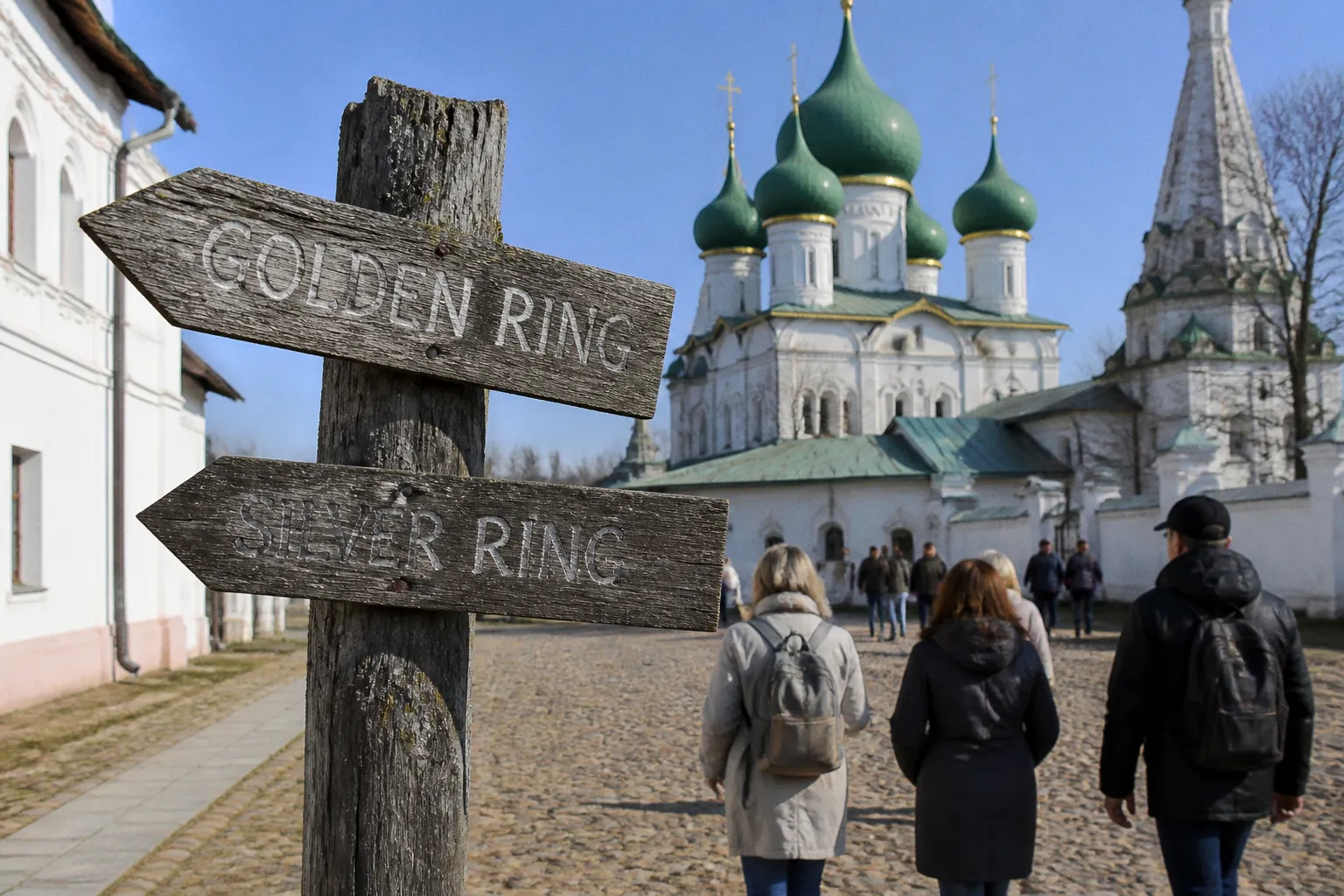
The 700-Kilometer Misunderstanding
They are two entirely different circuits, anchored to two different gateway cities, separated by hundreds of kilometers of Russian motorway and the kind of transit fatigue that quietly reshapes an itinerary before the sightseeing has even begun. One loops northeast of Moscow through a 700-kilometer circuit of medieval Orthodox towns. The other fans out across the Northwest from St. Petersburg, tracing Hanseatic trade routes and ancient fortress walls. Choosing between them is not a matter of preference — it is a matter of where your plane lands.
Compare car rental deals in United Kingdom
See available offersPartner link — DiscoverCars comparisonWe have watched travelers arrive in Moscow expecting to "do both rings" in a single week, only to discover that the logistics do not cooperate. The Silver Ring is not a satellite of the Golden Ring; it is a separate cultural geography, with its own historical DNA, its own architectural vocabulary, and its own rhythms. Think of them less as siblings and more as cousins who share a surname but live in different centuries.
Origins: A 1967 Essay and a 2012 Regional Initiative
The Golden Ring is younger than most travelers assume. The name was coined in 1967 by Soviet journalist Yuri Bychkov, who wrote a series of essays for the newspaper Sovetskaya Kultura after a road trip through the medieval towns northeast of Moscow. It was a literary act as much as a logistical one — Bychkov identified a constellation of towns that had long existed on maps but never as a unified route. The brand stuck, and the Soviet tourism apparatus built infrastructure around it.
For decades, the official list contained eight cities: Sergiyev Posad, Pereslavl-Zalessky, Rostov Veliky, Yaroslavl, Kostroma, Ivanovo, Suzdal, and Vladimir. That changed in March 2018, when the Russian Ministry of Culture officially added Uglich as the ninth city, recognizing the town's kremlin and the Church of St. Dmitry on the Blood as integral to the route's heritage corridor.
The Silver Ring — more formally the "Silver Necklace of Russia" — arrived much later, in 2012, as a regional tourism initiative connecting 11 subjects across Northwestern Russia. Where the Golden Ring was a journalist's invention that became state-backed, the Silver Necklace was designed from the outset as a regional cooperation project. It is less a fixed loop and more an umbrella brand, a flexible network of historic cities that share a Northern Russian identity. That difference in structure matters when you plan: the Golden Ring has a canonical 700-kilometer circuit; the Silver Ring is a menu of routes you assemble based on time and interest.
The Golden Ring is a 1967 essay that became a highway. The Silver Ring is a 2012 regional agreement that became a network — choose the one that matches how you actually want to move.
The Nine Cities: Orthodox Heartland Northeast of Moscow
If you are designing a Golden Ring itinerary, you are designing a study in medieval Russian Orthodox architecture. The route's spine is a roughly 700-kilometer loop northeast of Moscow, and its gravitational centers are three UNESCO World Heritage Sites: the White Monuments of Vladimir and Suzdal (inscribed in 1992), the Trinity Lavra of St. Sergius in Sergiyev Posad (inscribed in 1993), and the Historic Centre of the City of Yaroslavl.
Three UNESCO anchors in a single circuit is exceptional density, and it tells you what the Golden Ring is actually for: it is a heritage pilgrimage. Sergiyev Posad, the route's first stop and close enough to Moscow for a single-day excursion, houses the Trinity Lavra — the spiritual heart of Russian Orthodoxy and a working monastery where you will see pilgrims and seminary students moving through the same courtyards as tourists. Vladimir, the ancient capital of northeastern Rus, offers the Cathedral of St. Demetrius and the Golden Gate, both built in the white limestone that defines the region's architectural identity. Suzdal, perhaps the most photographed town on the route, is an open-air museum of wooden houses and onion-domed churches, preserved in a way that feels almost theatrical.
Yaroslavl, the largest city on the circuit, stretches along the Volga and rewards a full day of walking. Rostov Veliky — literally "Rostov the Great" — sits on Lake Nero and offers a kremlin that is more atmospheric than fortified. Kostroma, on the Volga's left bank, connects the route to the northern river trade. Pereslavl-Zalessky, founded in 1152, holds one of Russia's oldest surviving churches. Ivanovo, the only city on the list without a medieval kremlin, represents the Soviet textile industry and is often skipped by heritage-focused travelers. Uglich, the 2018 addition, anchors the Volga stretch with its kremlin and the blood-red church marking the death of Tsarevich Dmitry.
| City | Approximate distance from Moscow | Key heritage draw |
|---|---|---|
| Sergiyev Posad | ~70 km northeast | Trinity Lavra (UNESCO 1993) |
| Pereslavl-Zalessky | ~140 km | Pleshcheevo Lake, 12th-century origins |
| Rostov Veliky | ~200 km | Rostov Kremlin, Lake Nero |
| Yaroslavl | ~250 km | Historic Centre (UNESCO), Volga embankment |
| Kostroma | ~330 km | Ipatiev Monastery, Volga crossing |
| Ivanovo | ~300 km | Soviet constructivist architecture |
| Suzdal | ~220 km (via Vladimir) | Open-air museum, wooden architecture |
| Vladimir | ~200 km | White Monuments (UNESCO 1992), Golden Gate |
| Uglich | ~260 km north | Uglich Kremlin, Church of St. Dmitry on the Blood |
In practical terms, a full circuit of nine cities requires at least five to seven days on the ground, and that is without side trips to smaller villages like Palekh or Kalyazin. Most guided tours compress the route into four or five days, which means watching the country blur past the windows rather than absorbing it — pacing matters more than checklist coverage.
The Silver Necklace: Hanseatic Forests and Northern Fortresses
The Silver Ring operates on a different logic entirely. Where the Golden Ring is a closed loop defined by a single journalist's vision, the Silver Necklace is an open network of 11 regions across Northwestern Russia, and the destinations within it were significant long before anyone put them on a tourist map. This is the geography of Novgorod's veche assemblies, of Pskov's merchant fortresses, of Vyborg's Swedish castle — places that shaped medieval Russian and Northern European trade before Moscow was a capital of consequence.
Veliky Novgorod is the anchor. Its kremlin, often called the Novgorod Detinets, dates to the 9th century, and the St. Sophia Cathedral within it is among the oldest stone churches in Russia, built between 1045 and 1050. The city's role as a Hanseatic trade hub left a legacy of birch-bark documents, merchant stones, and a particular civic self-confidence that you can still feel in the way Novgorod presents itself — as a republic that predated Muscovite centralization by several centuries. From Novgorod, the route extends in several directions: south to Staraya Russa, the spa town where Dostoevsky spent his summers; west toward Pskov and the Pskov Krom, the old kremlin perched on the confluence of the Velikaya and Pskova rivers; and northwest to Izborsk, where the ancient fortress has watched the Estonian border since the 14th century.
Vyborg is the outlier — Russia's only medieval European castle, built by the Swedes in 1293 and changing hands multiple times before its incorporation into the USSR. Its cobbled streets and Nordic architecture make it feel like a different country, which is precisely why it matters as a counterpoint to the Orthodox white-stone cities of the Golden Ring.
The Golden Ring teaches you to read onion domes. The Silver Ring teaches you to read fortress walls — and the difference between them is the difference between Moscow's Russia and St. Petersburg's Russia.
Here is the practical reality: the Silver Ring is harder to tour as a single circuit. The distances between major destinations are larger, the public transit options thinner, and the regional infrastructure more variable than along the Golden Ring corridor. Most travelers experience it as a series of day trips or overnight excursions from St. Petersburg, rather than as a continuous road trip. That is not a flaw — it is a different design problem, and it rewards a different kind of planning.
Architectural Contrast: White Stone Churches and Northern Defensive Walls
The visual vocabulary of the two rings is distinct enough that you can recognize which one you are on within minutes of stepping out of a vehicle. The Golden Ring is defined by white limestone — the so-called "white stone" architecture of Vladimir-Suzdal, with its carved relief panels, blind arcades, and single-domed cathedrals built between the 12th and 15th centuries. The color is literal: the stone is pale, almost luminous in the low northern sun, and it gives the cathedral complexes of Vladimir, Suzdal, and Bogolyubovo a visual unity that survives across centuries.
The Silver Ring architecture is darker, heavier, more defensive. Pskov's churches are built from local limestone that weathers to a grey-brown, and their forms are compact, with low drums and tented roofs that reflect the region's independent ecclesiastical tradition. The fortresses — Novgorod's Detinets, Pskov's Krom, Izborsk's stone walls — are designed to withstand sieges, and their scale is industrial by medieval Russian standards. Vyborg's castle is European Gothic, with a square keep and defensive towers that have no visual relationship to anything else in Russia.
This contrast is not incidental. It reflects two different historical trajectories: the Golden Ring towns were part of the Vladimir-Suzdal principality and later Muscovite consolidation, while the Silver Ring cities were nodes in the Hanseatic League and the Novgorod Republic — independent, mercantile, and oriented toward the Baltic. Walking through Yaroslavl feels like walking through the consolidation of Russian Orthodoxy. Walking through Novgorod feels like walking through the moment before that consolidation.
Logistical Realities: Moscow Versus St. Petersburg as Your Gateway
The choice between the two rings is, in the end, a choice between gateway cities. If you are flying into Moscow, the Golden Ring is the natural extension. Sergiyev Posad is close enough for a single-day excursion, and the full circuit unfolds outward from the capital in concentric arcs. Most escorted tours base themselves in Moscow and run the route as a multi-day coach journey, returning to the capital each evening or moving overnight between cities.
If you are flying into St. Petersburg, the Silver Ring is the logical counterpart. Novgorod is roughly 200 kilometers south and accessible by direct train or guided excursion. Pskov is farther — about 300 kilometers — and usually requires an overnight. Vyborg, on the Finnish border, is closer to St. Petersburg than to any Silver Ring counterpart, and many visitors combine it with a day trip along the Baltic coast.
Here is the catch that catches even experienced travelers: the two rings do not connect easily. There is no continuous overland route that links them, and the Moscow–St. Petersburg high-speed rail (the Sapsan) takes roughly four hours one way. If you try to do both in a single trip, you will spend a full day in transit and arrive at your second ring too tired to absorb it. We generally advise travelers to commit to one ring per visit, or to spend at least ten days treating both as separate destinations with a full rest day between them.
| Factor | Golden Ring | Silver Ring |
|---|---|---|
| Gateway city | Moscow | St. Petersburg |
| Canonical route | Fixed 700 km loop | Flexible network of 11 regions |
| Number of principal stops | 9 official cities | Variable (commonly 5–7) |
| UNESCO sites on route | 3 | 1 (Novgorod's cathedral is national-level heritage) |
| Best for | Orthodox heritage, kremlins, medieval art | Hanseatic history, fortress architecture, lake landscapes |
| Transit ease | Dense, well-served by coach | Sparser, often requires guided transfers |
| Ideal trip length | 5–7 days | 4–6 days |
Seasonal Timing: When to Go
The Russian climate shapes both rings more than any guidebook admits. The Golden Ring's white-stone architecture photographs beautifully in winter under snow — the low grey sky and the pale limestone create a muted, almost monochromatic palette that suits the medieval subject matter. But winter temperatures in Suzdal and Vladimir regularly drop below minus 15°C, and daylight hours shrink to seven or eight. You will see the churches, but you will not linger in the courtyards.
Summer is the high season for both routes, and the obvious choice for first-time visitors. June through early September offers long daylight hours, warm temperatures in the 20–25°C range, and the best conditions for walking tours and boat excursions on the Volga. The trade-off is crowds: Yaroslavl's embankment in July can feel like a Moscow side street, and hotel availability in Suzdal books out weeks in advance.
Late September and early October are our preferred window for the Silver Ring specifically. The lake landscapes around Valdai and the forests between Novgorod and Pskov turn gold and amber, the summer crowds thin, and the light takes on the low, raking quality that makes fortress photography exceptional. Temperatures are cooler but manageable, usually 8–15°C, and the risk of early snow is low before mid-October.
For the Golden Ring, the shoulder seasons of May and late September offer the best balance: mild weather, fewer tour buses, and the churches still operating on their full schedule. The week around Russian Orthodox Easter can be atmospheric but logistically complicated — many sites adjust their hours, and the Trinity Lavra in Sergiyev Posad draws enormous crowds of pilgrims that overwhelm the visitor flow. Plan around it unless liturgical observance is your primary reason for traveling.