Security Risks for Cross-Border Rail Travel Near the Polish-Ukrainian Frontier
A Russian drone hit a passenger train two kilometers from the Polish border on September 14, forcing immediate reassessment of western Ukraine transit corridors.
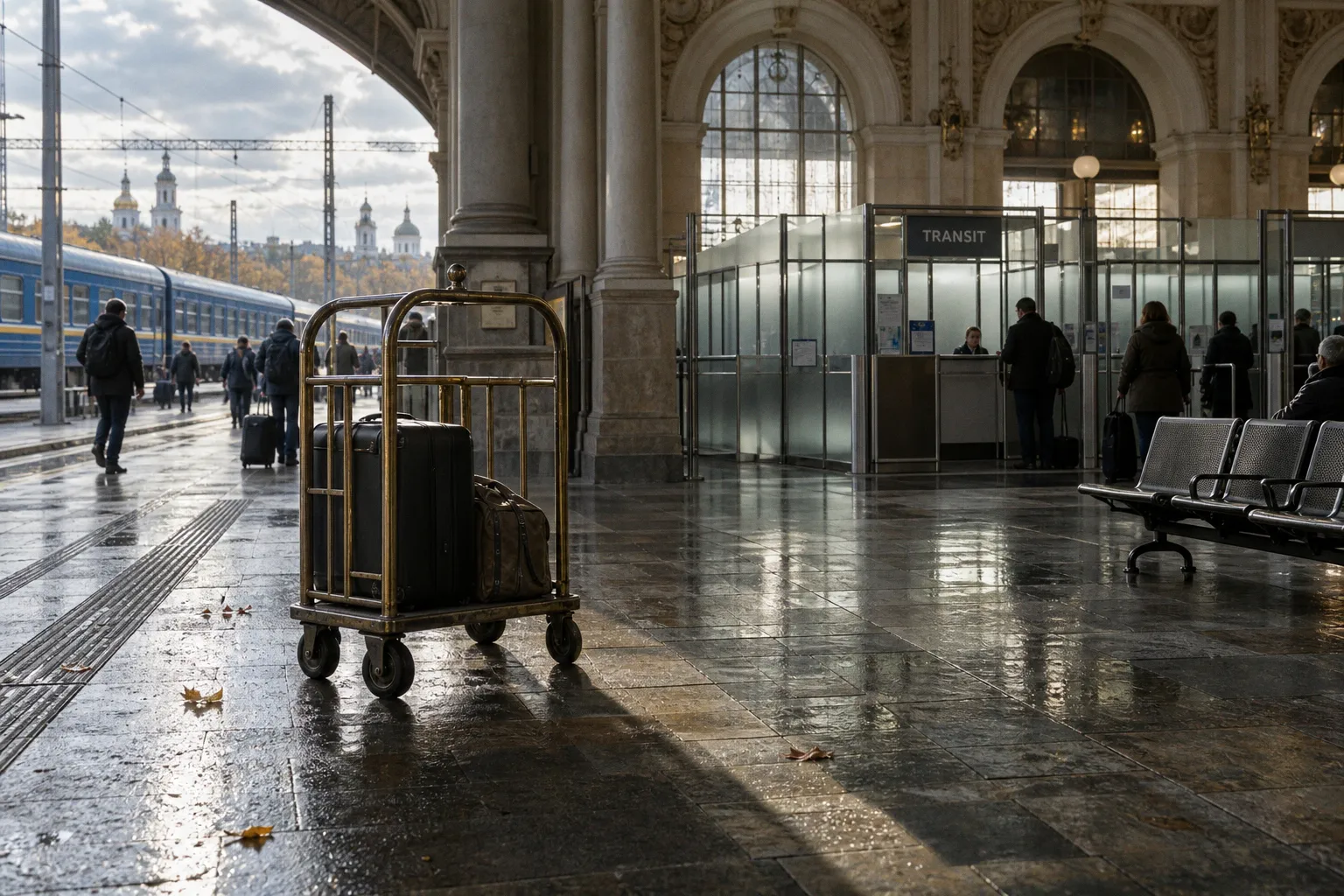
Ukrainian rail operator Ukrzaliznytsia and Poland's PKP Intercity both confirmed the strike at Yahodyn railway station in the Volyn region. The incident places a NATO-adjacent civilian rail line directly inside an active conflict zone — a status with immediate implications for travelers connecting through European hubs en route to Russia.
Incident Parameters
- Location: Yahodyn railway station, Volyn region, western Ukraine; approximately 2 km from the border crossing.
- Train manifest: 206 passengers, no Polish citizens among them, bound for Warsaw.
- Damage: Locomotive struck; Ukrzaliznytsia described it as "deliberately burned," with a nearby gas station also damaged.
- Casualties: None. The monitoring team issued advance warning to the train crew; the train was evacuated before the drone reached it.
- Adjacent hit: A truck was struck less than 1 km from the Dorohusk–Yahodyn crossing; border operations were briefly suspended.
Ukrzaliznytsia stated that a separate diplomatic train carrying former UK Prime Minister Boris Johnson, former Swedish Prime Minister Carl Bildt, former CIA Director David Petraeus, and security advisers from several EU member states had departed the station minutes before the strike. Johnson posted on social media that he did not know what "warped logic drove Putin to blow up a stationary Ukrainian locomotive on the Polish border this morning." Bildt confirmed on X that the train hit "wasn't our train, but the one just minutes after us."
Border and Political Status
Poland's Prime Minister Donald Tusk chaired an emergency meeting the same day and stated Poland "cannot rule out that this escalation will also affect our territory," adding that "the coming weeks and months will be a period of very intensive actions on the Russian side." Foreign Minister Radosław Sikorski characterized the broader pattern of Russian attacks near NATO as an "escalation" and called for doubled support for Ukraine. Following the attack, the Ukrainian and Polish foreign ministers jointly called for a full trade embargo and a new sanctions package on Russia.
Practical Implications for Russia-Bound Transit
Travelers routing through or near western Ukraine should apply the following operational adjustments:
- Volyn rail corridors: Treat all published timetables as advisory only. Build a minimum 24-hour buffer into any itinerary touching Yahodyn, Kovel, or Lviv.
- Poland–Belarus and Poland–Russia rail links: Active via Brest and Terespol. Expect extended customs processing; carry all documentation in printed form.
- Air transit: No Russian airspace restrictions changed by this incident. Verify status for Warsaw Chopin (WAW), Modlin (WMI), and Vilnius (VNO) given the escalation flagged by Polish authorities.
- Document posture: Digital-only visa support, hotel confirmations, and return tickets are increasingly rejected at secondary inspection. Carry paper backups.
What to Monitor
1. Polish border service bulletins on Dorohusk–Yahodyn operational status.
2. Russian Ministry of Foreign Affairs travel advisories for reciprocal measures.
3. EU sanctions updates following the joint Polish-Ukrainian embargo call.
4. NOTAMs for WAW, WMI, and VNO through the remainder of September.
Backup Protocol
If your itinerary depends on overland transit through western Ukraine, default to air routing via Istanbul (IST) or Minsk (MSQ). Rail remains a viable but high-variance option. Maintain a minimum 48-hour contingency window at any crossing bordering Ukraine.